Jupiter 12 / Best Production year?

myequation

Member
Local time
12:03 PM
Joined
Dec 2, 2008
Messages
48
I'm considering purchasing a Jupiter 12 in Kiev Mount.
With most Kiev products the early models means better quality.
But what about the j12s?

While reading another review I found that models from the 80s are better than 50s? Better contrast and flare control.

Is this true?

Actually while we are on the topic I would like to hear about any Russian lens and quality issues through the decades.
 
Last edited:
remember that these are old lenses, and they've had a long history. the stuff that's happened to each individual lens, is going to be more important in determining its current quality than its production year was.

for what it's worth my '71 J12 in the contax mount does a good job
 
remember that these are old lenses, and they've had a long history. the stuff that's happened to each individual lens, is going to be more important in determining its current quality than its production year was.

for what it's worth my '71 J12 in the contax mount does a good job

This is true, I guess I should have mentioned that I always CLA my own lenses. So little things can be fixed. What I cant fix is poorly cemented or polished optics
 
Best bet is to buy one that was already used by someone else, so they took the risk.

Hey, look at that: I have one in Contax mount for sale that works just fine. Now there's a coincidence. 🙂
 
As a rule of thumb, '55 through '65 can be considered the "golden age" of the Soviet camera industry. Having said that, it mostly comes down to the sample you get. An 80's lens will have more modern coatings than one from the fifties, so that could account for the review you saw. I would recommend buying one from somebody on the forum, or from fedka.com if you have concerns.
 
I have two Contax-mount J-12: One from 1961 (rear elements have a metal sleeve over them) and a black one from 1988, made like the other J-12, with naked rear elements.
Both are well made and work properly. The later one seems to show more contrast and gives a more neutral colour rendering. The blue coated glasses from the 1950s and early 1960s tend to add a bit of yellow in colour photos. Not much to be concerned about.
 
I have one in LTM mount that was made in 1990. Works fine, but as ZorkiKat said I've noticed higher contrast. I used to have older, silver one in Contax mount some years ago and it was also great lens though suffering from flares. I guess they were improving coatings during production period.
 
I found this from a russain site, translation is rough.
So you understand whats below.
KMZ made j12 until 1960ish
LZOS made them from 1960ish til end of production.


"
Additionally I encountered with flare in the center of a negative if the light source was in radius of half a frame diagonal from the center (for example sunset or sunrise scenes with the Sun within the frame borders). This flare copy the form of five-bladed diaphragm. So, generally speaking, the lens has tendency to "catch flares" in the back or side-back light. And also in scenes like snowy landscape (even on cloudy day) or a placid lake in the foggy morning when the sun did not rise from the forest. These flares have mean blue shade and place near the center of the negative.
As practice shows, lenses made by LZOS (Lytkarino plant for the optical glass) more then others incline to this kind of sabotage. If you have such ability, it is better to find KMZ (Krasnogorsk mechanical plant) specimens of the lenses. In the Internet you can find the useful qualifier of USSR optical plants (in Russian) by their logos."
 
I found that there is no true and tried method on guessing if a particular FSU is good and fault free or not.
only by using it and running it thru its paces.
most Kiev mount lenses are a bit less troublesome than their LTM version, but only trying them out is the clincher.
the J-3 and J-9 lenses are the most problematic in FSU land.
 
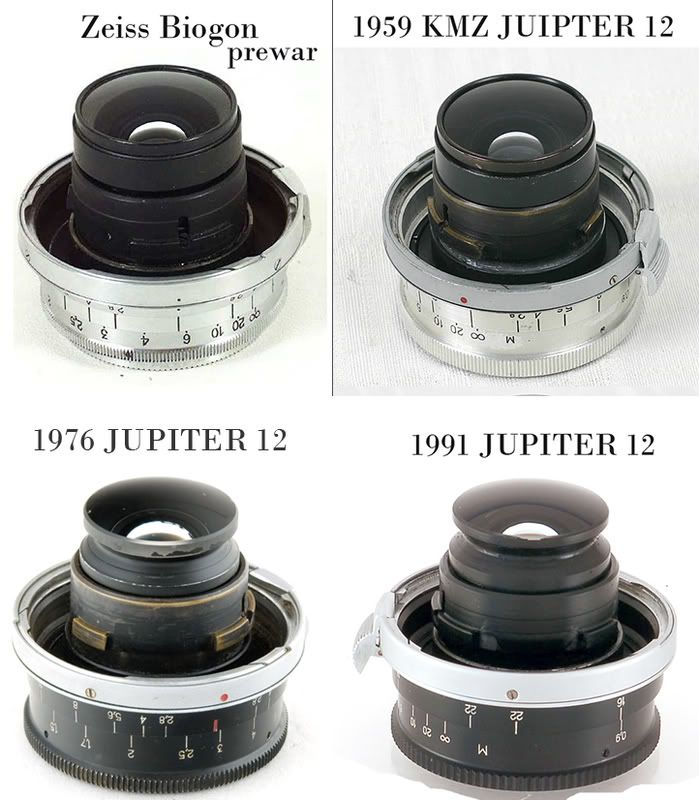
I posted this in another J12 Thread but it should go here too.
Notice how the rear optics are unprotected in the later models. Some say this is the reason for high flare
Untitled-1-3.jpg


I found this from a russain site, translation is rough.
So you understand whats below.
KMZ made j12 until 1960ish
LZOS made them from 1960ish til end of production.


"
Additionally I encountered with flare in the center of a negative if the light source was in radius of half a frame diagonal from the center (for example sunset or sunrise scenes with the Sun within the frame borders). This flare copy the form of five-bladed diaphragm. So, generally speaking, the lens has tendency to "catch flares" in the back or side-back light. And also in scenes like snowy landscape (even on cloudy day) or a placid lake in the foggy morning when the sun did not rise from the forest. These flares have mean blue shade and place near the center of the negative.
As practice shows, lenses made by LZOS (Lytkarino plant for the optical glass) more then others incline to this kind of sabotage. If you have such ability, it is better to find KMZ (Krasnogorsk mechanical plant) specimens of the lenses. In the Internet you can find the useful qualifier of USSR optical plants (in Russian) by their logos."
 
Last edited:
J12 Best production year?...mmm, I'd love to know!, I've had a couple-with ten years age difference, and both pretty crap! ( no, they did'nt need cleaning, shimming, a CLA, or anything else! ) I could have been unlucky!.....or just....'one man's meat...............' 🙂 fortunately they were dirt cheap!
Dave.
 
Back
Top Bottom