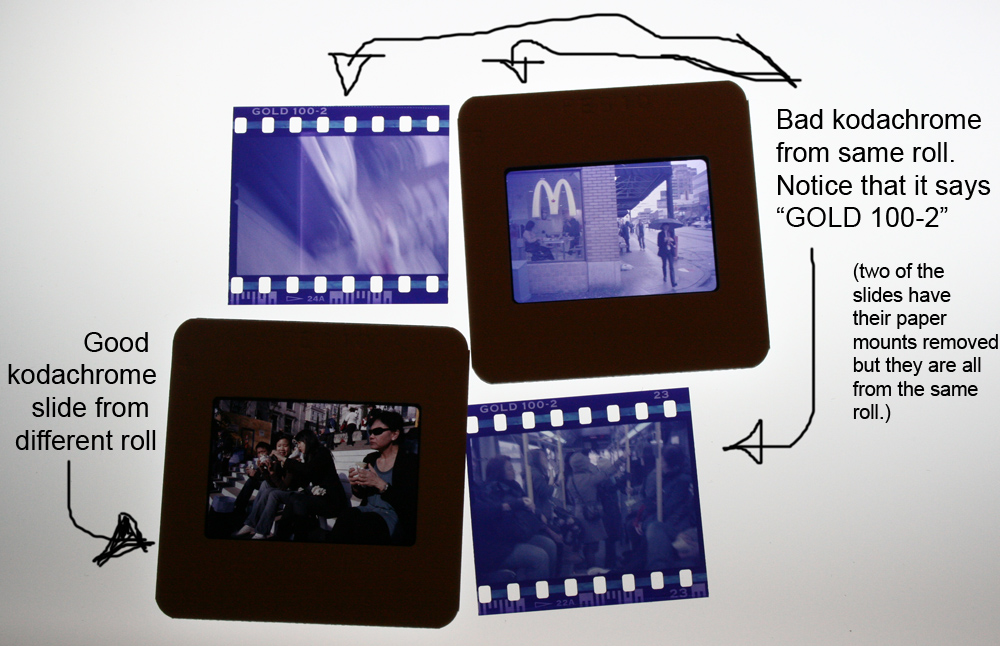
Kodachrome Came Back as "Gold 100"

disasterLabeledsm.jpg
 
It's my understanding that, with the Kodachrome process, the
color dyes are not in the film emulsion but rather in the processing
chemistry.

If that's true then Kodachrome couldn't be processed via C-41.

As Gabriel said, you can also develop c-41 film (not just bw but also color) in traditional bw chemistry. Remember, one thing all films have in common is that they contain silver. This will react one way or another with the chemistry.
 
But how could it come out as a positive? That's impossible, right? I mean, you can't take standard C-41 and process as chromes and expect it to come out as a positive image; that's just standard cross-processing, you still end up with a negative, don't you?
 
Well, you can get positive images by processing C41 images in E-6 Chemistry. In fact, they come out kind of blue and low contrast like these. But the Kodachrome process is different, so it surprises me that it works. I guess all that is really needed that's different in the slide developing process is the beach/fix to get the positive image. Interesting.
 
But how could it come out as a positive? That's impossible, right? I mean, you can't take standard C-41 and process as chromes and expect it to come out as a positive image; that's just standard cross-processing, you still end up with a negative, don't you?

No, it's not impossible at all. It's the developer that determines whether you get a positive or negative, not the emulsion (otherwise we could have C-41 slide film). You can take any chromogenic bw neg film and process it as positive (which is basically what Kodachrome is).
 
Well, IMHO, what you get when you do it, xwhatsit, isn't worth the extra cost or trouble, but it can be done. The result is more a blue tinted B&W positive that is flat and grainy.
 
If you cross proces slide film to C41, most often the base isnt clear. The color of the base changes from basic brown-yellow to purple or cyan or whatever, depending on the film (and maybe the state of the chemicals used). Some films are close to clear, most are not.

You can process any still film with B&W chemicals, because they all use silver-stuff as light-sensitive layer.

C41 dev. will develop a B&W neg and a color neg under this. Bleach+fix will remove all the silver from the film, because bleach will return all the silver to its original state (that it is in before exposure), so fix will remove all of it.

E6 instead, will first develop just a B&W neg on the film. This will kind of "block" these silver grains from getting developed in the next step, which is colour developer. This developer will also chemically expose rest of the halides or grains, so that you will get a positive colour image. All of the silver is exposed, so without bleach your image will be completely black. Bleach and fix will again remove all of the silver, and you are left with a color positive, as there is no color negative under the BW-developed grains.

Just like you can cross process any E6 and C41 color film, you can also develop B&W positives from regular BW films. You dont need Agfa Scala or such, but you do need some special chemicals. This process is explained for example on the Ilford website

(however, the amount of the "fixer" added to the developer seems too big there - at least according to my friends experience. So if you are going to try it, begin with much less or none at all. More info from the PDF on Ilford website and of course, other places in the internet)

Still I am wondering, how Kodachromes can be cross-processed as it really is a completely different process. You can develop BW negs from them but cross-processing them in another process, I dont know what will you get really.
 
The basic process of obtaining a positive image:

Develop the exposed silver halide.

Bleach the developed silver (but not the unexposed silver halide).

Reexpose the film either with light or chemically

Develop the exposed silver to obtain a positive image.
 
I was mistaken. After a bit of research I determined that the roll in question was a KR64P (professional) that came in red processing paid canister and was given to me by a friend who has kept it in his freezer for the past 25 years.

(The batch of 6-7 rolls he gave me has so far been my only kodachrome that never came from ebay.)
 
I was mistaken. After a bit of research I determined that the roll in question was a KR64P (professional) that came in red processing paid canister and was given to me by a friend who has kept it in his freezer for the past 25 years.

Sounds like your friend is a practical joker...
 
I think I told the story of some B&W 8mm movie film, years ago, which got accidentally sent in to Kodak and was processed as Kodachrome.

It looked almost normal except it was a very eerie green and white, instead of black and white.
 
Back
Top Bottom