artphotodude
Adam V. Albrec
I'm coming to you from a background in Medium Format (Minolta Autocord, Hasselblad, Pentax 67, Holga) and Large Format (Graflex Graphic View, 8-Banners Pinhole) and most recently digital (Canon and Nikon).
Now am putting all of that behind me to embrace Fuji's world class XPro digital series. BUT, there are still times that 'the film is the thing', more to the point, a classic lens can see things better than modern computerized perfection. Of all the lenses I used over the years, two groups leap to the forground as top performers. Zeiss (specifically the Planar), and Kodak Ektars.
Well, quite by accident, recently stumbled across a gorgeous little American-made rangefinder at an antique store for a mere $20. I've read that the Ektars in them have a very good reputation and the cameras themselves are considered real finds. The viewfinder was pretty dark and gummed-up, but because of the robustness of the parts (despite the small size), it turned out to be easy to disassemble and clean/adjust (thanks to a walkthrough on iFixit), and I just got my first rolel of test shots back (just ordinary 200 speed Fuji print film). PLEASED doesn't quite do it. This little thing is amazing! Almost no parallax despite focusing down to 2 Ft., and gorgeous performance across the entire aperture range.
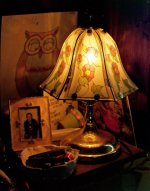
Truly-shocked by the wide-open performance. Silky-smooth bokeh and tack sharp at the point of focus (see the lamp pic below). Honestly, only the Blad with a Planar ever did that for me before. Also, while there seems to be a very slight fringing on highlights of out of focus areas, it is once again comparable to Gaussian lenses costing dozens of times more and even at its size, it has a 6-blade aperture, so no obnoxious pentagons throughout the image.
Have always liked Tessar formula lenses because of their flare-resistance (I shoot into light sources a lot), but generally, they are just too soft wide open to be useful, but this little guy really shows what American optical could do back in the day. Can't wait to take this on a real project with some Provia 100F, Illford Delta and Kodak Portra 160! 😀
BTW - a lot of these appear on eBay to come with a Series-V holder and the perk of this is that it is just about perfect as a lens-shade too.
A couple of outside links to check out for those interested in these,
Great shot from Japan showing some GORGEOUS Bokeh!!!!
https://pbs.twimg.com/media/Cqyid2fUsAEMm3Q.jpg
Also, another Site from Japan showing one of these lenses mounted on a Sony Alpha at 6000x4000. Ridiculous detail across all but the very corners (the fact that this old lens is being compared beside a Biogon and Summicron, should tell you something!).
http://dc.watch.impress.co.jp/img/dcw/docs/629/561/070.jpg
http://dc.watch.impress.co.jp/img/dcw/docs/629/561/069.jpg
Now am putting all of that behind me to embrace Fuji's world class XPro digital series. BUT, there are still times that 'the film is the thing', more to the point, a classic lens can see things better than modern computerized perfection. Of all the lenses I used over the years, two groups leap to the forground as top performers. Zeiss (specifically the Planar), and Kodak Ektars.
Well, quite by accident, recently stumbled across a gorgeous little American-made rangefinder at an antique store for a mere $20. I've read that the Ektars in them have a very good reputation and the cameras themselves are considered real finds. The viewfinder was pretty dark and gummed-up, but because of the robustness of the parts (despite the small size), it turned out to be easy to disassemble and clean/adjust (thanks to a walkthrough on iFixit), and I just got my first rolel of test shots back (just ordinary 200 speed Fuji print film). PLEASED doesn't quite do it. This little thing is amazing! Almost no parallax despite focusing down to 2 Ft., and gorgeous performance across the entire aperture range.
Truly-shocked by the wide-open performance. Silky-smooth bokeh and tack sharp at the point of focus (see the lamp pic below). Honestly, only the Blad with a Planar ever did that for me before. Also, while there seems to be a very slight fringing on highlights of out of focus areas, it is once again comparable to Gaussian lenses costing dozens of times more and even at its size, it has a 6-blade aperture, so no obnoxious pentagons throughout the image.
Have always liked Tessar formula lenses because of their flare-resistance (I shoot into light sources a lot), but generally, they are just too soft wide open to be useful, but this little guy really shows what American optical could do back in the day. Can't wait to take this on a real project with some Provia 100F, Illford Delta and Kodak Portra 160! 😀
BTW - a lot of these appear on eBay to come with a Series-V holder and the perk of this is that it is just about perfect as a lens-shade too.
A couple of outside links to check out for those interested in these,
Great shot from Japan showing some GORGEOUS Bokeh!!!!
https://pbs.twimg.com/media/Cqyid2fUsAEMm3Q.jpg
Also, another Site from Japan showing one of these lenses mounted on a Sony Alpha at 6000x4000. Ridiculous detail across all but the very corners (the fact that this old lens is being compared beside a Biogon and Summicron, should tell you something!).
http://dc.watch.impress.co.jp/img/dcw/docs/629/561/070.jpg
http://dc.watch.impress.co.jp/img/dcw/docs/629/561/069.jpg