Lighting food

Stephanie Brim

Mental Experimental.
Local time
12:02 AM
Joined
Apr 12, 2005
Messages
2,859
Location
Iowa
I'm trying to figure out how to take the best photos of my food for showing on my website. I'm not quite sure how to light them. I pretty much have to use the bright kitchen lights and I'm actually pondering shooting in black and white to avoid problems, but part of my food is the color and presentation. Does anyone have any advice for this?
 
Hm, thats not too different from the shoes and jewlery my father shot for a german mailorder company.
He used different types of lights, never flash, and reflectors and umbrellas in various colours. Usualy he set up the objects on a table with some cloth as background and arranged four tripods with double lights. He used four quartz and four xenon bulbs with different temperature for large format B/W negatives and five neon lights with two bulbs each for slides. He mixed daylight and white balanced neonlights and used filters to get the colours he wanted.
 
I have done a lot of food photography and what I highly suggest is that you diffuse all of your lights or else you will come up with a lot of overexposed areas where you have oils or anything like that. Also it helps to have a circular polarizer to compesate for unwanted reflections and give your food more punch. And as always, expose to the right!

ps. I used flashes (bounced and diffused) Wish there was something better for the bottom of those plates though, it helps to have something thats very dark (black shirt) to set your food on, makes it stand out more.
 

Attachments

  • IMG_9991.jpg
    IMG_9991.jpg
    149 KB · Views: 0
  • IMG_10043.jpg
    IMG_10043.jpg
    211.3 KB · Views: 0
  • IMG_10073.jpg
    IMG_10073.jpg
    123.6 KB · Views: 0
Last edited:
While not the way you'll be able to light the food; I did talk to a guy who works in for a studio the other night who has done/set up/seen a lot of food shots.

The studio does the food shots for product labelling.

Man.. after hearing the stories from him I would never want to shoot food photography in a studio set up. Cameras are 4x5's with Phase backs. It's not uncommon to shoot at, get this, f90 with strobes. Apparently when the strobes go off; the sound is akin to a small explosion - it's that loud.

Then of course there's the tedium of the "food prep/set up" folks. When they shoot "soup"..the company that they would be shooting for; say it's Campbell's, would send over a couple cases of the soup. The prep folks go through EACH CAN and get the "best" looking pieces of veggies/meat. The best ones make it into the "shoot bowl". The bowl is never filled with soup but instead layered with "plastic ice cubes" at the bottom and the soup poured into it.... it's never photographed hot; always cold soup.

There was a lot more I learned just by chatting with the guy but man does it ever sound tedious 🙂

I hope Steph's shots aren't as painful to set up 🙂

Good luck!
Dave
 
Steph's application is simply to have shots for self-promotion, so I think "simpler is better" is the mantra ... no howitzer/ozone strobe action! 😀

I agree, diffuse light; not only is it the default style right now, but as suggested it makes contrast and reflection control easier. Working with photofloods or other steady state lamps is a pain due to heat and bulk. Daylight is inconsistent and unpredictable, but when combined with simple reflectors is cheap. That's the route I would go until I got some experience under my belt. When I was doing product photography I eventually went to a two or three strobe setup; I built a light table myself and used coloured poster board underneath/behind the acrylic sweep to provide colour. But I didn't do any food shots; that would have required a different setup.

Earl

Edit: f90 with 4x5? With view camera movements I can't imagine needing f90 unless you're shooting a pretty large table spread. Most view lenses would have a sweet spot at somewhat wider than f90, no?
 
The most beautiful food shots, are that of food that's not edible. Eg, the turkey you see in food ads is _raw_, the browning of the skin is done by a blow-torch, the mash potatoes is Crisco, the steam from the coffee is dry-ice.

I saw an article about the top food photographers, and it's as Dave says, 4x5 + digital backs - keep in mind you often see pictures of food blown up _really_ big such as on the side of trucks. A plate/dish of food closeup, would require stopping down pretty heavily since you really cannot use movements too much - the OOF areas would look wierd on a food ad. The reason for a 4x5 is just for the pixel count.

The article talked about the photographer, the art director, the food artist and/or director. So literally 4 or 5 people just to shoot food.

So for Stephanie, try to get a nice table setting with lots of window light, but not direct sunlight. Use an SLR, tripod, remote release. For a website, even a 2 or 3mp digicam might do, since the extra DOF is now a benefit. BTW, you'll probably want to do it with the food _cold_.

 
I worked for two years with a commercial photographer who was well known for his food shots. He had a full kitchen at the back end of the studio just for food prep. For any other studio product shot we used quartz lamps. Big ones with diffusers and lots of them. But the heat from the quartz lamps is too much for food. For food we used multiple mono strobes with diffusers to keep the heat down. Oddly enough the 1st and the last jobs I did with Don were food shots. The first was of a lobster that needed to look "cooked". It was raw and I used a red marking pin to color the entire lobster to give it a hot freshly cooked look. The last was for a company called "Egee's" They make submarine sandwiches. They brought about ten times the amount of meats and cheeses needed to make 1 sandwich and they flew in a "food prep specialist" from LA. at $800.00 a day to make the sandwich we would shoot. She also had the McDonalds account I was told. She made a great looking sandwich and we shot it and the final Billboard shot stayed up for a couple of years around town.

Because of the care and money spent on high end food shots for magazines and billboards ect. the public has become much more sophisticated when viewing such items. If your shots fall short of this standard it is likely that the food will be supposed to be of a lesser standard as well.

You will either have to get lucky (very lucky) with available light that you can manipulate or you will need at least three adjustable strobes with stands and diffusers, a flash meter and a willingness to shoot and record the process until you get the desired lighting and results. We used a polaroid back for the view camera to check exposure and lighting.

As an aside, I've noticed for years that on locally produced resturaunt tv ads often show still shots of examples of the fare. Without fail there is a greenish tinge to the food when rendered onto the tv medium. It does not look very appealing to me and has a bush league kind of feel. The national ads don't have this problem.
 
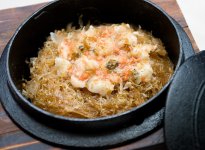
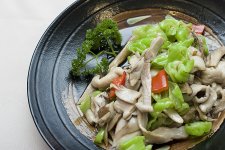
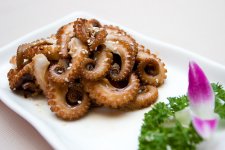
Day light works great.. here are some shots of food that was layed out on our dinner table. No diffusion of any sorts were done... just the light from the window..

39469032.jpg


39469031.jpg


39469033.jpg
 
Last edited:
ywenz said:
Day light works great.. here are some shots of food that was layed out on our dinner table. No diffusion of any sorts were done... just the light from the window..


While I will energetically agree with you about the superbly brilliant color and overall lighting of the shots only the third in my opinion works as an appealing display of the food. The very narrow dof does not work well with food. In the 1st shot the dof comes down on the subject like a wall. Did you use a close up lens? I've never had a lens with such narrow dof even at full aperture. On a tripod the same beautiful light could be had with better definition of the whole subject. The second shot is to my eye unappealing for the same reason. In the third shot you have the subject in a line that keeps most of it in focus which is a better display of the food and looks inviting.
 
1 Use a reflector. Any large piece of card will do fine: packaging from the back door of the appliance store is what you need to find. If the natural light comes from the right the reflector goes on the left...

2 Look at a typical plate through the viewfinder at 70cm or so. Think about using another sort of camera which will focus closer so you don't get the one small plate syndrome. Of course, if you're roasting an ox the RF camera may be fine.

3 Enjoy.
 
Heh. The rangefinder will be used to get photos of everyone enjoying my food...the SLR will be used to get shots of the food itself. I'm attempting a bid on a Spotmatic with SMC Takumar 50/1.4 right now...should be a good enough lens for the work. May want to pick up a longer one in addition later on, but I'm really a 50 shooter.
 
My first try into food photography was last year, I think I overdid the surroundings, in trying to go for the Martha Stewart look. I used a combo of window light plus flash with a diffuser cover on it. These are dslr shots.

I present.. green salat 😀
18358504-M.jpg

18358502-M.jpg


It was a pain in the arse doing the setup.. took forever (well, about 45 minutes, including time trying to find all the pieces).
 
Back
Top Bottom