My new ZM kit is perfect... but...

Jamie,
Forget digital... at least till the day it could rival the tonality of B&W film..., take a look at this shot - Fomapan 200 in FX39 1+14:
2884139045_e460b0638c_b.jpg


I'd recommend you to save some money and get the luigi half case WITH GRIP for your Ikon - great protection and great handling of the verticals + more subdued shutter noise.
 
You guys are CRUEL!! First I have to sell all my equipment to get the ZM body and one (!!) lens, and now you expect me to sell anything else that's sitting around loose here so that I can buy that beautiful Luigi case & strap?? D**m! I'm afraid I'm going to have to pass, otherwise my wife is going to notice that the silver is missing. 🙂
 
I've heard here why Mr. K won't do it (but I don't believe it). But why not Zeiss or Nikon or Canon? All the technology exists. And Zeiss appears to think the ZM is a winner in a certain niche. So why not offer the same thing digitized???
Dear Jamie,

Why don't you believe it? Ask him; that's what he'll tell you. If he really WANTED to do it, he probably would; but as he doesn't really like digital much, he's understandably disinclined to take a punt the way he did on film RFs.

Zeiss would be working with Cosina to make it, and besides, from the impressions I've gained from talking to them, they don't think there's a big enough market.

Nikon? Make a Leica M-mount camera from scratch? (Nikon mount is pure fantasy, a niche of a niche of a niche with an absurdly over-complicated focusing mechanism and a hopelessly undersized lens throat. The only reason to make it is because they could, not because it would sell in significant numbers)

Canon? Again, why? Here on RFF it's easy to forget that RFs are a tiny market AND that a lot of RF users are committed to film, so the digital RF market is even tinier.

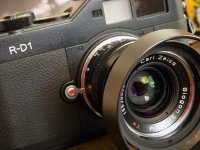
'All the technology exists'? Yes, but not in one place and not for full-frame. That's why Epson used a Voigtländer body. A beautiful job, but unless someone else wanted to come in with Voigtländer, Voigtländer doesn't have digital RF technology.

Finally, if the demand is that great, why did they stop making the Epson?

Cheers,

R.
 
Last edited:
Canon? Again, why? Here on RFF it's easy to forget that RFs are a tiny market AND that a lot of RF users are committed to film, so the digital RF market is even tinier.

Hi Roger,

that is a question I have for some time. Are people here really committed to film or are they using film because there is no economically viable rangefinder solution available to them? Digital SLRs really took off when they were substantially below £1000.

Ta
Joachim
 
Hi Roger,

that is a question I have for some time. Are people here really committed to film or are they using film because there is no economically viable rangefinder solution available to them? Digital SLRs really took off when they were substantially below £1000.

Ta
Joachim
Dear Joachim,

Quite a bit of both, I think -- but the likelihood of selling enough interchangeable-lens RF digital cameras to get the price under GBP 1000 strikes me (and Zeiss) as slender.

The mount would have to be M -- huge availability -- and the sensor problems for full-frame with such a flange/sensor register are notorious. Remember too that a digital camera demands much more precision from the rangefinder.

I'm not saying it can't or won't be done -- I've been wrong too many times before -- but if you begin by looking at the total number of RF cameras sold, versus SLRs, and assume that 50% of RF users would buy digital (as good an assumption as any), then the R+D costs would have to be amortized over a tiny market where Leica already has a very strong position.

The Voigtländer chassis is basically from a modestly-priced SLR, and cost relatively little to develop. The RD1 has a relatively small sensor; fitting in even a Leica-size sensor would be difficult, and besides, I assume that Leica has an exclusive deal with Kodak on the 18x27 sensor.

The ZI chassis was a much more expensive undertaking, and building a ZI digital for a decent-size sensor would involve a new chassis again.

Add to this the way that M8 prices will come down when the full-frame M9 comes out -- no-one knows when, including potential competitors -- and that Leica has undertaken to support the M8 for 20 years after introduction, and the competition from used M8s would also kick the legs out from under a competitor.

Cheers,

R.

 
Last edited:
Dear Joachim,

Quite a bit of both, I think -- but the likelihood of selling enough interchangeable-lens RF digital cameras to get the price under GBP 1000 strikes me (and Zeiss) as slender.

The mount would have to be M -- huge availability -- and the sensor problems for full-frame with such a flange/sensor register are notorious. Remember too that a digital camera demands much more precision from the rangefinder.

I'm not saying it can't or won't be done -- I've been wrong too many times before -- but if you begin by looking at the total number of RF cameras sold, versus SLRs, and assume that 50% of RF users would buy digital (as good an assumption as any), then the R+D costs would have to be amortized over a tiny market where Leica already has a very strong position.

The Voigtländer chassis is basically from a modestly-priced SLR, and cost relatively little to develop. The RD1 has a relatively small sensor; fitting in even a Leica-size sensor would be difficult, and besides, I assume that Leica has an exclusive deal with Kodak on the 18x27 sensor.

The ZI chassis was a much more expensive undertaking, and building a ZI digital for a decent-size sensor would involve a new chassis again.

Add to this the way that M8 prices will come down when the full-frame M9 comes out -- no-one knows when, including potential competitors -- and that Leica has undertaken to support the M8 for 20 years after introduction, and the competition from used M8s would also kick the legs out from under a competitor.

Cheers,

R.

Roger,

sorry I didn't say, I buy your arguments about a digital RF not being economically viable. -Thanks for your answer-
 
Roger,

sorry I didn't say, I buy your arguments about a digital RF not being economically viable. -Thanks for your answer-

Perhaps one thing to add, is the short product live time. A niche design in the 90ies (like the Contax G - I know you don't like them but I do) could be sold for a decade. This doesn't seem possible in today's market. Just look at the people moaning about the M8.2, that the M8.2 sensor is in their mind not up to the Canon 5DII.
 
congratulations Jamie,

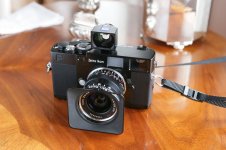
The Zeiss Ikon certainly is a beautiful camera. I followed the intro week by week before it was introduced and bought it as soon as it was available. A friend of mine who has a major in design (or something in that line) has looked over by camera collection and finds the Zeiss Ikon 'the most beautiful' (he calls my Canon SLR's for 'awefully vulgar').

A picture of mine bellow. With Zeiss Biogon 25 mm 2,8 and ditto viewfinder.
 

Attachments

  • WW9B5193small.jpg
    WW9B5193small.jpg
    111.3 KB · Views: 0
Going through my files from back in spring 2006, when I bought my Zeiss Ikon, I found this....

I drove to our summer house in Sweden for the weekend. This was early May and the snow had just gone and the small forest roads were soft. I noticed this, but was eager to start using my new camera - and I have 4 wheel drive! - It didn't help me much as you see. When stuck I put in 1. gear and and the wheel chewed dirt and dug itself down until I could hear the hissing sound of the exhaust pipes cooling off in the wet mud. Going out of the car I sank down to my ankles. Fortunately I got help from a neighbor with tractor - and a two wheel-drive car and a big glee -

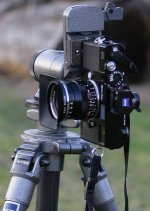
And another picture of my beautiful Zeiss Ikon on a tripod.
 

Attachments

  • WW9B5228copy.jpg
    WW9B5228copy.jpg
    125.3 KB · Views: 0
  • WW9B5229copy.jpg
    WW9B5229copy.jpg
    113.5 KB · Views: 0
  • WW9B5230copysmall.jpg
    WW9B5230copysmall.jpg
    114.2 KB · Views: 0
Hi there, Roger,
Thanks for the thoughtful response to my original post. Your points are well-taken.

A couple of things to add: Its going to be interesting to see what happens with Olympus' Micro Four-Thirds interchangeable lens camera, assuming it makes it to market. It seems to me that its very close to the camera I'm talking about (although not M-mount... although adapters?). That development is even more interesting to me when combined with my first hand knowledge that APS-C sensors are now capable of producing all the image data most of us mortals really need (The files that came out of my Nikon D80 were superb!)

The thing about digital rangefinder vs. digital SLR comparisons, is that the DRF idea is soooo interesting given its possible size, weight, & cost advantages. Its got to be a lot cheaper to build a smaller, lighter, and simpler camera body... doesn't it? And the Epson probably isn't a great model to judge the current potential today. Its cost new was prohibitive for most of us. I think it was its cost that kept a lot of us out of that camera, not its format/technology. And its cost used now doesn't make sense when you know that its sensor is several generations old.

And regarding Mr. K.'s interests... All I know about him is that he's putting the Bessa line of cameras out there, smack in the middle of the digital revolution!! That tells me that he marches to a different drummer... as long as it sells, I assume. 🙂
 
Last edited:
It is new to me that 'Mr. K say no' to develop and market a new digital viewfinder. I had the impression that 'they' (Cosina/Epson/Zeiss..) might come with something 'four years after M8 was launched'. Stephen (of cameraquest) hinted at this when the 'digital ZM' was discussed.

But it is all about profit....

While I harldy believe that M8 has been such an economical success for Leica, I am absolutely sure that 'the launch of M8' has been a storming success for Zeiss and Cosina. So, why bother making a digital rangefinder camera when you can make a handsome profit at others making the effort....?
 
I believe Carl Zeiss AG understands the market and has been very cautious about jumping into what is a very fickle segment.

If you notice, the interest in a new model wanes quickly and attention is then focused on the upcoming model and what features it might have. It cannot afford to try to compete in the 18-month life cycle, which seems to be shrinking to about 15 months as of late.

Mr. K has every right to refuse to make a digital Bessa. It's his company. And I think he is a wise man. He knows that Cosina has been very successful creating a product to fill a hole in a niche market. And now his company is the contract manufacturer of another product that fills a different hole in the same niche market.

At the same time, he has been able to vastly improve Cosina's image among photographers. Before the Bessa series, Cosina was viewed as a contract manufacturer of entry level cameras for other camera makers and a producer of lower-tier optics.

The Voigtlander lenses are very highly regarded, and the bodies have done very well. If only they could spend R&D to solve once and for all the rangefinder calibration issue (I know that I'm repeating myself here from earlier posts).

But when it comes to Zeiss, it will be Zeiss, not Cosina, that determines when a digital version of the Zeiss Ikon is produced. It's not Cosina's decision to make.

A small but very vocal group of users demanding a digital version of the Zeiss Ikon gives no assurance of turning a profit. And from Zeiss's standpoint, there is no reason to rush a product out the door, merely to try to satisfy this group. And it all comes down to profit. If you don't make a profit, you don't stay in business -- that's the bottom line.

I believe that the Zeiss approach is to deliver a fully developed product and not rely on countless firmware patches (Canon, Nikon, Olympus, Pentax) to correct product deficiencies that weren't properly solved in the development stage. I know that's the way to do things in the current age (release it and let your customer find the problems), but that's just a reflection of inadequate product testing and not something that I would expect or want from Zeiss.

I think that in time we'll see a digital version of the Zeiss Ikon. One year, two years or four years. I'm not connected so I don't know. In the meantime, we can all be happy shooting film.
 
I believe that the Zeiss approach is to deliver a fully developed product and not rely on countless firmware patches (Canon, Nikon, Olympus, Pentax) to correct product deficiencies that weren't properly solved in the development stage. I know that's the way to do things in the current age (release it and let your customer find the problems), but that's just a reflection of inadequate product testing and not something that I would expect or want from Zeiss.

Software is a tricky business. Unless you're writing code for NASA's space shuttle, there will be bugs (well, even that code has bugs). In other words, I welcome firmware updates!
 
A couple of things to add: Its going to be interesting to see what happens with Olympus' Micro Four-Thirds interchangeable lens camera, assuming it makes it to market. . . . The thing about digital rangefinder vs. digital SLR comparisons, is that the DRF idea is soooo interesting given its possible size, weight, & cost advantages. Its got to be a lot cheaper to build a smaller, lighter, and simpler camera body... doesn't it?

Dear Jamie,

Yes, unless you try to put an optical rangefinder into it.

The obvious solution, as far as I can see, is a 'focus confirmation' system in the viewfinder, perhaps with manually switchable frames, Voigtländer-style.

I can even see Leica considering that, BUT the smallest sensor that would make sense is APS-C 16x24mm (1.5x crop factor). The effective crop factor of 2x linear, 4x area, with the 13.5x18mm 'four thirds' would greatly limit the usefulness: even a 21mm would only be a 'standard' lens, though the 15mm would be a handy wide-angle.

Cheers,

R.
 
Back
Top Bottom