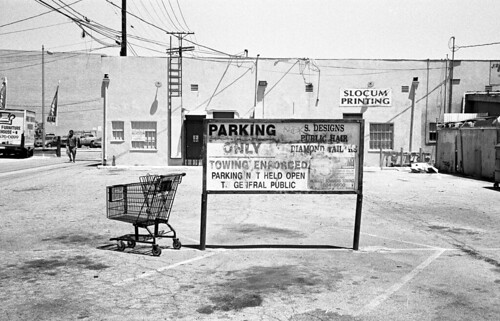
Neopan 400 and Rodinal

Fotohuis: thanks for that comprehensive comparison of all three films. It is great background knowledge before I jump in and do it myself.

That is good advice Tom - I will purchase more film. I honestly love the stuff. Unfortunately, due to the increase costs of film & financial constraints, I have to be a little more selective/careful with my recent emulsion purchases. That is why I'm doing a little research here before I commit to different varieties.

Also, I am curious, Trius what does this mean: "a film that requires 11 minutes in Rodinal 1:50...Fancy that". I was just wondering because I have read on the massive development chart and Ilford website that both Neopan&HP5 both need 11 minutes for 1:50. (although that site is a starting point and is often wrong) So, are you saying that 11minutes is a common time for many different films? Thanks.
 
I like Neopan pretty well; I bought a lot of it when it was cheap, and tried it in a few different soups. But it was a shot of Melanie's that convinced me to give it a closer look.

Now it's one of my go-to 35mm films. Mostly I expose it at 400, and I too run it in Rodinal 1:50 (though I give it 12 minutes, with agitation for the first 40 seconds, and then 3 inversions per minute). Processed this way, I think the grain has something of the look of Tri-X to it (never mind that Tri-X doesn't really look or behave the way it used to, but that's another topic).

Anyway, compared to (old) Tri-X, Neopan's emulsion looks thinner and the tonality is a bit different, but as I said, it's familiar- and more importantly, it prints well. (A gallery here in Louisville currently has on display 9 18x23 inch prints I made from Neopan negs. I don't normally print 35mm that large, but I wanted to see how they'd look, and I was pleasantly surprised!) I only wish it was available in 4x5.
 
I'd like to offer a dissenting opinion. When I started souping 120 Neopan 400 in Rodinal about six months ago (at 1:50), I used the MDC time of 11 minutes and found it was much too long. Yes, it yielded wonderful blacks, but the highlights were usually blown -- a common problem with this film, no matter what developer you use. So I've cut back the times a lot. I now develop for 7 1/2 minutes for films exposed at anywhere from box speed to +2/3, 6 3/4 minutes for films at +1 and above. I find this yields a more balanced result. (I notice that the bottle of Agfa Rodinal I bought recently recommends 8 minutes for 1:50 dilution, so these times aren't as abnormal as they may appear.) Naturally, the agitation routine plays a part too. I invert continually during the first minute, 4X per minute thereafter. I guess it finally comes down to what you're looking for. If you prefer contrasty negs, and can live with less than wonderful highlights, then 11 or 12 minutes is probably better.
 
mgd711 - thanks for that clarification. That time of 11minutes with Rodinal is now firmly lodged somewhere up top! Looks like that is the ever increasing beauty of Rodinal, aesthetics and its easy application.
 
I think there may be a difference between whether one's final output is a scan or optical print. And if an optical print, whether condensor or cold light illumination. I agree that 11 minutes may be too long for scanning and condensor printing.
 
I think there may be a difference between whether one's final output is a scan or optical print. And if an optical print, whether condensor or cold light illumination. I agree that 11 minutes may be too long for scanning and condensor printing.


Agree totally ... for me anything over nine minutes for this film and developer combo would give a negative too dense for an optimum scan.
 
Agree totally ... for me anything over nine minutes for this film and developer combo would give a negative too dense for an optimum scan.

I find the advantage of the shorter development times to be a longer scale somewhat flat negative. Since I scan, I can then use curves in Photoshop to put the contrast where it works best. Sometimes it is in the midtones with the shadows and highlights gradually tapering off, sometimes it goes in the the shadows to create more dark areas and the remainder in the midtones.

I really like the ability to place the contrast where I think it should go rather than across the entire image as I used to do in the wet darkroom unless I burned and dodged each print. That shorter development time is what gives me that option.
 
Carl, you can also keep the time the same and dilute the Rodinal even further. I frequently run 400 speed films at 1:60 or 1:75 when the contrast range is greater than I feel the film can handle. I like 10-11 minutes time - most of my developers are "adjusted" to that. This way I can set up a "flow" with my tanks and have 2-3 tanks, 1 developing, 1 fixing and 1 in the wash. More efficient - and let's face developing film is a bit boring!
 
Tom,

I guess that works too. But then you have to keep track of all the off-beat dilutions you use to achieve your standardized time! Anyway, we're after the same thing -- adjusting the potency of the developer in order to create a better "fit" with the inherent characteristics of the film and the exposure you've given it. I'm struggling with this constantly, so I can't yet agree with you that "developing film is a bit boring"!
 
These are all 35mm in 1:40 dilution of Fomadon R09.

3724521111_5846ccccb7.jpg

http://www.flickr.com/photos/nategrossman/3724521111/in/set-72157621878029718/

3783247749_a286603e47.jpg

http://www.flickr.com/photos/nategrossman/3783247749/in/set-72157621929600568/

3783732428_533847f53f.jpg

http://www.flickr.com/photos/nategrossman/3783732428/in/set-72157621929600568/

3724747871_8b6b10e5fa.jpg

http://www.flickr.com/photos/nategrossman/3724747871/in/set-72157621534312978/
 
Back
Top Bottom