SLR - Single lens reflex, e.g., viewfinder through the lens itself ... mirror flips up on shot.
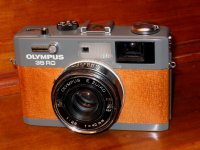
RF - Uses a rangefinder for focusing.
P&S - Doesn't use a RF for focusing and you don't look through the lens when focusing.
So everyone who uses an external viewfinder on their RF and scale focuses is using a P&S now.... what does this make the Contax G2? It uses a rangefinder but for AF. Most compact digital cameras do look through the lens when focusing, just on an LCD, rather than througha viewfinder.
To describe them as P&S is to dismiss anyone who has done any good work with one and there are plenty of those.
There are quite a few good reasons to use a digital compact too. They are much smaller, even compared to an RF, often quieter, usually cheaper, record movies, something SLRs haven't been able to do until very recently - for a lot of street photographers who prefer a lot of depth of field and want a small, quiet and unobtrusive camera a digital compact is the camera of choice.
There are drawbacks - the LCDs are often rubbish, the sensors are tiny to reduce cost and suffer in low light and offer no DoF control, the AF systems are slow, and they often lack any degree of manual controls because the companies that make them have decided that the people that buy them wouldn't use it. None of these are fundamental limitiations to the format of the digital compact - just their implementation thus far.
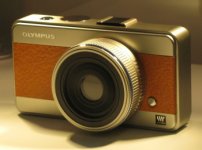
There isn't any reason one cannot build a digital compact with a good electronic viewfinder or LCD, with a large sensor and actually put some R&D money towards their performance. That is exactly what this micro 4:3rds initiative is.
Besides, cameras don't point at anything and shoot anyway. They sit there doing nothing. People take snapshots. People point and shoot. Sometimes they actually pay attention to what they are doing and make good pictures but a lot do not and the reputation of digital compacts have suffered from the association.