Outsiders

...most of mine seem to be 'insiders' with me the one on the outside. Not sure what, if anything, that may say.
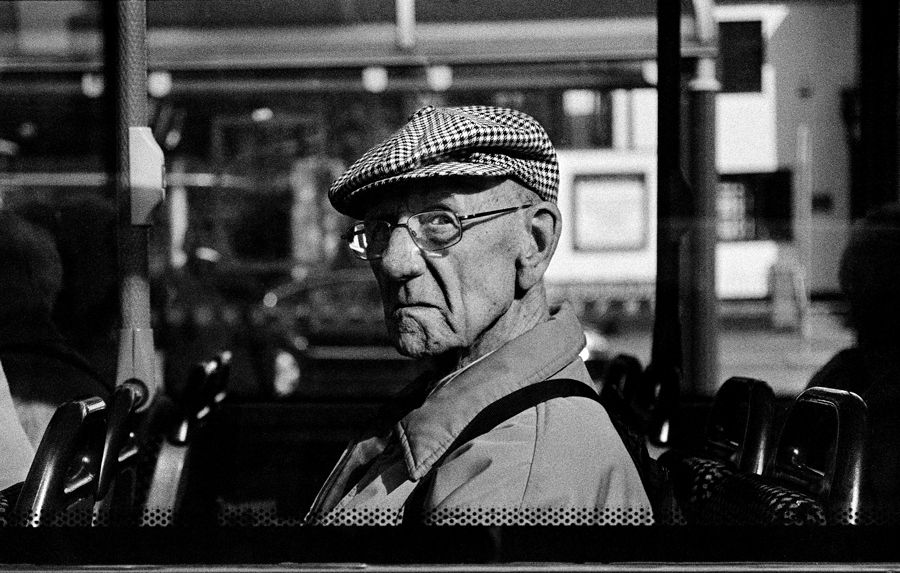
Grumpy-old-man1_zpsbe7070e9.jpg

Fabulous expression on his face, it really makes the shot.
Well caught, or provoked!

Dave

 
Speaking to the critiques:

I can be responsible for no one else's interpretation of other images here, but an explain my own contributions. The first, a disabled young man in a permanent wheelchair with his attendant scouting out the street crossing in a very crowded market, attracted me for its intimacy and the sense that they are virtually a compound being. But yes, they invited stares from those who surrounded them who were not disabled, not tatted, not struggling with motor/muscle control.

The second man is a severely crippled Jamaican junkie in San Francisco. Possibly part of a begging syndicate, and paying most of his take to a dealer to keep him out of pain. He was hitting me up for money. I offered him money for breakfast to pose for me, and he posed with aplomb and tremendous dignity. When he saw me an hour later, he sought more cash, because what I had given him had been taken from him either as tribute or by force by stronger panhandlers.

Those are the thumbnail stories for my images.

The question about who is an outsider, and how, and why, is legitimate. The images are trying to apprehend these things. And a forum for visual discussion of a proposed subject should be able to evolve its idea at the visible level for more than a few hours without having to answer merely verbal charges about its still-improvisatory rule of engagement.

So why not contribute rather than scoff? William Blake comes to mind: The questioner, who sits so sly/Shall never know how to reply.
 
BTW: I am a virgin RFF poster until now- be kind.Ive been a daily reader of forum & fan of everyone's work in the Gallery for last year & this my first post here- from a new to me M6 purchased in Feb
9381210506_a79d9f57cf.jpg
 
Pre-Photography 101 is taking street photos of people who look like the Unfortunate Ones. Pretty trite and ho-hum these days. And I have to object to labeling these people, without the help of any professionakl social worker or social scientist input, as "outsiders." Outside of what -- the human race? Your own middle class prejudices? How many times does one have to bathe every week to be part of the "in" crowd? If I have a broken leg you feel sorry. If I have a broken brain you think I'm not quite human. I think we need to do better than this.

You assume that the term 'outsiders' is perjorative and that it only applies to one class of person. Many great artists, photographers, muscians etc. have been proud to call themselves outsiders. You may consider the photograph of a poor person looking in the window of an expensive restaurant as trite or compassionate, depending on your own prejudices.
 
I find that the drive to exclude, or undermine the value of shots of people who appear to be somehow unfortunate, or to write these shots off as "exploitative" ends up with a sanitized view of the world through "acceptable" subject matter.

By "protecting" those people in this way, it ends up hiding them from view, and that bothers me.

Yes, it's possible to conduct yourself in an exploitative manner as a photographer, and that would be deeply distasteful, however I discount the idea that by taking somebody "unfortunate"'s photograph, you're necessarily exploiting them.

Sometimes those photographs, show viewers how disposable society can view those who fall outside it's norms as, and to me that's an entirely valid photograph. Equally some photographs show a great deal of character, and it can be a celebration of that, and sometimes the fact that a photograph of an "unfortunate" can make you think "this really could have been taken at any point in the last X years" and realise that our "progress" as societies is often very limited in who gets to benefit from it.
 
Last edited:
The way I approach the subjects is up close and very personal. I have conversations with them and try to show them in a dignified light. I'm not taking them from a block away asleep on the pavement or digging through the garbage. This is a mirror to our society and we should all look at it hard because in any society you are only as strong as your weakest link. Some of these people are the ones that many want to sweep under the rug.

Thats my 2 cents.

I do think there is a fine line between making a dignified portrait of people that need to be seen and making images that are exploitive.
 
Speaking to the critiques:

I can be responsible for no one else's interpretation of other images here, but an explain my own contributions. The first, a disabled young man in a permanent wheelchair with his attendant scouting out the street crossing in a very crowded market, attracted me for its intimacy and the sense that they are virtually a compound being. But yes, they invited stares from those who surrounded them who were not disabled, not tatted, not struggling with motor/muscle control.

The second man is a severely crippled Jamaican junkie in San Francisco. Possibly part of a begging syndicate, and paying most of his take to a dealer to keep him out of pain. He was hitting me up for money. I offered him money for breakfast to pose for me, and he posed with aplomb and tremendous dignity. When he saw me an hour later, he sought more cash, because what I had given him had been taken from him either as tribute or by force by stronger panhandlers.

Those are the thumbnail stories for my images.

The question about who is an outsider, and how, and why, is legitimate. The images are trying to apprehend these things. And a forum for visual discussion of a proposed subject should be able to evolve its idea at the visible level for more than a few hours without having to answer merely verbal charges about its still-improvisatory rule of engagement.

So why not contribute rather than scoff? William Blake comes to mind: The questioner, who sits so sly/Shall never know how to reply.

Hear, hear! Well said.

Photographing those who have less than we do is not somehow automatically exploiting them, as many try to claim these days.
 
Hear, hear! Well said.

Photographing those who have less than we do is not somehow automatically exploiting them, as many try to claim these days.

If its approached correctly its no more exploitive than Davidson's "East 100th St" or Arbus's work in the insane asylum or Walker Evan's, Dorothea Lange, etc.
 
Back
Top Bottom