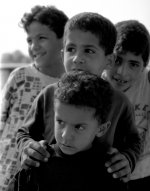
It is possible that the horrific nature of so many photojournalistic images says more about our world than it does about photojournalism itself.
The owner of the laundromat at the corner of my street greets me in the same way every single day: "Grand day, isn't it?" The other day, the sky was dark and the rain was pouring down. As I walked past his front door, he called out, "grand day, isn't it?" I stopped and pointed out to him that buckets and buckets of water were pouring down on my head. "Better than bombs," he pointed out.
That kind of optimism stands out because it is so rare. When I take photojournalistic images, I try always to look for the "grand" in the day. But sometimes, it's just not there. Just have a read through Raid's recent
THREAD.
Good photojournalistic images speak to the human condition. They tell us about ourselves. In a world in which morality is so often trumped by greed and ambition, is it any wonder that photojournalists wind up taking so many images of human suffering?
Certainly, we are drawn to images that convey strong emotions. And emotions like grief and pain are amongst the most powerful. However, there is no necessary connection between photojournalism and human suffering.
Human suffering brought about by natural disasters is, for the most part, out of our control (except insofar as the magnitude or frequency of natural disasters is increased by us impacting our environment). And photojournalists will always cover stories of natural disasters. But much of the suffering in the world is visited by people upon people. And until we all come to see human lives as equal and some stop looking at the world solely in terms of how they can enrich and empower themselves, I am afraid that photojournalists will be taking a whole lot of images of great human suffering.
Sorry for the negativity. But sometimes I really despair at the current state of the world.