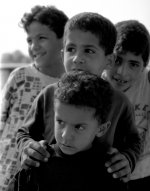
photojournalism = images of human suffering?

To extent I'd agree but then Martin Parr to give one example doesn't fit into this category. In a way it reflects how tragedy is viewed as a higher art form than comedy, so most of what's viewed as worthy is pretty depressing. Anyway here's one I made earlier...
 

Attachments

  • west6.jpg
    west6.jpg
    104.6 KB · Views: 0
Most photojournalism DOES NOT show people suffering. However, the photojournalism that we remember very often does show people suffering. We, as humans, empathize with other humans in trouble. We also have a nasty side to our nature in which we gawk at others' misfortune, in part relieved it didn't happen to us.
 
Well, i don't know Vince, you might have a point there that we remember selectively. However, when I think e.g. about the last large exhibition I've seen, "another asia", almost all series were about suffering people somewhere in Asia... except a few, which were not photojournalism at all.
These images present an Asia that is a terrible terrible place, where it's almost impossible to live and be happy. I have friends from south and se asia which are the direct proof of the opposite.
That's why i thought about, maybe by definition PJ equals reporting trouble out in the world. But what's the rest then? Travel photography? Art?

I don't mean that one single image shows actual persons suffering, not necessarily, but i mean the final message of a series of images within one frame is about the suffering.
 
The World Press Photo 50 years gallery -- Click Here -- is also pretty downbeat.

I'd say most serious photojournalism has a depressing quality to it because photojournalists have become our emissaries for grief. ... They go to places most of use cannot visit and see things most of us hope not to witness. There is also an element in which photojournalists want to roust people out of their complacency and make them care about the problems of distant peoples. There's also the widely accepted definitioni of news ... things not going right, conflict. Flowers blooming and planes landing on time are not news.

I've got three newspapers on my desk this morning: The New York Times shows a man carrying a banner yelling, surrounded by smoke, after political violence broke out in Budapest. Below the fold is a very engaging and pleasant photo of some African women in headscarves enjoying an evening under palms at an outdoor cafe. The caption says the young women are enjoying an evening out in Khartoum while, 600 miles away, one of the world's worst atrocities unfolds in Darfur.

The Washington Post shows an artistic photo of windows and reflections at the opening of a new visitors center in Mount Vernon, George Washington's historic home. There's also an upbeat personality portrait of a man campaigning for U.S. Senate in Maryland.

The International Herald Tribune shows another photo from Budapest, a man kneeling with raised arms as he faces a phalanx of at least two dozen black-clad riot police. There are three environmental portraits of North Korean nuclear scientists. The Herald Tribune also ran the same piece about Khartoum booming as Darfur sinks into despair, and showed a different photograph of the same young women in an outdoor cafe.

I don't ordinarily look at the Washington Times, but it wins my favorite photo-caption poll this morning ... there's a telephoto photograph of a North Korean soldier preparing to throw a rock at the photographer, under the caption "Not Ready to Play Nice"
 
On a more serious note ...

It doesn't have to be. Note the photos after the conclusion of WWII, celebrations in the streets, walk on the moon, summits on (name a mountain), victories in sports, achievements and milestones in art, music.

PJ work is what you make of it. It can relate to human suffering, or human achievement.
 
VinceC said:
Below the fold is a very engaging and pleasant photo of some African women in headscarves enjoying an evening under palms at an outdoor cafe. The caption says the young women are enjoying an evening out in Khartoum while, 600 miles away, one of the world's worst atrocities unfolds in Darfur.

That's exactly what I mean. Even if an image does not show anybody actually being in trouble, the captiion, the title, or something will indicate that the main idea,the message is, that the world sucks.

It's good to think that PJ's are doing this to make us realize what's going on outside of our peaceful beautiful world, but i wonder if this degraded into a hunt for shocking scenes in order to achieve fame, prizes and new assignments.
 
It is possible that the horrific nature of so many photojournalistic images says more about our world than it does about photojournalism itself.

The owner of the laundromat at the corner of my street greets me in the same way every single day: "Grand day, isn't it?" The other day, the sky was dark and the rain was pouring down. As I walked past his front door, he called out, "grand day, isn't it?" I stopped and pointed out to him that buckets and buckets of water were pouring down on my head. "Better than bombs," he pointed out.

That kind of optimism stands out because it is so rare. When I take photojournalistic images, I try always to look for the "grand" in the day. But sometimes, it's just not there. Just have a read through Raid's recent THREAD.

Good photojournalistic images speak to the human condition. They tell us about ourselves. In a world in which morality is so often trumped by greed and ambition, is it any wonder that photojournalists wind up taking so many images of human suffering?

Certainly, we are drawn to images that convey strong emotions. And emotions like grief and pain are amongst the most powerful. However, there is no necessary connection between photojournalism and human suffering.

Human suffering brought about by natural disasters is, for the most part, out of our control (except insofar as the magnitude or frequency of natural disasters is increased by us impacting our environment). And photojournalists will always cover stories of natural disasters. But much of the suffering in the world is visited by people upon people. And until we all come to see human lives as equal and some stop looking at the world solely in terms of how they can enrich and empower themselves, I am afraid that photojournalists will be taking a whole lot of images of great human suffering.

Sorry for the negativity. But sometimes I really despair at the current state of the world.
 
Last edited:
As Rafael said, some of the darkest corners of this world need a bright light shining into them to discourage the cockroaches; we should all be made aware of what’s going on in Raid’s families’ neighbourhood and thousands of other places for that matter regardless of “good taste”
If it offends enough people maybe we will do something about it.
 
well Sparrow, that's of course true, but let me tell you a different example.
When I first time was stopped on the street (i mean first time in my life) by a beautiful young, smiling girl volunteering for Amnesty Int. and collecting money (,signatures,..., any kind of support), i listened to her, was feeling touched, had a nice discussion and finally i was honoured to be able to help.
Nowadays if i walk on a crowded place in the center of a town I have to slalom between the volunteers of Amnesty Int., Unicef, Greenpeace, WWF, etc, etc, and I don't dare to even look at them, otherwise i will never get to my destination and I will spend all my salary and some more.
One can get overloaded with images of horror, war, famine, and develop a kind of immunity against them. And that is the better case; one can also become depressed and disappointed in life, the human race, God, whatever he believed in before. As written by someone in the same thread started by Raid, we are too small to do anything important in the world. Well, most of us are.
 
Maybe the queston should be "good/interesting photojournalism = images of human suffering?" because when we think of photojournalism we always think of those pictures that make us stop and look. The newspapers are full of boring photos of local events, unknown politicians, construction sites etc.. Maybe they don't make the front page but there's definitely more of those in the newspapers than there are photos of human suffering. It also makes sense because probably very low percentage of photojournalists are what we would call war/conflict photographers.
 
Pherdinand
I imagine Raids family get overloaded stepping over the corpses each morning, they unfortunately don’t have an alternative, being depressed and disappointed would be of little help to them. We can at least bear witness to what’s happening, so that eventually enough little people know the truth and think alike, public opinion is a good stick to beat politicians with.
 
Good photojournalism depicts human emotion. There's just a lot of suffering happening in the world, and bad news seems to be of greater relevence/importance than good news. That sounds like a negative attitude, but imagine managing a business or corporation: attention must be focused on issues that are problematic rather than on things that are going along well. One tries to find a balance, but with a limited amount of energy/awareness capability, efforts need to be directed to the bad news issues as they may have a greater impact/relevence.
 
Jamie, I can rant on about most photos in the press, and I can do the old man thing and complain, they’re not as good as in my day, ya got proper pictures of death and mayhem from Vietnam you know! Not like this Gulf war II! The truth is the good stuff is only ever a very small proportion, but it is worth suffering all the rest because the very best can help change history who remembers this.
It had a huge effect on public opinion at the time
 
Last edited:
There's an old saying that it's no news when a dog bites a man - only when a man bites a dog. Reporters (and probably photojournalists as well) seem to have a nose of smelling out the negative side of the human condition.

But it's also true that a photographer takes many photos in the course of a day's work. So it's as often as not the editors back home who decide what gets printed.

Consider the controversy between CNN and FOX news. Which one a person prefers probably says as much about that person as about the news media. Dan Rather cut his teeth, so to speak, tearing down Richard Nixon. And then there was Sam Donaldson of ABC fame.

Ever wonder why journalists constantly complain that Presidents don't hold enough news confernces, especially the televised variety? But consider the President's side, too. Puttng ANYONE up on front of that crowd is like putting Daniel in the lions' den. They ALL want to tear down, and won't miss an opportunity to do so.
 
Back
Top Bottom