Cheers guys, so many good feedback here. good to know that I'm not the only one who's slightly pervy about those PMTs
😀
Hello Margus,
I'm stunned. I feel like throwing away the free Epson scanner I got few months ago. Once I'm back to UK, I hope to send some old (from 80's) negs (35 and MF) to you.
Do you have any (youtube) video as to how you scan them or in general a brief overview about PMT scanning techniques? I don't have money, time or intetion to get into such highly technical stuff. I am just very curious about the whole machine and the process after seeing your stunning images and the accompanying notes you've kindly posted. 🙂
Don't throw away your Epson - when you IT8-calibrate and use good film holder it's decent for 4x5". But questionable on medium format and definitely poor on 35mm.
Just PM or e-mail me if you're interested to have some of your work drumscanned.
YouTube video on drumscanning sounds like a plan to consider in the future. I'd love to help analog-users community, introducing some drumscanning and giving some tips and tricks on this "dying art" of scanning. I have to motivate myself more!
🙂
The thing is that a drum scanner is so acurate (the pixel by pixel scanning) that it will pick up every grain on the film sometimes. So well developed film was crucial. Garbage in, garbage out was a mantra often heard.
Also 35mm films often resulted in quite noisy scans – medium and large format was best. Especially for the front covers of brochures and magazines, when the digital resolution had to be very high. So, ironically, sometimes I've found that a decent 'low-end' scanner can produce more 'usable' results, simply because it doesn't pick up as many 'artefacts' as a higher end scanner.
Yep, those probably were the "golden" times (90s) on drum scanners when they had high-throughput (=big $$$) and often the operators cut corners to get huge loads of negs/positives through them w/o wasting time doing it properly for each particular requirement, let alone use their equipment advantages to full.
Film's haydays are long over and modern day drum scanning is now fully a high-end niche market and the operator must meet all the demands of the client for each batch or even for each frame.
The very first simple trick is wet-mounting that was often neglected in the past and still is today in some cases since it requires some dedicated handwork on drums. This optical effect, when the negative or positive sits in specialized liquid (or some cases: gel), considerably reduces grain effect, increases dynamic range and, for the lack of a better word: adds "authority" to scans, especially to the color work. Another benefit of the wet-mounting is that it hides most of dust and removes large part of the scratches (unless it doesn't "cut" into emulsion itself, i.e. damaging the usable info) and other defects of the film. You lose some of the sharpness with the wet-mount, but you gain in overall tonality, dust and defects removal.
Then there's the second trick, and IMO one of the main distinct advantages of elite drum scanners: the
adjustable scanning aperture. Some cheaper drum scanners don't have this or just have a couple of usable apertures. Adjustable aperture is what separates the elite drum scanners from CCD scanners that do not have adjustable aperture (meaning they scan with only one aperture in every setting - basically they're a "one trick pony" in pixel-level in comparison).
Adjustable aperture on drum scanners is similar to the aperture used on a photographic lens, but not at the whole frame level (i.e. you can't simulate this with dSLR macro lens scanning by adjusting lens aperture) but on a microscopic pixel level - you can adjust DoF and detail rendering sharpness with it on pixel level, each adjustment direction with its own compromise like with a normal lens aperture (with smaller aperture you'll lose some light, with bigger aperture you'll lose some detail).
The drumscanning "trick" taming those very grainy films is to use bigger scanning apertures. Optimum aperture for the particular emulsion or for the preferred result are chosen through the experience by the operator, mostly decided on inspecting the negatives or positives on the light table through enlarging loupe or running various aperture tests before final scan when looking for that "sweetest" spot (visual grain vs usable detail). Bigger aperture creates "smoother" (less grain but slightly reduced overall fine detail resolution as a payoff) overall image. This can be used also as contra-effect: using very small scanning apertures to "enhance" the grain, on some images that can work wonders as well where visible grain and noise is actually preferred. I.e. some high-ISO b&w "romantic" films where the client demands highly visible "analog-looking" grain w/o emulating it with software.
Since drum scanners offer the best possible film flatness another less used trick on those very grainy (or poorly developed or underexposed shots) is de-focusing the scanner just a tiny bit off the film-plane. Note you need near-perfect film flatness for solid results. This can work wonders while preserve most of the usable details since you're off the focus just a tiny bit. In some cases this can work well on C41 color negatives since not only it reduces grain but it also "smoothens" those harsh color transitions in shadows as well on those grainy images. Note this is done optically - you can't fully emulate this slight optical de-focus in PP with different blur effects etc. Skillfully performed hardware-based adjustments almost always come out better than the software emulations/simulations IMHO.
But smartly adjusting the scanning aperture is the real art of drum scanning.
When you combine wet-mounting with adjustable scanning aperture you can obtain really decent results in terms of grain reduction, negative defect- or scratch removal while still get highly detailed images.
I am admittedly ignorant about scanning so please forgive the question. I noticed that many of these drum scans are either MF or LF. Is there a point of diminishing returns in regard to size if, say, I only shoot 35mm? Or is the advantage of drum scans as clear in that case as well?
Not ignorant at all
🙂 Like with all photography the short answer is: it depends. How you look at it and what do you expect out of your analog work.
There is advantage in 35mm film for drum scanning, but it's not as huge as i.e. medium or large format. Since 35mm frame is pretty small and it's easier to hold flat, dedicated (CCD-) scanners are pretty good in terms of resolution for this smaller format. I.e. Hasselblad's X1/X5 offers some astounding 6300ppi for 35mm frames (while it's limited to 3200ppi for medium format and 2040ppi for LF while it's constant on drum scanners). A true optical 6300ppi is really a true high-end, even in high-resolving drum-scanning terms. So for the 35mm some CCD scanners really perform very good.
However you can't get that "PMT-feel" out of any CCD scanner and this is where drum scanners still offer something "new" that separates your analog works from the majority of others who're using CCD-based machinery. Add scanning aperture feature and other thing is the shadow performance that is in most cases superior on drum scanners.
So it's up to you to decide what you look for, but I'd say drum scanning is a decent choice with 35mm frames.
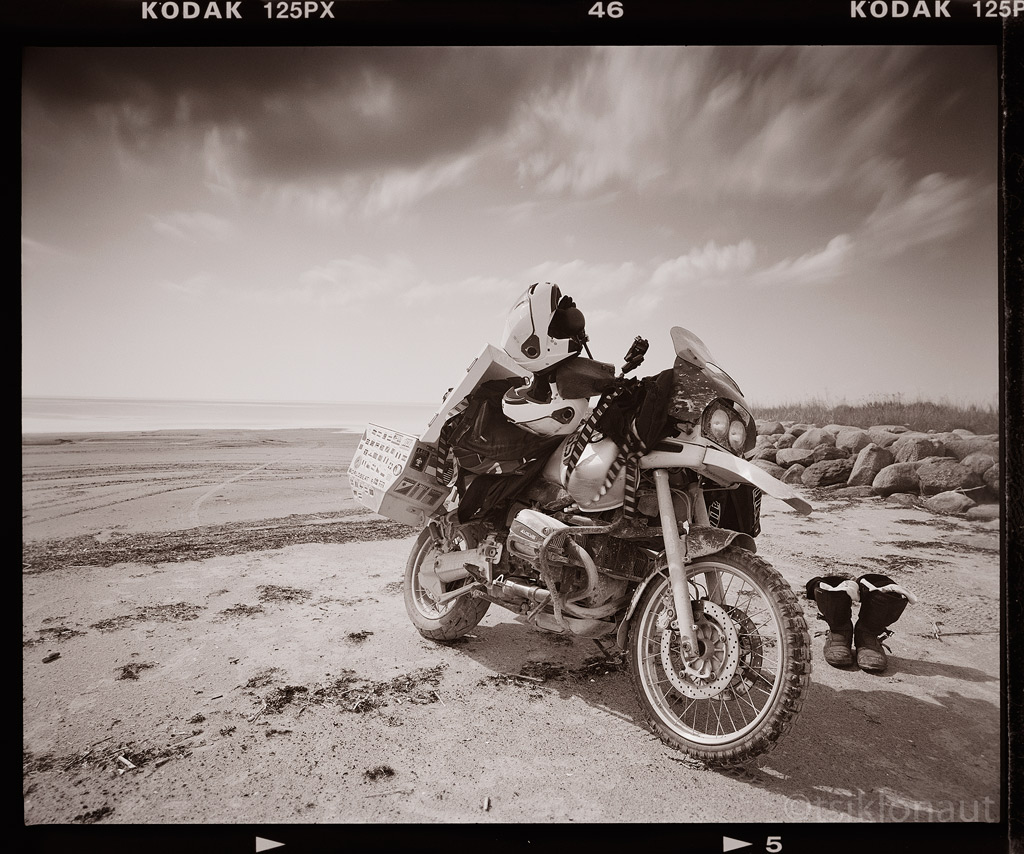
Lovely 1100 i have got a Kalahari Yellow one and great shots
Good to hear here're some other trailbike nutters among us as well
😎 My previous GS was a Kalahari, loved it to bits and brings back so many good memories. I had a fantastic time on it in Iran back in 2005 with a brave girlfriend (now wife) who was willing to come with me into the darkest unknown back then, without any kind of support or backup we went to Iran alone on a single bike. But that turned out to be the beauty of it. I took my semi-faulty Kiev 60 camera with me as well:
But then came the reality check: one cocky cager in Poland did an illegal turn and totalled it and almost killed me along with my wife in the process when were coming back from Iran trip - ironically our very last day of the 5+ week expedition, like real-life proof of the Murphy's law. We were lucky to escape alive from this 100kph crash:
Ironically this didn't stop my love for the bikes and travelling, instead it increased it. The bike was so good I got another good 'ol 1100GS - this one and "adventurized" myself, mostly DIY-style. Together with analog (both audio and photo) motorcycles and travelling with them is my other very "bad habit" to be ashamed of since together they all kill my time beyond my own reckoning
😀
Ride safe,
Margus