Reading Photos

The first part of his statement is important, too. It's something of a lament about the people themselves being photographed not-understanding/not-caring-for the final image. That's different than the general viewing public not understanding the image. It's really quite common for subjects to not get/not like the images others make of them. For photojournalists and those who do documentary-style shooting, it's important to bear in mind that your raw material is people's image of themselves, which is an intensely emotional and sensitive thing.

Still, this quote leaves me with the inescapable feeling that the photographer is a jerk.
 
I think that we as photographers, if we are lucky, learn things about composition, color or lack of it, and many other things that "work." We learn to "see" and recognize all these elements and soon they become like language; we think in them. Like language, sometimes we consciously incorproate these elements in our photographs, sometimes they just appear almost unbidden, not perhaps seen until we look at the image after it is taken. Sometimes a photo we take just works. If we analyze it enough, we will recognize what makes it work, why it speaks to us.

The same thing in photos of others that we look at. Sometimes they really speak to us without a lot of analisis, but we can analyze then and figure out why. Having a photo reach out and grab us doesn't require that we "read" it in my opinion.

It may be a fine line, but I think that reading in the sense of the Magnum photographer, implies a studied approach, which indeed may prove enlightening and satisfying, but should not be necessary to every photograph. And the fact that it doesn't reach out and grab us doesn't mean we don't know how to "read" it. It may simply mean as others have pointed out, that it just isn't our cup of tea.

Just my two cents.
 
I have a tendency to agree with the quote, more than I disagree. I think that there is a "skill" to seeing or reading a photograph, and that a lot of people don't have that skill. I think it's more a willingness to "see and read" an image, to look at it for meaning, and that's something that stems from critical viewing. It sounds elitest, and there's probably no way to take this position without sounding that way, but it has a lot to do with education, and educating oneself.

You learn to look at images critically, in a critcal setting, which most often occurs in an "educational" environment. This is where you learn to look at images, to see them, and you do that by looking at a LOT of images, breaking them down, studying them. It's the same for any art: painting, scuplture, filmaking. Take a film appreciation course or seminar, and you will never "see" film the same again. You won't see the same film as the "uneducated" person sitting next to you.

Take a wine apprecation class, and wine will take on new and different dimensions. Not a lot of people have studied photography, created images, put them up for critique, participated in a critique, or visited a gallery to look at photographs. It's not that far-fetched to suggest that most people don't know how to read an image. It's not a slight against those people, nor is it an elitist position.

Most people don't know how to read a balance sheet, an accountant can, because he/she studied accounting. Most people couldn't plane a piece of wood, but a carpenter can. I couldn't do either without training, but I'm not offended in the least. I've got very little appreciation, or desire to understand opera. I don't know how to understand or appreciate (read) it. Other people do. I am uneducated regarding opera.

For most people, the only images they see are on their calendar, in magazines, coffee table travel books. They're not looking at those images critcally, any where near what happens in educational environment, or even what we do here in our gallery.

There is a skill/ability/apprecitation, and it is learned.

🙂


.

 
RayPA said:
I have a tendency to agree with the quote, more than I disagree. I think that there is a "skill" to seeing or reading a photograph, and that a lot of people don't have that skill.
There is a skill/ability/apprecitation, and it is learned.
🙂
.

No provocation intended, a question only: Would not be the conclusion then that "good" photos can be seen and appreciated by visually educated people only ?

I admit there are people who are visually absolutely "underexposed", the acoustic type, genetically focused on the acoustic perception. Leaving those specialists aside, should all the rest be unable to recognize a visual message, below/behind the visible forms, figures and and colors ?
I have serious doubts that this ability comes with education only. Maybe the untrained spectator cannot describe his perception clearly (analysis), but the emotion is there, isn't it ?

bertram
 
Bertram2 said:
No provocation intended, a question only: Would not be the conclusion then that "good" photos can be seen and appreciated by visually educated people only ?

I admit there are people who are visually absolutely "underexposed", the acoustic type, genetically focused on the acoustic perception. Leaving those specialists aside, should all the rest be unable to recognize a visual message, below/behind the visible forms, figures and and colors ?
I have serious doubts that this ability comes with education only. Maybe the untrained spectator cannot describe his perception clearly (analysis), but the emotion is there, isn't it ?

bertram

I will not be provoked 😉

I think to "read" an image requires some skill and understanding, experience beyond just having eyes, intellect and feeling. Sure anyone can appreciate a good photo, just like anyone can appreciate a good wine, a good film, but the 'why' of it comes from having some experience, and that's what we're discussing: READING an image. So yes maybe we're talking the inability to elaborate upon the 'why,' to talk-the-talk.

But like you, Bertram, I have been looking at photographs for years. I've shown the work of great photographers to people who just don't get it, and will not get it, because they have no interest in getting it, or at looking at images. Getting these folks to Read an image, to study why it works will just not happen (and that's fine). Like George Carlin said once, "Ya Gotta Wanna." And when you do (want to learn), when you pursue an understanding, educate yourself, somehow (and it doesn't need to be formal univeristy study) you can learn it.

The quote to me is dead-on. Most people don't know how to read an image. I would add that the disclaimer, "...and there's nothing wrong with that."


🙂
 
Ladies and gentlemen. OK, gentlemen... "reading" (which should have read interpreting) a picture has nothing to do with its own aesthetic merits. They can coexist and yet not overlap.

We could argue this until we turn to ashes.

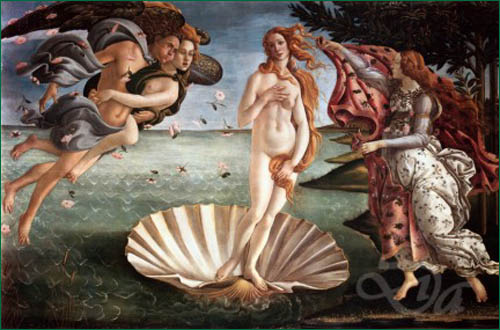
Behold a picture for you to "read":

birth-of-venus.jpg


Whether you can read it or not, you may like it.
 
I think there are two levels of response: one is gut, and is essentially unlearned, and one is learned and conditioned by culture. If you look at a lot of Annie Liebovitz's photos, you find that they may mean a lot to you, because you lived through the era in which certain personalities and symbols stood for things outside the frame of the photograph. So a photo of John Belushi standing by the side of the road or John Lennon and Yoko Ono wound up together on a bed may hit you very hard, but a hundred years from now and forever after, look quite inane because there is nothing of particular interest on a gut level, and the personalities will be forgotten. On the other hand, there's porn: all gut, nothing to think about. If you put a piece of pornography in most guy's books, where he'd come on it unexpectedly, I would suggest that as aesthetically unpleasing as it may be -- stupid, poorly lit, ugly models etc. -- he'll stop and look at it, because of the gut response. I think the same would be true if you could take that photo all the way back to the Paleolithic, in any culture.

Dealing with more aesthetics works, or works that pretend an aesthetic purpose, humans seem to me to vacillate between the classic (appeals to the mind) and the romantic (appeals to the gut.) The best artists, in any art form, blend the two...

And the very best artists interest almost everybody, in one way or another. Everybody reacts to their art. In my opinion, if you say it takes a trained eye to appreciate your art, you're saying your art isn't very good. Durer drew and painted a Large Piece of Turf a half-millenium ago -- and what could be more common than a piece of sod -- and people still look at it in awe. Doesn't take any training at all.

JC
 
I think the idea of art existing on two levels is the right direction. Certainly those of us who take photographs or study photographs look at images with a different level of complexity and appreciation than the non-photographic viewer. We can appreciate some of the photographer's challenges and technique. On the other hand, really powerful images can grab the viewer's attention regardless of their familiarity with the process. Often by depicting either a very strong emotion (maybe good but or often bad) or by showing something that's unique or perhaps out of place. The now-ubiquitous photo of Depression-era workers eating lunch on a sky-scraper girder high above New York City is a good example of a photo that works on both levels. It's become a cliche, but we're intrigued by it because everyone is so comfortable in such a dangerous location, and on a secondary level we're asking ourselve, How did the photographer get up there?
 
RayPA said:
I will not be provoked 😉

I think to "read" an image requires some skill and understanding, experience beyond just having eyes, intellect and feeling. Sure anyone can appreciate a good photo, just like anyone can appreciate a good wine, a good film, but the 'why' of it comes from having some experience, and that's what we're discussing: READING an image. So yes maybe we're talking the inability to elaborate upon the 'why,' to talk-the-talk.

🙂

In principle I agree to your POV 100%. I simply wasn't sure if de Kayzer meant with "reading" what you and I mean. If he does , it's o.k.
I had such a certain smell in my nose, as if he would complain in a bit ironic and derisive way about the many people who are not able to understand his so extremely complex photos. 🙂
Maybe this has been my own insinuation only. I got that "in the wrong throat", as we say in Germany meaning a misunderstanding or mis-interpretation.

bertram
 
John Camp said:
...
And the very best artists interest almost everybody, in one way or another. Everybody reacts to their art. In my opinion, if you say it takes a trained eye to appreciate your art, you're saying your art isn't very good...
JC

There are countless examples of artists whose work takes on new appreciation once their work is understood, and appreciated on a deeper level. I think Gabriel's example above is a classic example. There's also Pollack, Picasso, Mondrian.

In photography, there's Eggleston, and to follow the Liebovitz example above there's even Winogrand. His work was shown in popular magazines of his time, but nowadays to most people they are dated black and white snapshots. To photographers, however, who know and understand just how consistently incredible they are, who have an appreciation based upon their time spent shooting (their education), his images are the grail, the epitome. It's not uncommon for beginning photographers to dismiss Winogand, only to realize several years later that they love his work. I appreciate his work more than my wife, for example, who finds them barely interesting. For me, my level of appreciation is higher, primarily because my 'education' as a photographer.

The two-level idea appeals to me. Back in the seventies, my mom and dad thought the reproduction of Pollack images in a book I had laid out were linoleum countertop patterns—they loved them!

🙂
 
Mostly I don't have the patience (short interest span) to breakdown an image to see a hidden truth, story or meaning. I'm easily bored. 🙂 Only when I actually stumble upon an image that grabs my attention and can hold it for longer than a few seconds, do I perhaps get interested in "reading" that image. Also, I try to "read" an image when I'm trying to learn but I then often end up "reading" the technicals of an image and not so much the truth, story or meaning that some critic or psychologist tries to find in a certain image. BTW, I'm certain that the way one "reads" an image is heavily influenced by once culture, plus whatever education and experience one has. I seriously doubt whether my "reading" would be universally applicable any time, any place anywhere. My personal experiences in Mongolia have lead me to believe that "readings" differ and are heavily culturally influenced if not purely culture based.
 
Personally I think a great photo is one that can be read at many levels, it should have an immediate message or story, but with care and thought it should contain deeper meaning. You should want to look at it for some time to gleaner what it is about. There are a lot of different paths to this effect, all are valid, but none are trivial.

I do think there is a skill in reading images, it starts as simply as wanting to look longer and deeper and goes from there.
 
mazhewitt said:
Personally I think a great photo is one that can be read at many levels, it should have an immediate message or story, but with care and thought it should contain deeper meaning. You should want to look at it for some time to gleaner what it is about. There are a lot of different paths to this effect, all are valid, but none are trivial.

I do think there is a skill in reading images, it starts as simply as wanting to look longer and deeper and goes from there.

Aptly put!

The key is *taking the time*. Unfortunately, it's an activity that is getting harder and harder to do in this "instant" cultures we're living in today.
 
on a very basic level, visual communication can be "taught". photographers use these communication tools the way a literate person uses letters to "read" words. line, shape, contrast or affinity of tone, depth cues, balance or weight, direction, are such tools and even a street photographer is aware of these as scenes or subjects are chosen and compositions made. then, there is the editing of images. most photographers don't exhibit all of there images. they are "read" and the images with the most successfully communicated message or emotional response are chosen to be shared. images, in this way, can be composed and read in the same way that words and symbols can be read.

check out "the visual stoy" by bruce block for help on reading images.
 
Last edited:
Back
Top Bottom