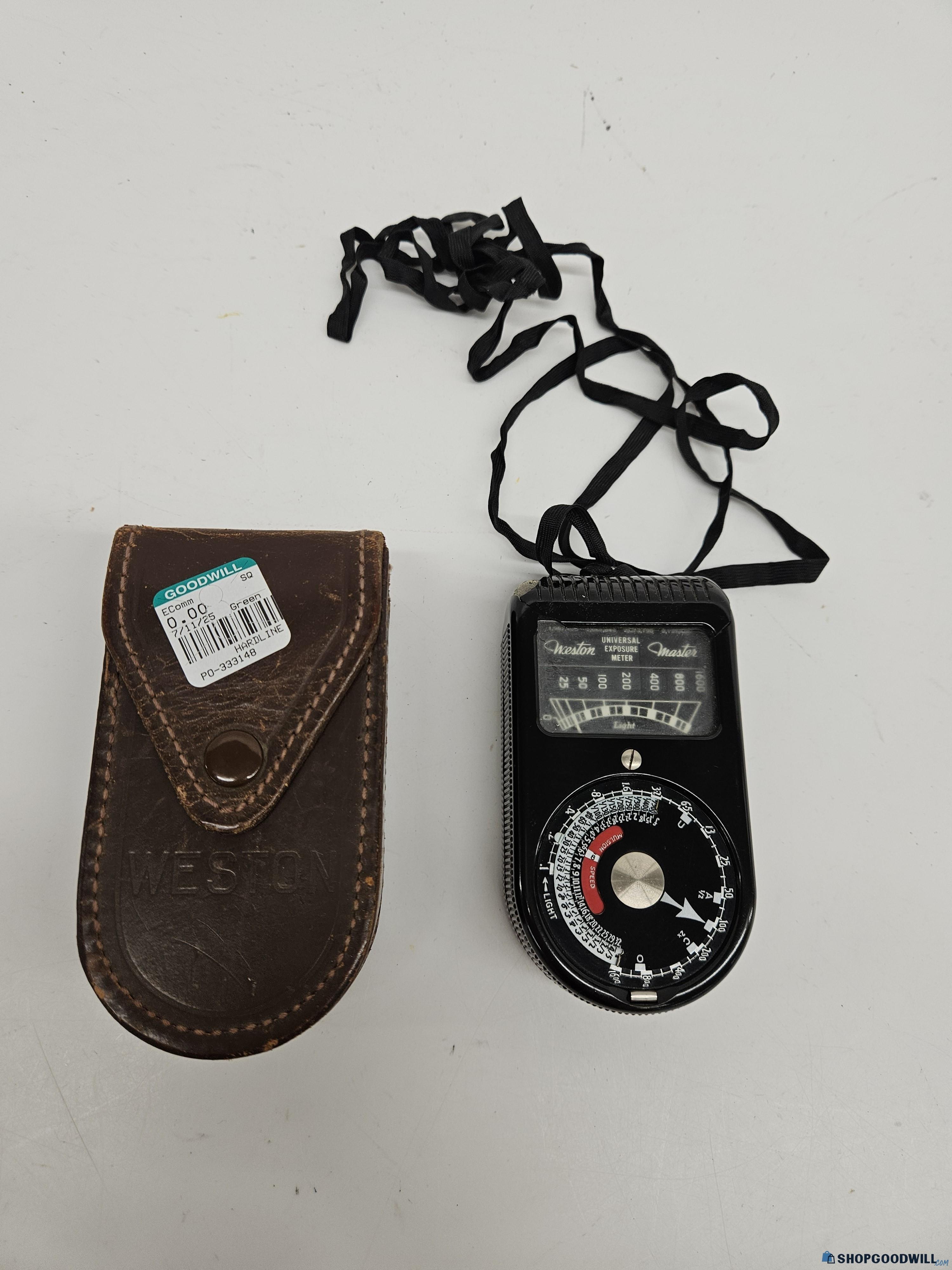
Repairing a bargain Weston Master

Coldkennels

Barnack-toting Brit.
Local time
10:39 AM
Joined
Feb 26, 2011
Messages
1,800
Location
Tunbridge Wells, England.
Today's chance find in a junk shop in Rochester: a hideously overpriced Weston Master III, in case, with the needle completely stuck and non-functional.

Cosmetically, it was in great shape, so I showed the owner that it was not useable (she laughed when I pulled out a Weston II from my coat pocket to compare!) and talked the price down a bit. I figured that in the worst case scenario, I could harvest the body shell to fix up a very battered Weston III with a working cell.

After getting into it (the "security screws" holding the name plate on the back were pretty well seized and stubborn to remove), it turns out the only issue was a loose front glass pinching the needle and the floating pivot was slightly out of place, causing the electromagnetic coil to catch on the magnet at a certain point in the meter's travel.

IMG_1816.JPG

An hour's work and this will be good as new once the new glue for the glass is cured and the case goes back together. These UK-made Westons are solid - in fifteen years I've only ever seen one with a cell that was truly dead.

IMG_1817.JPG

The zero point isn't perfectly adjusted, but this is already close enough to my "known good" Weston II that I think it'll be bang on the money.
 
I have an old Weston II, but I'm not sure if it works. Been a while since I've had it out to photo it. Honestly don't think I'd actually be able to figure out how to use it either.
View attachment 4882901
As long as you can check how the Weston number relates to ISO when you set it they're much the same as the later Westons, if that's any help?
 
Have you ever gone into a EuroMaster V? I dropped mine a couple of years back, and could only get so far dismantling it.
Didn't you start a thread about that? I thought you went in the same way as every other model (remove back plate, remove screws holding back half on, remove three screws underneath back half holding the front half in place), but I seem to recall there was something about having to remove the dial (which you don't have to do on the early models). I personally stick to Westons before the IV came out - the III is the best of the batch, with a much clearer dial than the I and II, but they're all a lot more solid and dependable than the IV onwards. And that's because...

I don't remember, are you supposed to leave a later Weston (IV,V etc) with the needle locked or unlocked?
That needle lock is a problem. Leave it unlocked - it's far too easy for it to get stuck in place. It also bends the needle slightly, from what I remember - and if it gets too bent, it ends up catching on the internals and not moving freely. I've had to repair a few with this issue over the years.

The back case of this Weston III has a date of May 1962, which is some time after the IV was introduced (1960, according to The Masters | John's Weston Meter Collection), so there was obviously some continued production and demand for this model. I'm always impressed to see that they're still working as well as the day they were made.

IMG_1818.JPG

I have an old Weston II, but I'm not sure if it works. Been a while since I've had it out to photo it. Honestly don't think I'd actually be able to figure out how to use it either.
With the baffle on the back closed, cover the back of the meter with your hand and hold it upright and horizontal (like the Westons positioned on the shelf in my original post). The needle should sit exactly at 0. Then, pointing the meter towards a light source, remove your hand and the needle should move freely upwards. A bright cloudless sky in early afternoon on a summer's day should get you a direct reading of 400 on the meter's scale, but this time of year you'll be lucky to get a direct reading of 100 in most places. Once you know how it works, you can compare it to a "known good" meter to be sure.

Everything else is covered in the PDF copy of the manual here: Weston Master II Model 735 light meter instruction manual, user manual

Just remember that on the Weston II, Weston speeds were two notches below modern ISO (64 Weston = 100 ISO). From the III onwards Westons are only one stop out (80 Weston = 100 ISO). I suspect a lot of claims of inaccuracy come from people who don't know that, but I do have a working theory that the black-faced US-made Westons like yours are far more prone to failure than the white-faced UK made ones like mine. Almost all the reports of totally dead ones come from the US, but I've picked up countless Westons of all ages in the UK without any issues (barring mechnical ones like this).
 
Hmm, I can see I am going to have to go back in to work out where I got stuck last time. That thread digressed about the time someone told me I couldn't have a Euromaster because the back was black...
 
Coldkennels, I have a Weston IV. Is what you said true for the IV as well? Is the ISO off? Just curious. i have a drawer full of meters so I barely ever use it but it is fun to pull it out every now and then and use it with the Leica I have.
 
Coldkennels, I have a Weston IV. Is what you said true for the IV as well? Is the ISO off? Just curious.
Yep, even the V is one notch out (320 ASA = 400 ISO). You can see this in the photos @Dralowid has just posted - with the Weston V set to 400 ASA, pointing the arrow on the dial directly at one of the readings on the scale will give you odd combinations like f/8 and 1/5, but setting it to 320 ASA will give you more common combinations (for the era, at least) and correctly aligned Exposure Value readings.

I always thought this was down to the changes between the 1950s/1960s ASA scale and the modern ISO values (ASA was "bumped up" from 320 to 400 at some point in the 60s), but the Weston V has DIN values that correctly correlate with the ASA reading (27º DIN equals 400 ASA after the shift) and DIN hasn't changed, so I can only assume that this was Weston not quite making the jump from their own proprietary Weston values to ASA correctly - or, alternatively, as Dralowid's scan suggests, ignoring the manufacturer-assigned ASA ratings and issuing their own!
 
Last edited:
Back
Top Bottom