Reversal TRI-X Film? (Daido Moriyama)

antiquark

Derek Ross
Local time
1:46 PM
Joined
Nov 11, 2006
Messages
1,494
Location
Winnipeg
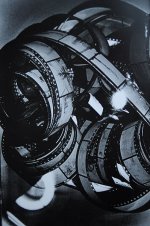
This is a picture from Daido Moriyama's book, "The World As I See it." It sort of doesn't make sense. The numbering on it indicates that it's TRI-X, but it appears to be a reversal film, not a negative.

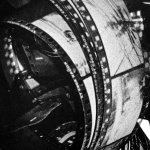
For educational purposes, I've included some crops to show what it looks like. In the second picture you can barely make out that it's KODAK 5063 TX.

I don't think the whole image is inverted, because the shadows and hilights look normal.

Maybe it's a sort of "rolled" contact sheet, in which the contact is done on another roll of film?

attachment.php
attachment.php
 

Attachments

  • --DSC_0962.jpg
    --DSC_0962.jpg
    97 KB · Views: 0
  • --DSC_0965.jpg
    --DSC_0965.jpg
    137.9 KB · Views: 0
There was indeed a sort of contact printer thing used in newsrooms before the film was cut. After the automatic exposure, the paper went through a processor and came out dry.

These strips could be from that sort of machine - I can't remember a name for the machine though.
 
Thanks! It would be interesting to find out what the procedure was called. Googling for "contact print roll" (and things like that) didn't give anything useful.
 
I only remember seeing the machine in a tv-documentary about a press darkroom - and I can't recall the name of that either, as it was about thirty years ago . . .
 
These strips could be from that sort of machine - I can't remember a name for the machine though.

A sheet wise dry to dry press contact proof process was marketed by Agfa Gevaert ages ago - it may have been part of the Copyrapid family of products, I remember that the fresh prints had an distinctive alcoholic smell like the Copyrapid halftone proofs. I haven't ever seen that in strip wise though.
 
Paper Prints - quote from the link below...

"These paper prints exist because of an interpretation of the copyright law at the time that motion pictures were invented. That interpretation said that a motion picture film is simply a series of still photographs and therefore the still photographic copyright law applied. If you wanted to copyright a motion picture, you had to provide the Library of Congress two copies of the film, and they had to be on paper—not film. Thus a process was invented to literally create long strips of photographic paper, exactly the size of 35mm film stock. Contact prints from the original 35mm negatives onto those long strips of paper were then deposited with the Library."

http://www.amiaconference.com/techrev/V01_02/papers/weismann.pdf

Casey
 
Paper Prints - quote from the link below...

"These paper prints exist because of an interpretation of the copyright law at the time that motion pictures were invented.

Nice discovery. But I doubt that it is the thing in question. A briefly used motion picture technology created to satisfy US specific requirements which became extinct soon after 1912 is rather unlikely to have silently survived in Japanese press photography for another sixty years.
 
EDIT: Although it only lists 8 and 16mm applications.

I've shot tons of Tri-X in either format during student days. But there was no 35mm reversal film (whether Tri-X or any other name) at that time (early eighties), and I never heard of one either, which makes it very unlikely that it existed a mere decade earlier. Besides, these are obviously 24x36mm images, not motion picture 18x24mm.

But anybody could (and can) of course reverse develop photographic Tri-X.
 
I think I mis-spoke with my original post. I just noticed that it doesn't look like reversal film at all. If it was, the white parts would actually be transparent, not white. So it looks more like a paper print that's perforated, in a long strip.
 
I think I mis-spoke with my original post. I just noticed that it doesn't look like reversal film at all. If it was, the white parts would actually be transparent, not white.

WET b&w reversal sometimes looks like that - the reversal etch used in some processes can leave the emulsion foggy until it dries.

But I agree, it probably is paper - and probably some professional rapid proofing process.
 
Last edited:
I remember recently someone showing me proofs from their wedding in the early seventies and instead of conventional contact sheets they were in long continuous rolls that looked exactly like those.
 
Contact prints on paper strips w/ sprocket holes were quite common in the 1960ies and 1970ies. I recall that it was standard practice in Germany if you had BW film developed to receive both the negative and contact positives in full-length strips rolled up in cans.
 
Newspaper darkrooms were heavy users of Kodaks' Ektamatic processors which processed developer incorporated papers. Think of single weight fibre paper...really nice actually. The image would eventually disappear over time if the print wasn't fixed and washed etc.. Some papers would print the entire roll uncut for editing. Ours would cut them as usual and make a trad contact print.

You can still find these machines on eBay but not sure about the chemistry and one could theoretically run some rc paper through it.
 
Back
Top Bottom