Thank You very much.
Another question, I have a Rolleiflex that appears to not have that bellows going around the lens. Why did Rollei resort to using that because it looks like a lot has to be taken apart to replace the bellows?
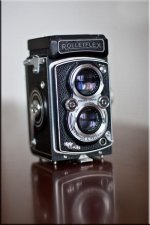
I have attached a photo of my Rolleiflex that doesn't appear to have the bellows. I paid little for it and it operates like it has had little or no use or a terrific re-build before I bought it!
Thanks!
I can't tell you why Rollei tried the bellows. There may have been an 'historical moment' thing going on with the 2.8C? The first 2.8 used a pre-war Tessar lens. The 2.8B with the Biometar didn't go far- not certain of the reasons. Maybe it was Zeiss's slow return after the war? During this time Rollei continued with the K3A with minor changes from the pre-war design, and then made the K4 series, again with small changes.
So maybe the 2.8C was the first 'new' camera after WWII? So you had all this pent-up design energy, machinists happy to be done with making armaments, a desire to do something new. As I said before, the focus rails and mounting on the 2.8C are different than on previous Rolleis. And the models right after the 2.8C reverted to the pre-war focus rails. The plastic locks on the shutter and flash sync were new, and dropped for later models. The two posts projecting from the body which the lens board rode on were new, and disappeared for later models until fully realized in the F series (by the mid-50s, Rollei was simply not making mistakes like exist in the 2.8C).
And maybe the bellows were a 'solution' to a problem that didn't exist. But it was new and improved! The focus distance of the 80mm lens is different than on the 75mm lenses, so this might have been the crack in the door an impatient designer/engineer needed to propose a new system?
Well, this is all conjecture on my part.
Oh, I just finished restoring someone's Rolleiflex MX-EVS from this time. Smooth as could be. This isn't any great skill on my part, but a testament to the skill of the Rollei machinists and engineers. Cameras like yours represent a pinnacle of industrial age machining in my opinion. There are better-made cameras, but maybe only Leica combined such quality of workmanship with industrial-level quantities of production.