Semi-stand

KenR

Well-known
Local time
2:55 AM
Joined
Feb 14, 2007
Messages
842
After reading about semi-stand development here on RFF, I decided to try it. I've tried things on kind of an informal basis, which gave me some nice negatives. With the kind assistance of a Radiologist friend (who allowed me the use of the practice densitometer) I tried some sensitometry as well.
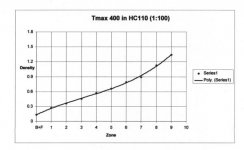
Tmax 400 was rated at box speed as I took different exposures of a white board in open shade from -4 steps to +4 steps. Processing was in HC110 at 1:100 dilution for 26 minutes at 68 degrees. Aggitation for 45 seconds initially and then 3 shakes at 9 and then at 18 minutes.
The enclosed H-D curve is interesting because it shows a slight upward bulge of the curve in the lower zones. This seems consistant with the theory that the shadows get a bit of extra development compared to the highlights using this method.
 

Attachments

  • Tmax400.jpg
    Tmax400.jpg
    17.6 KB · Views: 0
I use HC-110h and HC-110 at about 1:120. I have never done densitometer work, but I have used semi-stand and also minimal agitation with Tmax400 and Tmax100. My impression is that the shoulder of the curve you get is different. I feel, and again I haven't done testing, that the shoulder rounds instead of the shoulder that you show. When I did regular agitation I felt that the shoulder looked like the one you show. Here is someone that has done testing with, and this is Rodinal, Tmax100 with regular agitation and minimal agitation. This is a interesting subject, and I really can not find very much written about it. I seems that stand and semi-stand really only benefit from reduced agitation and not so much from high dilution. But I'm a Monday morning quarterback, and would really like to hear more. Anyway, here is the post I think it is #12, and be sure to look at the H-D curve:

http://www.apug.org/forums/forum37/55796-tmx-rodinal-examples-2.html
 
H-D curves

H-D curves

The H-D curve that he shows with Rodinal is quite different, with a pronounced shoulder. Developer related? Dilution related? More experiments are needed?
 
Agreed, the Covington site implies that HC-110 with Tmax100 gives a H-D curve similar to your example. Here is the site and go down to 'Curve Shape.'

http://www.covingtoninnovations.com/hc110/

The strange thing I have found with HC-110h and Tmax100 is that even when I knew that the H-D curve indicated a propensity to blow highlights, it really never happened with my developing. I've used that approx. 120:1 dilution and developed for 38 minutes agitating every 5 minutes, and still no blow outs. (I even did 41 minutes once the only problem was increased density.)
 
Dilution effect?

Dilution effect?

The 20% difference between 1:100 and 1:120 may be enough to lead to exhaustion of the developer in the highlights and lead to the lack of blown out highlights that you and others have obtained. The whole reason why I started looking into semi-stand were the occasional "bullet proof" negs that were so dense in the highlights as to be quite difficult to print. I'll try a more dilute solution and see what happens.
 
Could be the dilution and hence exhaustion. I use 4ml per 500 ml of water. Some say you need 6ml of syrup (USA) for 36 exposure 35mm film, that comes out to be 3.96 ml to cover a 24 exposure. I have always felt I was in the safe range, especially as others say 3ml is enough to develop a 36ml exposure 35mm roll. The way it acts where I can just take as much time as I want and not get blow outs, maybe you are right or the solution is so weak it is working so slowly that I don't see the differences.

It is hard to find H-D curves of different film and developers, even on the Kodak site. I wish they were available, but I have read in more than one source that the Tmax film have a straight curve (some say linear). I was happy to see the H-D curve that I referenced in my first post. I had been working with Rodinal but agitating the common method. Again no testing, but I have Tmax400 really where I like it. I still use HC-110 for many of the films I use, and I really prefer it (it is just easier to use and a error is no a tragedy), but I do like Rodinal with Tmax400 and I'm zeroing in on Tmax100 and I have been using minimal agitation.

Other HC-110 experiments that I have done have been with Tri-X, again minimal agitation, but this time I got the method from Ansel Adam's book. Now this really controls highlights, agitate every 4 minutes.
 
Last edited:
Thanks for the tip on semi-stand developing with HC 110. I did run 5 rolls last night. Four were "old" Tmax 100 (expired in 1991) and a reference roll of Acros 100. All at rated sped.
The Tmax came out fine - the Acros a bit dense - but modifying the speed to 125/160 should fix that.
I have never tried the HC 110 as semistand (35min.12 ml/1500ml of water and a flip every 5 minutes).
This gives me hope for the 18-20 rolls of old Tmax 400 that is cluttering up my fridge!
The compensation could also work with Agfa Scopix and possibly with Tech Pan - will try that this week.
Too hot to scan at the moment - but will do the Tmax 100 later today.
I also need to load up some more IXMOO's with XX and try with this combination.
 
My preferred TriX combination, is HC110 in 1:100 semi-stand. 6ml per 600ml tank means your HC110 lasts a good bit. 🙂

And saving the highlights on hot chicago summer sidewalks is priceless.
 
Just uploaded 30 shots on our Flickr site done with the HC 110 semi stand.
The old Tmax worked well, the Acros 100 is a bit fried, but scanned OK.
Rolls F091 to F095 were done with this combination.
I will try some other films as the heatwave (+30C - which is REALLY hot for Vancouver) lingers. Maybe some tech Pan @40 and Fuji Minicopy at 20 iso - as well as some Tmax 400 that is left over from a project 15 years ago. Also need to spool up some XX in IXMOO's - should work well with that film.
 
Like rogue, my "standard" is a dilute HC110 with 400TX.

I use dil H (1:63), which is a bit more than 6 ml in 400 ml (one 135mm reel in a two-reel Paterson clone); like others have said, very economical. I'm not stand-ing as long as others, but it's at least very low agitation. Makes for a very relaxed session!

HC110h @70F for 25 min, agitation 30 s + 5 inversions every 5 min
Leica M4, Summicron 50/2 v1

2738532008_24c73f1e93.jpg


Cheers,
--joe.
 
I've never used HC110, but I gather Ilford LC29 is a similar product, and is a liquid. I've done a few rolls in LC29 1+100 1hr semi-stand with 30 seconds of inversions to start and one slow swirling for 15 seconds at 30 minutes. Results looked good to me. Just an option for those that can't get HC110! Attached example is PAN-F. Have also developed a roll of Kodak 2485 Traffic Surveillance film shot at 200 iso.
 

Attachments

  • BW169_01.jpg
    BW169_01.jpg
    99.5 KB · Views: 0
Last edited:
3766687392_1b117b26f5.jpg

This is my "test" root down on the beach! Nikon 105mm f4.0 Rf lens ( a bit of a rare beast = 3 elements and very light).
Acros 100 @ 100 in HC110 semi stand development according to Charjohncarter's formula. I did cut the time to 35 min as it was a bit hot in the darkroom.
 
Last edited:
3765887449_bf1856a191.jpg

Tmax 100, vintage 1991 and Heliar 50mm f3.5 (@ f4.0) on a Bessa R2S. Damned good lens. Again according to Charjohncarter's recommendation. Works very well with this film.
 
Last edited:
Lord Ansel also used a technique involving standing in water to exahust the developer in the emulsion.
Any experience with this technique?
 
Water bath development doesn't work as well with more modern, thin emulsion films. The few attempts I made didn't work very well, but others may have better results. Efke or Foma films may be better candidates than TX, TMX, TMY, etc.
 
I tried it some years ago with XX - it works fine. You have to establish your own "times" - I found that increasing the water bath time with a minute after two or three of them helped to lift the shadows. It works very well with old style sheet film (Plus X/Tri X).
I tended to use it with D23 or D25 - cant remember if I tried it with HC 110.
I would suspect that if a film works with a two bath developer it would work with a water bath. It is all a matter how much developer is absorbed into the emulsion initially.
 
Last edited:
Back
Top Bottom