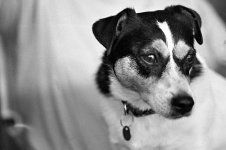
So I thought I'd give this developing lark a go

mfunnell

Shaken, so blurred
Local time
6:17 AM
Joined
Sep 23, 2006
Messages
2,595
Location
Sydney, Australia
So I bought a tank, some chemistry etc. fired off a roll (Delta 400) of mostly cr#p photos of a friends backyard & dogs, souped 'em in LC29 1:19 @ 20°C for 7.5 mins, 4 inversions per min, stop bath, Ilford Rapid Fixer 1:4. A few of the better frames are attached, and don't look too bad (scanned with Canon 9950F).

I think my only mistake was the final bath in distilled water and wetting agent - my impression is that distilled water alone might be better in terms of blotches that need spotting. I didn't need much adjustment on the low-ish res scans - just correcting dust and drying marks.

I also need some better workflow for figuring which negs to work on. Some sort of scan/check/proof-print.

Thoughts? Suggestions?
 

Attachments
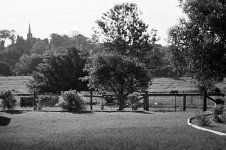
  • camden_backyard-1-weba.jpg
    camden_backyard-1-weba.jpg
    213.8 KB · Views: 0
  • jessie_dog-2-weba.jpg
    jessie_dog-2-weba.jpg
    145 KB · Views: 0
  • jack_dog-2-weba.jpg
    jack_dog-2-weba.jpg
    174.3 KB · Views: 0
Last edited:
I love the dog shots and it's excellent that you've done such a good job straight up!

I gave up on wetting agents and hang my films on one of those heavy duty stainless clips and carefully drag a chamois down them. I used to rinse them in wetting agent and let them air dry but found they were always covered in crap when I went to scan them.

Developing your own film is totally adictive I've discovered and has been the near death of digital for me. It's great to refine your process until you have it where you want it ... after getting less than satisfactory results with Neopan400 I persisted and listened to a lot of advice here and now I'm very happy with it. It took me ten to fiteen rolls to get to where I have it now ... for a while I was getting too much grain and too much contrast and just kept changing things a bit at a time until it was right!

It's a lot of fun and very satisfying to control the whole process from the time you release the shutter until you have the image there in front of you! 🙂
 
Keith said:
I love the dog shots and it's excellent that you've done such a good job straight up!

I gave up on wetting agents and hang my films on one of those heavy duty stainless clips and carefully drag a chamois down them. I used to rinse them in wetting agent and let them air dry but found they were always covered in crap when I went to scan them.

[...]

It's a lot of fun and very satisfying to control the whole process from the time you release the shutter until you have the image there in front of you! 🙂
Thanks, Keith. I'm fairly pleased with the first-time results. I'll add a chamois to my list of "things". A decent timer is the first item - my mobile phone countdown timer wasn't such a good idea 😱

I look forward to being practised enough to call it "fun". I was cursing the damned spiral inside the changing bag: all my test runs with a dud film went fine, but the first real one ...

...Mike
 
mfunnell said:
Thanks, Keith. I'm fairly pleased with the first-time results. I'll add a chamois to my list of "things". A decent timer is the first item - my mobile phone countdown timer wasn't such a good idea 😱

I look forward to being practised enough to call it "fun". I was cursing the damned spiral inside the changing bag: all my test runs with a dud film went fine, but the first real one ...

...Mike

Just a point with the chamois ... I use a synthetic variety, I think Kenko or someone make them. The real leather ones dont work as well and leave particles on the film and around the sprocket holes ... I think the leather is too soft and gets torn by the edges of the holes and of course the pieces wind up all over the film!

I can't deal with change bags at all I'm afraid ... I tried but my hands break into a lather of sweat instantly inside the bag and it all becomes impossible! 😛

ps ... I just use on of those very cheap timers you buy from kitchen stores ... I think mine was two dollars from memory!
 
Last edited:
Keith said:
Just a point with the chamois ... I use a synthetic variety,
Point taken. I'd already decided the one I use for the windscreen would probably be a bad idea 😀

I'll have to see how I go in the long haul with the changing bag. I don't think I can really do without it, though, as any form of darkroom seems way too hard in terms of space.

...Mike
 
Nice job on this.... nice tones and all! When I first started processing, I read as much as I could on agitation, dev times, etc... then I realized that the only way to really learn it is to do it yourself and have "your own" way of doing things and then going from there....
Enjoy the processing thing... it can be quite meditative.
 
What's the punchline to the joke about what you call 1000 lawyers chanied together at the bottom of the ocean? (Answer: a good start.)

I'd say you're off to a great start. And, when you're a bit tight on space, a changing bag are is your friend. Some are better than others, however, so don't go too cheap on one if you're planning to use it a good deal. I'd gotten back into souping my own a few years back, just before moving in with galfriend, and I'm still getting my bearings again, post-move, but the changing bag means almost-anytime, anywhere developing. (I do need to set up my electric film dryer someplace, though.)


- Barrett
 
I didn't think wetting agents were useful when I was using a squeegee but once the squeegee started scratching the film, I turned to the wetting agent and it does a great job of keeping most all of the dust off.

anyway, nice work
 
Very nice pictures- I'd say you're off to a great start. I'd be happy to get scans like that at all, never mind right off the bat. Your negs look like they must be pretty good, so I'd say don't fix what isn't broken; but if you want to re-visit wetting agent, remember, less is more. I use a few drops (less than half a teaspoon to the gallon) in distilled water. Don't squeegee, just hang to dry. If there's any time you are likely to really damage your negatives, it's when they are wet- the last thing I would do is drag anything down them, no matter how soft a thing or how carefully you can do it. Keith, if this works for you, great, ignore my advice, but I implore you to stop doing this before you regret it; and mfunnell- don't start. Fix your wetting agent situation.
 
mfunnell said:
So I bought a tank, some chemistry etc. fired off a roll (Delta 400) of mostly cr#p photos of a friends backyard & dogs, souped 'em in LC29 1:19 @ 20°C for 7.5 mins, 4 inversions per min, stop bath, Ilford Rapid Fixer 1:4. A few of the better frames are attached, and don't look too bad (scanned with Canon 9950F).

I think my only mistake was the final bath in distilled water and wetting agent - my impression is that distilled water alone might be better in terms of blotches that need spotting. I didn't need much adjustment on the low-ish res scans - just correcting dust and drying marks.

I also need some better workflow for figuring which negs to work on. Some sort of scan/check/proof-print.

Thoughts? Suggestions?
I put my films through a warm shower as a last bath. It cleans better and allows for a good uncurling of the film.
 
Back
Top Bottom