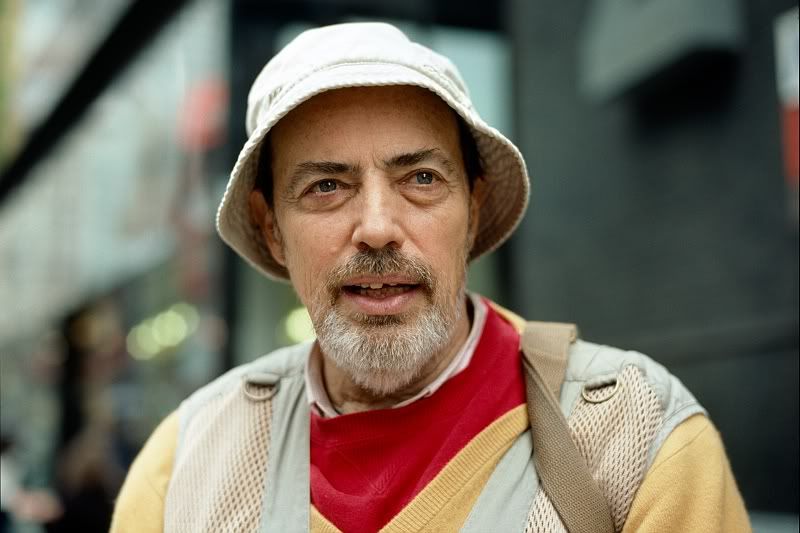
Strange Leica guerilla-style photographer on 5th Ave. NYC

I really like his work, his technique is a little intrusive, but if you're the type that absolutely needs personal space I kind of doubt new york city is the place for you. I'd be more annoyed walking through little italy having menu after menu shoved in my face than the slight chance of being "accosted" by this guy.
 
ae53a510.jpg


The thing I noticed is that he is not looking at the person he is listening/talking to but looking behind him for another face/target/victim. Always working I guess.
 
I enjoy his work. I don't think his working style is as aggressive as some make it out to be. He likes photographing "tough guys." He'd be a little worse for wear if people were really offended by his actions. If you watch some of the photo essays on the Magnum website you really get a different perspective on his own attitude toward his subjects--I find it quite respectful. I googled this short interview with him and found this interesting response.

EGG: What advice can you offer other photographers?

BG: A lot of people who come to photography come to it with baggage, and they can't get beyond their own baggage that they bring with them. For example, when I was in Haiti in 1984, I passed these funeral processions. I got out and I started to take pictures, but I was very cautious because I didn't know how the people would respond. Then, after going to the cemetery over several weeks, I was able to even try my flash because I found that most people didn't mind. And I think that's a very good lesson. In your culture it may not be done. In another culture they may love it. The people in Haiti, they don't get dress up all the time and they couldn't afford to have a camera, so many of them asked me to photograph them at the cemetery or the burial. "We'd be more than honored," they'd say. So that's a very important lesson. You know, the world doesn't just revolve around that one person. And it doesn't revolve around me either. I've traveled the world. And that's one thing I've realized. When I've spoken about photography, I always tell the people that the best advice I can give you is to be yourself and to photograph what you're comfortable in doing. And I think that's the best answer.

It is from americansuburbx.com
 
I've not looked through much of his work, but his method makes sense, I don't think I have the balls (as someone else said) to do that. I work in an environment where if you're using a flash, it's customary to say 'flashing' first, that aside, I never, ever use a flash because I find them obnoxious.

The alternative is to be creepy I guess. You could try to stealthily shoot people but you wouldn't get the shots Gilden is able to get, the flash guarantees him enough light for every one of his shots so that he essentially doesn't have to focus. In the time it would take you to focus without the flash most people would become aware of your presense. He's about to just lift the camera and snap, like a point and shoot.
 
I have mixed feelings about that. I find some street photography by famous photographers quite superficial as well - in particular the one based on visual puns, juxtapositions or on surprise-effects.
Some street photographers on the other hand are extremely good at revealing aspects of the human condition that we might need to be reminded of, often with deep psychological and emotional insight - which is one of the points of art imho.


Still I think street photography is superficial. Not because the public sphere is superficial but because most of the street photography I see is a somewhat random accumulation of pictures that rely either on visual puns, complex compositional structure or 'characters'. And I don't mean flickr street photography, I mean the photography done by well known photographers.
I must admit that the further back the street photography dates, the more I'm interested in, mainly for historical reasons.
 
I must admit that the further back the street photography dates, the more I'm interested in, mainly for historical reasons.

I find that the older the street photography the more interesting it is. It serves as a reminder of the way things used to be. Take a look at a photo of any major city in the US from the 70's, it was a totally different world. To those of us that were alive it is likely to bring back fond memory's, to those that were born after that time, it's almost an alien world.

Zane
 
I very rarely will take candid photographs of people who are* homeless. More often, I will talk to the person for a while, and then ask for permission to take their photograph.

On the other hand, I do take pictures of people reacting to (or trying not to react to) homeless folks. Those pictures are often far more revealing, and I never ask for permission in those cases.

*More accurately, who I presume to be homeless. The assumption that one can always tell, by grooming or clothing or other cues, is frequently incorrect. Not to mention rude. At any rate, my working assumption is that people who live in vulnerable social or economic conditions deserve more courtesy — not less.

a good set of "street rules," well put
 
I've never seen a pic of Gilden until now and I can see why he gets away with it ... he has an open engaging demeanor and if someone like that took my photo in the manner he uses, especially wearing that hat, I wouldn't feel threatened.

I think Winogrand had a similar quality.
 
If street photography means taking photos of people in public places whether that be the streets of a large city or in a suburban park or a small town bar in the middle of nowhere, than I am all for it. Great street photography can be found in may other places in the west other than the intercity streets of large metropolises. And the best of street photography captures real unposed human expression and existence. Unlike so many other types of photography and I truly believe that any of the members of this forum that think "street" photography is superficial need to find another place to post on the internet or a serious education in photography history- Kievman


Nikkor 14 mm @ 5.6 ISO 1250 1/2 second exposure on Nikon D3 with SB-900 TTL cord.

Last week I shot several rolls using this tech.

I haven’t picked up the film yet but already, I can tell you I am hooked. And judging from one night when I used my D3 and the Nikkor 14-24 and TTL cord and the SB-900 instead of the M7 and the 15 mm and the Vivitar 285 and TTL cord, I can tell you that I really like the results.

It's liberating using the flash and not worrying about focusing. There is an honesty in getting this close. So far with using this style, I have been mostly doing full-body shots with some environment in the photo. And because of the flash there is no question whether I took the photo or not. They know it, I know it. No deception.

I can see why some of the more timid and discreet photographers would not take to this style and be offended by those of us that go down this path. I admit that early in my photographic journey, I was much more "in your face" with my photographic style. Wide angle/flash, up close and personal.

Here is a sample of my new work. I am really excited about my street photography and really want to explore this style of street shooting in the near future.
 
Last edited:
Didnt read the whole thread but here is a video of Mark Cohen using the same method

http://www.youtube.com/watch?v=cOr5MHlJQUA

His style of shooting seemed slightly more impersonal to me - watch at about 2:10 when he's stood next to the business man - as soon as the man looks directly at him, he ducks away. The difference between Gilden and Cohen seems to me to be that whereas Cohen seems not to want to be seen, Gilden actively interacts with his subjects, something which he openly admits to himself
 
Back
Top Bottom