The purpose of extreme wides?

My personal view is that they (wider than 21mm) are exceedingly useful on a very infrequent basis, but a waste of time the majority of the time. As I say, a personal view!

I think it unwise to work too hard 'to make super wides work' unless they are clearly the tool for the job, otherwise you end up with lots of gimmicky looking photos with the same in your face oddness but no real depth or enduring quality. It 's a quick visual rush of sugar with nothing left 3 seconds later.

Use them with care. By far the best shots I have seen on super wides are where the perspective is not immediately obvious i.e. where style, content etc are still the dominant visual qualities.
 
I find a 21mm invaluable for man-made structures or urban environments, but I find my 35mm is plenty wide for anything 'out' in nature. I see some wonderful ultra wide nature shots, but I haven't gotten too many keepers...

Zeiss ZM C-Biogon 21mm:

6820083449_ab55361ea1_z.jpg


6779593941_f109aa8c49_z.jpg


6540229689_0637259346_z.jpg
 
capture the mood of an environment


brooklyn bridge by Marcelo Colmenero, on Flickr


sunset in oia by Marcelo Colmenero, on Flickr


quite a drop by Marcelo Colmenero, on Flickr


merry-go-round by Marcelo Colmenero, on Flickr


é campeao! by Marcelo Colmenero, on Flickr


saveiro espaçosa by Marcelo Colmenero, on Flickr

make everything fit...


barragem canal 3 by Marcelo Colmenero, on Flickr


my cage by Marcelo Colmenero, on Flickr


the colors of greece by Marcelo Colmenero, on Flickr

or go for different angles


ant cam by Marcelo Colmenero, on Flickr


free candy by Marcelo Colmenero, on Flickr


pilotecks by Marcelo Colmenero, on Flickr


A by Marcelo Colmenero, on Flickr


standup kebabomedy by Marcelo Colmenero, on Flickr
 
I think it unwise to work too hard 'to make super wides work' unless they are clearly the tool for the job, otherwise you end up with lots of gimmicky looking photos with the same in your face oddness but no real depth or enduring quality. It 's a quick visual rush of sugar with nothing left 3 seconds later.

Use them with care. By far the best shots I have seen on super wides are where the perspective is not immediately obvious i.e. where style, content etc are still the dominant visual qualities.
Exactly!

Cheers,

R.
 
By far the best shots I have seen on super wides are where the perspective is not immediately obvious i.e. where style, content etc are still the dominant visual qualities.

Isn't that true for pretty much any photo (the bit I made bold)?
 
I was never fond of super, super wides because of the distortion. 28-35 was always the zone I preferred. That has changed since I got my hands on a SWC. A 21 with zero distortion (yes, when used with consideration) on medium format? Right into the story... Smelling the emotion and feeling the hearts beat. A very effective way to work on some occasions.
 
I started out with a CV 21mm for some interiors. It did that well, but often left me wondering what the CV 15mm would be like. So eventually I sold the 21 and bought a 15, and now there's no going back. My normal is a 50mm, so I find it pairs better with a 28mm and a 15mm, so that is what I have settled on for my kit. I don't use the 15 often but do have fun when I do:

21mm
4822311100_69d86fb884_z.jpg


15mm
5275125380_89859e10e3_z.jpg


6036179367_116a533776_z.jpg


Cheers,
Rob
 
The 15-21mm range seems to be very popular around here. I am being curious as to what you guys are shooting with these extreme wide angle lenses .... I believe that some of you are actually using these lenses for everyday walk around lenses, and I would like to know what kind of scenes you shoot with them - and any other usefull information, tips&tricks for extreme wides.

i use them to shoot low and/or close. the results above tell me i need to rethink my approach 🙂
 
I originally bought mine for shooting interiors, especially for a book on the American Civil War. Then I started to use them for other things. But generally, unless you have a specific use for something, it's not a good idea to buy it, i.e. if you have to ask what it's for, you don't have a use for it.

Cheers,

R.

Roger - I just think you cured my GAS 😉

Never the less, I´ll go and use the CV zoom set at 19mm for a while and see what happens. At least there is a lot of inspiration in seeing the photos in this thread - thanks 🙂
 
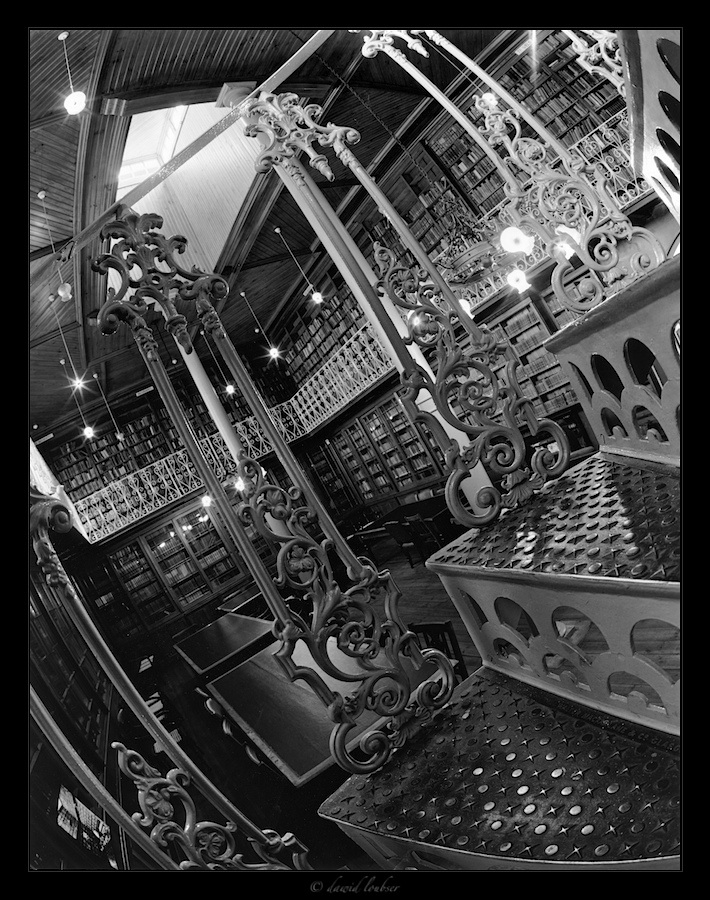
Ultra (or ultra-ultra-ultra) wide lenses, like the Mamiya 37mm I have used here on 6x7cm film, are great for careful interiour compositions:

haunted_africana_library_by_philosomatographer-d4dbtba.jpg

(Ilford Pan F 6x7cm, 12x16in darkroom print)

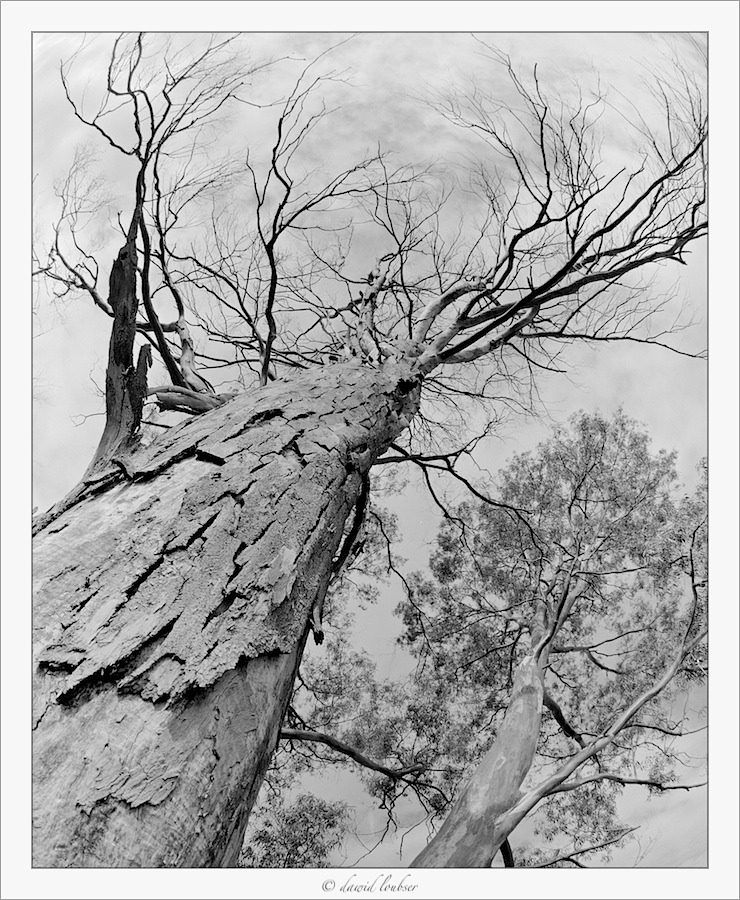
Or for dramatically altering the impression of familiar objects (there is nothing very special about these two trees seen normally):

dry_and_drying_by_philosomatographer-d3clb1b.jpg

(Ilford HP5+ 6x7cm, 12x16in darkroom print)

Most people go to earth's ends to get (and brag about) ultra-wide lenses with no distortion. They forget that such lenses grotesquely deform and enlarge objects close to the edges of the image (just look at the Cosina Voigtlander 12mm images in this thread!)

The Mamiya 37mm fisheye is of course much wider than the CV 12mm, but for my work - when such a wide angle of view is called for - I definitely prefer the much more natural distortion of the full-frame fisheye lens. If you compose carefully, and ensure that the straight lines pass through the centre of the image, images that are both striking, and natural, can be obtained.

Mind-bending 12mm or 15mm rectilinear images always challenge my eyes (or brain, I guess) - they serve to disorient the viewer. I challenge you to call either of the (radically wider) images above, both of which are very non-level, "disorienting". Anyway, I just want to throw the fish-eye option into this discussion, since we're talking ultra-wide.

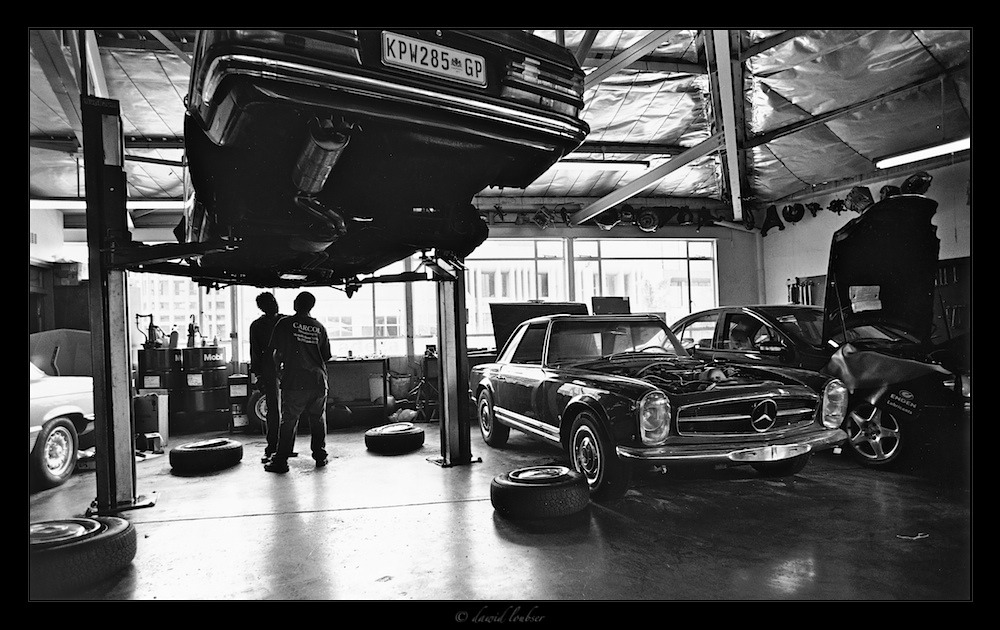
For rectilinear, the widest I go is a Zuiko 21mm on my Olympus OM SLR (35mm film):

the_specialists_by_philosomatographer-d37vqba.jpg

(Kodak TMY400-2 35mm, Zuiko 21mm f/2.0, Olympus OM-3Ti, 12x16in darkroom print)

The Zuiko wont best the Rangefinder 21mm lenses, but it certainly eats most SLR 21mm lenses for breakfast. And it's actually smaller than a (slower) Leica M or Zeiss Biogon 21mm f/2.8 rangefinder lens - an amazing feat that will probably never be repeated.
 
Back
Top Bottom