The quality of light where you live.

Seem to catch quite a lot of overcast and cloud as I live at the mouth of a glacial valley. Half a mile in any direction and the light always seems very different. Two miles away on the open coastline the sea seems to dictate the light. For the last couple of years our weather seems to have been wetter and cloudier - open skies and bright sun are the exceptions.
 
Living at the Gulf of Mexico coast offers me plenty of awesome light conditions throughout each year. No complaints here.

I agree, except I do hold to the line about "mad dogs and Englishmen" and, not being either a mad dog or Englishman, I tend to avoid the near noon lighting. Occasionally though, the shadows thrown at that time will work for a particular image. It never gets particularly hot here (records are around 98-99F and summer norms are 88-92F) and most of the time it's T-shirt and shorts even in the dead of winter (makes shooting easy as no gloves are needed). Still, the sun beats down hard at mid-day in the summer and is still very high in the sky in the winter.
 
Washington D.C., same latitude as southern Spain, Southern Italy, Northern Africa.

Love the light here: it's sunny most of the time, even in winter, with occasional snow storms and virtually no Spring/Fall. 9 months of summer with great light and dramatic clouds from time to time! 😀

I also spend significant time in Argentina, which has the best light I have ever seen. The sky is so crystal clear (no pollution!) that you get pitch black skies with a red filter and B&W film and no contrails due to a lack of air traffic:

995378295_1000pix.jpg
 
Thanks Bill.
The question was intended to get others to describe the type of outdoor light in their location.

I've lived on the Texas Gulf Coast all my life, and I shot a lot in high school / college, but only now am considering the seasons and the type of sunlight for the 2 seasons here: summer / not summer.

What are you photographing? It sounds like scenes, is this what you are asking with your question?
 
I've already posted, but one thing I remember about Panama' vs Northern California is twilight. There is very short if any twilight at the equator, in NC we have a good hour in the evening. Also the same in the morning if I ever get up and out that early.
 
Thanks Bill.
The question was intended to get others to describe the type of outdoor light in their location.

I've lived on the Texas Gulf Coast all my life, and I shot a lot in high school / college, but only now am considering the seasons and the type of sunlight for the 2 seasons here: summer / not summer.

Here, the air is quite clear all year. There is some moisture haze at times but there is very very little air pollution. Distant horizons can get hazy (they are all water as KW is a small 2x4 mile island), but not always.

I seem to remember 4 seasons in Beaumont, but Sprint and Fall lasted for only a few days each. Here we have two, wet and dry. The wet season is a bit cooler than the dry, with highs often in the 70s F.
 
I'm in the northeast kingdom of VT, the northeastern corner, about a half hour from the Canadian border. We have lovely light all summer, and in the winter we are blessed with enough cold to make the air crystal clear. That is when the sun shines. Much of the winter is grey here. That starts around now. I usually shoot a lot of HP5+ from November till March. Giving ORWO N-74 a run this year.
 
I live in the Columbia Basin, central Washington State, east of the Cascade Mountains. This area is northern desert or near-desert. The sky is typically a light blue color, more often than deep blue, so the light tends to be on the cool side.

I am long-time slide shooter, so color temperature is a significant consideration and I normally use a warming filter (81B) during the daytime. At one time I could buy Ektachrome that had a warm bias, sparing me the need to use filtration.

I don't use a warming filter in late afternoon/evening or early morning light, which is naturally warmer in tone.

I also use an 81B for window-light indoor photography.

- Murray
 
Sweden. During the summer months it never really gets dark at all, sun really just dips below the horizon for a couple of hours. Pretty much the opposite during winter.
 
I live in the Tennessee valley where we have dust and heavy pollen trapped. I'm a pilot an when flying above 8,000 ft a brown layer of dust and pollen is visible. The prevaling wind blows across the ridges from the north west but if it shifts to the north east or south west the Krud is swept out of the valley and the air clears.

General the sunny 16 rule doesn't work well here due to the Krud blocking about a half stop of light like huge neutral density filter. I use the sunny f12.5 rule.

Right now we're dealing with smoke from multiple forest fires and only have hazy to overcast skies.

Summer skies often are hazy with soft shadows unless we have a clear day then we have harsh contrasty light except early morning and late evening. Early and late light are by far the best.

Winter light is harsh with clear skies.

Imo the prettiest light I've ever photographed under is the morning light around Point Lobos California when there's a low fog off the ocean over the area. The ceiling is about 100-200ft with highly diffused light. It's much like a huge softbox just over your subject. It's warm and wraps around the subject.
 
I'm in northeast Texas and the light isn't much different to your location. I did go for a walk with my camera around noon and noticed how long the shadows were cast. November through January are about the only time mid-day photos look good and then it depends on the direction of light relative to subject (doesn't always? 🙂 )
 
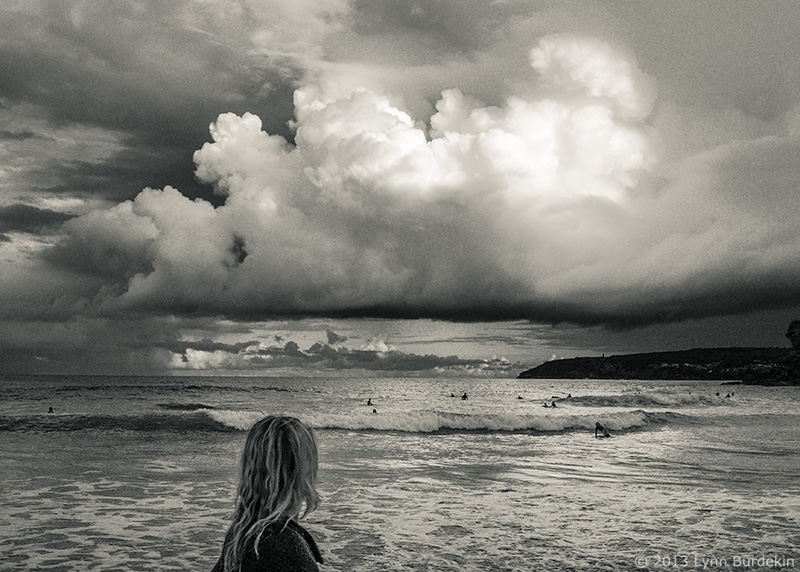
Sydney has the same latitude as LA and similar light, apart from higher humidity and more cloud along the coast, making things more interesting. Summer light is harsh. Late summer brings spectacular afternoon thunderstorms with highly reflective towering cumulus. Autumn and spring are sublime, often crisp and clear, interrupted by occasional cold fronts bringing gusty wind, storm clouds and rain. Winter a mix of good clear light and rainy/stormy periods.

Summer and spring frequently bring a blanket of smoke haze from bushfires or controlled hazard reduction burning, giving strong orange light (just like an orange filter) and reduced visibility.

I used to photograph almost exclusively early or late in the day during the warmer months (and anytime in other seasons), but since going back to film I've had much more success with the contrasty harsh light during the middle of the day.

This is bushfire smoke being blown out to sea during the fire season:
U27021I1382186571.SEQ.0.jpg


Typical late afternoon summer storm. The clouds make good reflectors.
U27021I1365253817.SEQ.0.jpg


Late afternoon summer sky, around sunset
U27021I1351929723.SEQ.0.jpg


Winter: more delicate light, great for portraits
U27021I1308274709.SEQ.0.jpg


Summer: harsh light but film can tame it. Often a boring bright pale blue sky.
med_U27021I1475752110.SEQ.0.jpg


med_U27021I1450274533.SEQ.0.jpg


late afternoon in summer brings better light, uncoated or single coated lenses can help soften the remaining harshness in the light (this is with a Steinheil-Cassar 105mm f6.3 uncoated)
med_U27021I1456397652.SEQ.0.jpg


Apologies I've probably overdone the images 😱

 
I'm in Northwest Louisiana so I'm near Texas, Arkansas and not too far from Oklahoma. Spring and fall are the best seasons for shooting around here--it's generally clear with nice directional light early and late with deep blue skies on the best days. Summer is hot, humid and hazy a lot of the time and winter skies are frequently featureless and white, good for some photos but sometimes hard to work with. Still, it's all manageable. I've gotten some very good and some very bad photos in all types of light.
 
Here in Charlotte NC (outer southern suburbs) the early morning light and evening light seems much sweeter than when I lived in a more northern latitude (St. Louis, MO inner suburbs).

It's much greener here too with more diverse foliage. Of course there are flat winter days with terrible light... but they're less frequent.

Harsh m--day light seems about the same.
 
The light conditions in Maine are quite variable through the seasons and in different weather, but much like as in Vermont as discussed above. One special kind fo lighting that I like is when we have snowcover in the winter: on overcast days in the winter the snow bounces the limited skylight, fills shadows and makes trees, architecture, etc, look very different than in more contrasty conditions.
 
Portland, Ore gloom.
Beautiful and ever changing moods for black and white work.
But Fuji Pro 400H looks absolutely frigid.
We cope with coffee.
And Ilford FP4.
 
Denmark is about the same latitude as Labrador but with at milder climate due to the Gulf Stream and to being surrounded by water. Still, the weather is very gray and wet most of the year. In winter time at high noon you sometimes have to go for ISO 800 if you want to shoot hand held. In good weather the sunrises and sunsets can be really amazing. It is hard to plan a shoot - you might start with blue, sunny skies and 10 min. later it is pouring down.

med_U29503I1385920662.SEQ.0.jpg


The changing weather conditions sometimes provide some interesting light.

med_U29503I1340720700.SEQ.0.jpg


U29503I1295095014.SEQ.0.jpg
 
I live in northern Michigan about 35 miles from Lake Michigan, which puts me smack dab in the middle of the “lake effect” zone. Now that autumn is here, cold, north winds blowing over the warm waters of Lake Michigan generate clouds. A lot of clouds. Pretty much, we won’t see much sun until next March. On the plus side, heavy overcast is great for many outdoor pics. Very little contrast.

Jim B.
 
Back
Top Bottom