
This could be fun - Univex Mercury II

kb244

Well-known
Local time
11:10 AM
Joined
Dec 13, 2006
Messages
623
Location
Grand Rapids, Mi
Got one of these in trade, bit of oxidation going on the surface but pretty sold shape and lens looks good. I loaded up a roll of BW400CN ( though I only had 36exp lol, so will have to shoot up 72 shots).

It's interesting, cuz like the Pen-F it has a rotary shutter, except this one always travels at 1/10th of a second and looking inside each speed just has a tighter slot.

I thought maybe if the shutter always moves at 1/10th of a second, perhaps at 1/1000th setting I might actually be able to get weird 'stretched' look when shooting moving objects gone across the screen quickly. Kinda like the old focal plane shutters that traveled slower but had tighter slots.

mercury2.jpg


mercury2t.jpg
 
kb244 said:
Got one of these in trade, bit of oxidation going on the surface but pretty sold shape and lens looks good. I loaded up a roll of BW400CN ( though I only had 36exp lol, so will have to shoot up 72 shots).

It's interesting, cuz like the Pen-F it has a rotary shutter, except this one always travels at 1/10th of a second and looking inside each speed just has a tighter slot.

I thought maybe if the shutter always moves at 1/10th of a second, perhaps at 1/1000th setting I might actually be able to get weird 'stretched' look when shooting moving objects gone across the screen quickly. Kinda like the old focal plane shutters that traveled slower but had tighter slots.

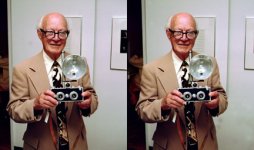
seton rochwite actually built his prototype stereo camera that later evolved into the stereo realist out of two of these univex mercurys...
 

Attachments

  • setonpairbydavidhutchison.jpg
    setonpairbydavidhutchison.jpg
    62.8 KB · Views: 0
Cool camera to tinker with!
All focal plane shutters use slit width rather than curtain speed above their flash sync speeds, and all can distort moving objects. The Univex's shutter may do it especially easily, being rather slow moving though.
Enjoy!
 
Bryce said:
Cool camera to tinker with!
All focal plane shutters use slit width rather than curtain speed above their flash sync speeds, and all can distort moving objects. The Univex's shutter may do it especially easily, being rather slow moving though.
Enjoy!

Well I knew that much, but thought was interesting cuz of the speed of it, I know most modern shutters are a bit faster to the point that you don't really notice distortion of that type.
 
Bryce said:
I've never actually noticed it in any of my photos...
Maybe you'll get some examples soon?

I aim to make it happen, I imagine it'll only be noticible in higher shutter speeds (500, 1000, etc) because the slit is much smaller, while the shutter still cycles at 1/10th, if it were any larger a slit I'd imagine that the subject blur would start to show up due to longer exposure per area of section.
 
Univex introduced the hot shoe, too, as far as I recall. I found two main problems with mine (sold long ago): the lens was lousy and the rotating shutter speed dial is easy to hang up (fingers and, I am told, long hair worn in a fringe -- a friend said she had this problem). The rest of the controls weren't super-convenient, either. Nevertheless, a very interesting camera, though I can't say I regret selling mine after playing with it a bit.

Looking at it, I can't see HOW I managed to hang up the shutter dial, but I'm pretty sure I did (it was over a quarter of a century ago).

Cheers,

R.
 
How do you like the one on the left.

http://www.nikonians-images.org/galleries/data/500/127190Cameras_1.jpg

It's a CC1500 with the very good Hexar 2.0.
In addition to the hot-shoe, it has a rangefinder, light-meter, rapid winder, and 1/1500th shutter.
The New York Camera Company's Univex Mercury's all used an adaptation of their movie camera shutter
(spinning wheel with a slit). The 'wheel' on the models CC and CX move at 1/10th second and the exposure is determined by the size of the slit.

In order to beat Contax (1/1200th advertised, not really achieved) cloth focal plane shutter, in 1939 they cranked the spring tighter and called it the CC1500. Unlike the Contax, they really did achieve 1/1500th shutter speed. However, the tight springs would usually break with moderate use.
 
Last edited:
These were popular in the 1950's in tourist areas. They used to have these little plastic "telescope" key chain viewers that took a half frame transparency, and Anscochrome was easy to process. Often the name of the hotel or resort was on the viewer.

The lens was so-so and the shutter not super accurate or quiet. The finish on the body ALWAYS corroded in short order. The hot shoe only worked if the flash could slide in from the front because the shutter housing was in the way. It was big, bulky, heavy, and it had no strap lugs. It had a lousy viewfinder, but most cameras did back then.

It wasn't a true "half frame". The negatives were slightly wider, closer to 8 X 10 proportion, and I think it got 65 frames per roll. It also didn't space the frames very well. They never overlapped but the space between frames varied a lot. Still, it was fun to play with for awhile and I had no trouble reselling it when I decided it wasn't for me.
 
Yep, this one is always fascinating to see, it has that Victorian "Steampunk"-look 🙂

I saw one in a dollar bin at a camera show, but it's dead as a doorknob, and cosmetically awful, so I didn't pick it up.
 
Al Kaplan said:
The lens was so-so and the shutter not super accurate or quiet. The finish on the body ALWAYS corroded in short order.

May I say the corrosion problem only applies to the Mercury II. The previous models
(CC & CC1500) had beautiful finishes. Even today most are still very nice. After WWII the new York camera Company had two disastrous problems:
1) The company that produced the 'alloy' camera housing made a mistake in
the formulation, resulting in rusty cameras.
2) General Electric messed up the glue for the leatherette on the NYCC's TLR
line of cameras, resulting in cameras that lost their covering while sitting on display shelves.

As far as shutter accuracy is concerned, tests by independent firms indicated the
Mercury shutters were, in fact, very accurate.

Get a CC or CC1500. They are smaller and brighter. Of course you will need to make your own bulk film loads for them.
 
Back
Top Bottom