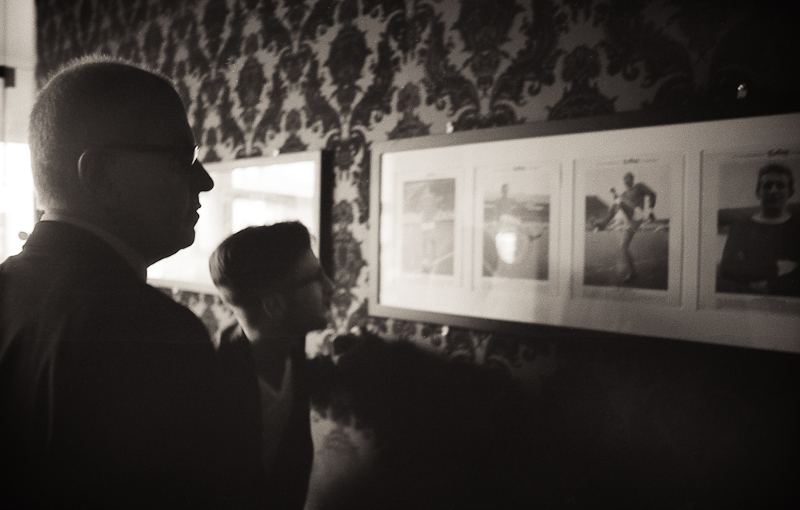
To the guy who took my picture without my permission ...

You have to be open and visible for taking pictures like this. I took pictures in the bars with mobile phones, rangefinders, SLRs and big DSLR rigs.
Every time everyone around me was aware with what I'm doing it was no problems.


Anyone can get upset over anything.

This really isn't about photography at all. It is about an entitled millennial with a mistaken belief in her right to privacy, a strange little man with a propensity for drunken violence and, only incidentally, a cell phone.

It is very unlikely he was charged with anything. The police were called, took statements and made a report, case done. They probably wouldn't even have bothered showing up to do that if the guy had left the bar quietly. Instead he made a scene and tried to punch an employee.

There is better action to be found in most Florida Wal-Marts.

The bigger problem for this guy was his wife, regardless of his intent. 😀

But I kind of agree with Daveleo. This was really a non-story which, base on the history of follow-up and verification of most reporters, probably didn't happen at all. Another urban myth created by a girl who wishes she had done what she claims.

So good! Another unequivocal explanation by a man who speaks only what he knows.
 
The law is simple on this issue (at least in the USA, at last I read): You have no expectation of privacy in a public space. If you are in a private space it is up to the owner of that space to dictate when photos can or can not be taken....like at some bar...like what owner is going to get involved?
 
Yeah, I've seen it happen. If some idiot with a camera is harassing his/her customers, the owner may take his own action against the idiot if the victim/subject doesn't.

Do you really think you can walk into "most" businesses and start photographing customers with no concern or action from the owner? If it happened to me and I complained and the owner did nothing, I would find another place to spend my money. If the photography became a known issue at the "bar" the only customers left, over time, might be photo-idiots (those with cameras and those who don't care if they're photographed). A select business model..Right?
Can't see why it shouldn't work...

Cheers,

R.
 
I can only speak for the laws in the United States, but they are pretty specific. If your subject is in public, there is no presumption of privacy. That means, for instance, you can take a photo of an accident victim in a demolished car or lying on the street. Once the patient is moved to an ambulance, you can still photograph if the doors are open. You cannot, however, get into the ambulance and keep taking photos unless you have permission. The same goes for someone's home or business. If you're invited and your subject knows you are photographing and does not object, you are OK. If not, then you have no inherent or legal right to continue to take pictures.
 
Does anyone know the U.S. law when photographing in a privately owned space that is open to the public? I know it's up to the owner, but must the policy be posted?

I read that a private space is considered public if opened to the public and not otherwise stated.

John
 
I would expect it varies by state. But I've seen such notices posted in places like grocery stores (usually hidden in whatever area they display all their required notices about fire extinguishers, hiring, food safety, etc.). There are a lot of reasons store owners wouldn't want you taking photos in their shop, aside from annoying other customers.
 
I have no idea how US law works or even in other country's. When you take the picture, regardless of what subject; the intent is there. I already seen posted here that you can photograph whatever in the US without fear. I sure would like to know if this is another hear say internet quote? My belief is the the US has good laws and they will stand up in court.

Here's my interpretations from reading the Photo Attorney blog. To quote the Photo Attorney (Carolyn E. Wright) "Take my advice; get professional help. "

There are two separate issues.

  • Taking The Photograph

In the US the First amendment has prevailed. So far, state laws that limit taking a candid photograph have either been ruled unconstitutional, vetoed by a governor or repealed. As mentioned earlier, the legal limitations are: violation of a person's right to privacy, trespassing and a few locations protected by national security concerns.

Besides than obvious disgusting, blatant violations in pubic spaces, in New York State the right to privacy is legally defined as a situation where the subject(s) could reasonably assume they could disrobe in private. This seems to be a widely accepted definition.

Trespassing is simple. On private property no-trespassing signs limit photography. On private property where there is free public access you can legally photograph until someone tells you to stop. No one can legally take your camera, etc. nor can they touch you. They can instruct you to leave at once. They can instruct law enforcement to arrest you if you reuse to leave.

There may be un-resolved state laws limiting photography of agricultural properties. I don't remember how these were resolved. The definition of locations protected by Homeland Security law is somewhat ambiguous. In my experience it seems to be up to individual security officer.


  • Photograph Usage

In the US there are two types of usage – editorial and commercial.

Briefly, commercial usage means a person's rights of publicity are violated and only the photographer benefits financially from the usage. Rights of publicity involve voluntary vs. involuntary endorsement. A model release covers general or specific publicity endorsement and requires compensation for the subject(s).

Editorial usage is an all encompassing term for non-commercial usage. For instance, selling candid photography prints without model releases as works of art has never been legally ruled as commercial usage. To date, US courts have ruled the creators right to freedom of expression is more important than privacy concerns. The proliferation of internet photograph publishing has not yet affected this balance.

As long as a candid photograph was made legally, editorial usage is not restricted.

Intent becomes important because editorial usage does not mean slanderous or malicious usage is legal. These are not. Any malicious usage creates liability. Public figures have less legal protection than others.

Photographing without fear is much more complicated. People can physically attack you. You can legally defend yourself and you can press charges against the assailant(s). Private security officers can attempt to violate your rights. You can take legal action against them too. Even law enforcement officers can bully you. Very recently a policeman was filmed telling a driver that recording a routine traffic stop was illegal. It is not. However, interfering with a police investigation is a different matter.

 
In your analysis, is producing a work of art editorial or commercial? I think you said it was. As far as I know, photographing someone who is in a public space where they have no expectation of privacy and selling the resulting photograph as a work of art is constitutionally protected speech. No model release required. If you are selling sweaters or shoes and use the image as an advertisement, that is something different. As others have noted, what the photographer did in the bar was legal, but maybe not smart. Still, when push comes to shove (pun intended), I side with the photographer, not the unwitting model.
 
...On private property where there is free public access you can legally photograph until someone tells you to stop. No one can legally take your camera, etc. nor can they touch you. They can instruct you to leave at once. They can instruct law enforcement to arrest you if you reuse to leave....

Thank you. I assume the "someone" who can tell you to stop must be a representative of the property and not another visitor.

Seems to me that public events on private property is the big gray area. Personally, I would not shoot in a crowded bar, but festivals and similar events are often held in privately owned spaces.

My friends are often shocked when I explain how U.S. law applies to street photography. Pretty much everyone assumes a stranger has no right to photograph them, regardless of the location, and even less right to exhibit or sell a picture of them. The issue for street photographers is perhaps more about misunderstanding than it is about the law.

John
 
Too bad the referenced article does not allow comments. It would be interesting to hear how "the guy" spins his story ("I did exactly what she asked - I deleted the pictures, no hassle."), how others in the bar saw it and very interseting to read the police report.
People can type anything on the internet and send the community of readers into a tizzy. Partial truths, omitted facts, writing toward a biased conclusion ..... happens a million times every day.
Trust no one.
 
...
Seems to me that public events on private property is the big gray area. Personally, I would not shoot in a crowded bar, but festivals and similar events are often held in privately owned spaces...
John

I agree. I shoot a lot of bands performing in small clubs. For a long time, I tried to keep the audience out of my pictures. But then I looking at photographs of the local scene in Memphis by Bully Rook which showed the fans as well as the bands(which actually led me to go to Gonerfest and visit Murphy's and the Hi-Tone) which were much more interesting than mine, and started to do the same. But I do get uncomfortable sometimes, because people don't always dance with the guy that brung ya.

One interesting thing is that standard wording on tickets now includes, in addition to the no photography clause, a clause that by attending the show you are consenting to being photographed and videoed🙂
 
I also looked for a comments section. Given my annoyance at the article, it's probably better there wasn't one.

John


Too bad the referenced article does not allow comments. It would be interesting to hear how "the guy" spins his story ("I did exactly what she asked - I deleted the pictures, no hassle."), how others in the bar saw it and very interseting to read the police report.
People can type anything on the internet and send the community of readers into a tizzy. Partial truths, omitted facts, writing toward a biased conclusion ..... happens a million times every day.
Trust no one.
 
Thank You Willie 901 for your research on US law, and Johnwolf; I wonder if it is really a misunderstanding, rather than the person getting a quality legal advice/opinion? It appears here by a few, that Google is the lawyer or a friend said to a friend this? Again, as Willie 901 said in his 1st sentence; "quoting a lawyer; seek proper legal advice" if your going to play in this area.
 
Back
Top Bottom