hepcat
Former PH, USN
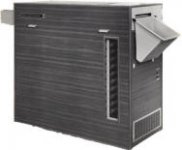
The Kodak EH-38 b&w processing machine...
The Kodak EH-38 b&w processing machine...
So, in the days before one hour photo labs, the Navy shot 5", 7", 8", and 10" wide aerial film in their aircraft system cameras. Although it had probably been processed by hand once upon a time, it was long before my experience. In the Navy Photo Labs to which I was assigned, there were Kodak EH-38 machine processing units installed. These were big machines, with a dark room side and a light room side. In the dark room side, you'd open the film cassette in the dark, and splice on a thicker film leader with tape. Then you'd set the roll of film (usually 50' or 100') on some rollers in a dark box, feed the leader into the rollers leading into the first bath, and let it spool in until it was all processed. You'd go out the roller door to the light side, and in about ten or twelve minutes, the machine would spit the leader out processed and dry, and you'd feed it onto a takeup spool. I don't recall exactly how many feet it could process dry-to-dry any more, but it was pretty fast. I think it could do a 100' roll in about 45 minutes. It had automatic replenishment from mixed chemistry in tanks. Every day, and sometimes twice a day we'd run a gamma test sheet to make sure the chemistry was in tolerance. If I recall correctly, the machine was about 8' long, two feet in the dark room and about 6' on the light side, and was about 5' tall. It had several chemical tanks and many rollers through which the film would progress ending with a wash rack and drying roller rack. As a 19 year old kid, it was just another thing we had to run, but looking back 40 years now, it was pretty amazing technology for its time.

The Kodak EH-38 b&w processing machine...
So, in the days before one hour photo labs, the Navy shot 5", 7", 8", and 10" wide aerial film in their aircraft system cameras. Although it had probably been processed by hand once upon a time, it was long before my experience. In the Navy Photo Labs to which I was assigned, there were Kodak EH-38 machine processing units installed. These were big machines, with a dark room side and a light room side. In the dark room side, you'd open the film cassette in the dark, and splice on a thicker film leader with tape. Then you'd set the roll of film (usually 50' or 100') on some rollers in a dark box, feed the leader into the rollers leading into the first bath, and let it spool in until it was all processed. You'd go out the roller door to the light side, and in about ten or twelve minutes, the machine would spit the leader out processed and dry, and you'd feed it onto a takeup spool. I don't recall exactly how many feet it could process dry-to-dry any more, but it was pretty fast. I think it could do a 100' roll in about 45 minutes. It had automatic replenishment from mixed chemistry in tanks. Every day, and sometimes twice a day we'd run a gamma test sheet to make sure the chemistry was in tolerance. If I recall correctly, the machine was about 8' long, two feet in the dark room and about 6' on the light side, and was about 5' tall. It had several chemical tanks and many rollers through which the film would progress ending with a wash rack and drying roller rack. As a 19 year old kid, it was just another thing we had to run, but looking back 40 years now, it was pretty amazing technology for its time.