Underexposure with incident metering

lrochfort

Well-known
Local time
11:10 AM
Joined
Feb 21, 2011
Messages
239
Hello all,

I don't know what's going on of late, but I'm consistently underexposing when incident metering. I've been incident metering for some years with what I'd describe as adequate to good results, and I think I've generally been getting better. I've never been really happy with my results though, so am on a mission to be more methodical and empirical.

To be honest, I think I've just got a bit sloppy. To that end, I've recently bought Roger Hicks' "Perfect Exposure", which I'm working my way through, but would like to sanity check my thoughts and plans with those in the know.

I'm using B+W negative film, specifically Tri-X at present, and am taking landscape/activity shots with 35mm lens on 35mm format.

I think perhaps, now that it's summer (and SUNNY!!) in the UK, I'm reading too much of the sky and that's causing the underexposure. I have also tended to go by the box speed because I haven't set aside time to record my results when trying other speeds.

So, my plan of action is this:

1) Use Tri-X at box speed of 400 ISO
2) Angle my meter more towards the ground
3) Point my meter towards the camera (should this be towards the light source?)
4) Gauge how far below the scene average I think the shadows are
5) Compensate the exposure according to point 3
6) Keep notes
7) Evaluate the results and update my notes accordingly

Thanks all,
Laurence.
 
Certainly item #3 is important as are notes. If you have a meter with the flat white sensor in addition to the dome, you might try using that (or leaving the dome recessed if your meter allows). Either one would give you less light from the sky. You could also reduce the ISO speed set in your meter if your negatives are underexposed. I don't use the incident meter as often as I should, but when I do, the negatives are properly exposed (for black and white 35mm, either Tri-X or HP5+). Good luck.
 
May I ask what meter you are using?

I use a Weston meter and occasionally with the incident attachment (invercone).

If you are metering from the subject back toward the camera and have a meter that also does reflective, meter the shadows as well.

The Weston's have a handy dial marked with a number of points not just a single average. This allows easy metering of shadows or highlights. Other meters may be similarly marked or you could add your own target for shadows.
 
The more I use incident the less sense it makes to me, I just use reflective. The thing is is you face the dome toward the light you get one exposure, if you face the dome 90 degrees perpendicular to the light, you get a stop more exposure. Everything else seems like some kind of mystical genuflecting, depending on the lighting contrast and direction. There's nothing consistent about it!
 
I get mystery readings too with incident. Today, I took a photo of a Harley-Davidson motor. The incident reading was 1/100 at F4. The reflective was 1/100 at F 5. As the major portion for the image was polished metal I went with the incident as I figured the metal was elevating the light level. I'll see the results tomorrow when I develop the roll.

My method of comparing both readings, a trick from Roger's book, has helped. If the readings are different I try to figure out why. But if I can't figure it out I use the reflective.
 
I find the solution quite simple. Use your brain to determine exposure considering the reading from your light meter to be no more than one of the factors you take into consideration. You also take subject luminance and other factors such as what you want the photo to convey into consideration. It is actually quite simple. People easily determined the best exposure many years ago before light meters were commonplace.

Remember, no meter will tell you the best exposure no matter how you use it. It will only measure the light intensity.

I fear that modern technology has caused many to be unable, or forgotten, how to think.
 
Incident light metering : The ideal spot is with the bulb in the middle of the field, pointing towards the camera, perpendicular to the film plane : if your camera points down, the bulb should point up the same amount, and vice versa. If the light in the area of the frame is similar to the light in the area of the photographer, the light meter can be held to the side or at the back of the camera, as long as it is exactly parallel to the position it would take if it were in the middle of the shot, pointing straight at the center of the lens.

It may be worthwhile to test this out with a greyscale card, which one should place in the middle of the frame, parallel to the film plane : this insures the card receives the same light as the bulb of the light meter, which should also be parallel to the film plane, and pointing behind the camera - you cannot stress this enough 😉 . If you then print or process so the the grey card has the right density, you'll know for certain wether your negatives are underexposed, or your film stock over-rated.

The true sensitivity rating of film also depends on the development : Labs have their quirks.
If your film consistently underexposes, you should rate it lower. Again a test with a grey card can be very helpful here. Spending a film on a few bracketed exposures in different lighting conditions : inside, artificial light, outside sunny, outside overcast, outside shadow; should give you a pretty exact idea of how to calibrate your combination of light-meter, film and development.
 
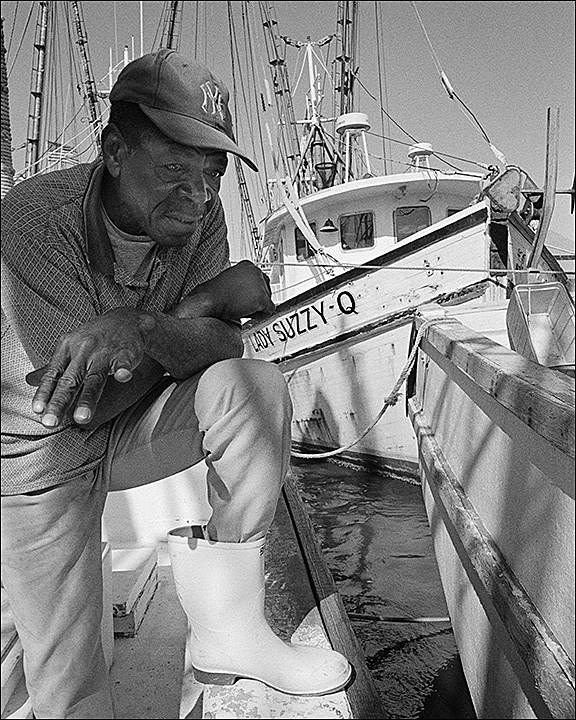
Here is an example of simply determining exposure by using your brain and not being misled by meter readings. I challenge anyone to tell me how to get any meter to tell you a good exposure with this scene dominated by white shrimp boats in full sun but an important negro face in the shadows.

I simply did not use a meter but determined exposure from the sun's intensity (f16 which is a constant) adjusted by my knowledge of the films tolerance for overexposure and underexposure. It was simple. Almost everyone used to know how to do this before light meters became so popular.

The subject is James Ford, the last negro shrimp boat captain in the US. It was shot at the shrimp boat dock in Fernandina Beach FL which has since become resort condos.

Shrimper-James-Ford.jpg
 
Right, tough metering, looking at it the only thing I would do with a meter (and then not be very confident) would be to meter off the shrimp boat captain's face (only his face) and set that at zone 3.5. Still, I bet your method would be closer.

Good portrait by the way.

I had one the other day which I knew would be a problem. I was using a DSLR and fill flash, but the face colors were really different. I just let the camera decide and used RAW. Luckily, you have lots of PS tricks, which I'm not good at, to play with it. Still, the question is you have to think what is going on.

14876845133_2daa6ed020.jpg
 
Incident metering is ideal for slides, where exposure is keyed to the highlights, i.e you don't want to overexpose and blow the highlights. It is a lot less than ideal for negative, where exposure is keyed to the shadows, i.e. you don't want to underexpose and get empty shadows.

See http://www.rogerandfrances.com/subscription/ps expo neg.html (negatives)

http://www.rogerandfrances.com/subscription/ps expo slide.html (slides - ignore the stuff about digital as it is no longer true with decent sensors and Raw)

Cheers,

R.
 
I have to ask, but ... if it's sunny why do you need a meter at all?

Stewart makes a very valid point that probably escaped many readers. Most great exposures, including chromes, were made long ago by using the exposure tables printed on the inside of Kodak film boxes. And there was never the problem of someone over / underexposing entire rolls of film "because they forgot to reset the iso/asa on the meter"

I fear that today's technology, automation, and implied precision measurements causes too many to blindly follow nonsensical meter readings while ignoring red flags telling them that the exposure is vastly different that what they have done in similar lighting in the past.
 
I have to ask, but ... if it's sunny why do you need a meter at all?
Dear Stewart,

Brightness range.

Of course you can replace that with experience -- when you have the experience.

That's true of most kinds of metering: the more experience you have, the easier it is to fudge the meter reading. Or even to guess.

Cheers,

R.
 
I have to ask, but ... if it's sunny why do you need a meter at all?
It's a good point. On reflection (no pun intended), I find that many of the exposures I've made without a meter are as good and occasionally better than those I've made with a meter. I suppose because I start off thinking, I don't forget to as I might when using a meter.
 
Dear Stewart,

Brightness range.

Of course you can replace that with experience -- when you have the experience.

That's true of most kinds of metering: the more experience you have, the easier it is to fudge the meter reading. Or even to guess.

Cheers,

R.

... well no, not really. Full sunlight is the same wherever one is, one need only adjust from that to the subjects illumination, no?
 
To begin with, as Roger said, when you say: underexposed, you probably want to see details in deep shadows. Depending on the type of direct light and how much reflected light is present, you should expect between 3 and 4 stops difference between objects lit directly and those in the shadows. You can rate Tri X at EI 400, but you have to expose for the shadows. A rule of thumb could be to cover the light with your hand and measure incident reading with your light meter pointing down. You will know how to expose, if you want your details medium gray. If you want them dark gray, expose 1 stop less. If you want to keep things simple, in bright sunlight, normally lit scenes, expose at EI 100, if shooting against the light, at EI 50.
 
You could set the meter for half the asa you want and point the dome at the light source. That way you'd be splitting the difference of 2:1 ratio and ignoring the rest of the shadows..
 
Spot meter

Spot meter

I could never get consistent negs with my incident meter and this year started using a spot meter with 4x5. I was shocked at some of the readings that I was getting with my incident meter - I was grossly underexposing things. I then hedged my bets using both exposures and found that the spot meter gave me easy to print negs - zone 3 was really zone 3 and a zone 8 really was zone 8. I had to give minus development quite a bit to get there a lot of the time. I am now a believer! If you're not getting the consistency that you want, try a spot meter.
 
Incident light metering : The ideal spot is with the bulb in the middle of the field, pointing towards the camera, perpendicular to the film plane : if your camera points down, the bulb should point up the same amount, and vice versa. If the light in the area of the frame is similar to the light in the area of the photographer, the light meter can be held to the side or at the back of the camera, as long as it is exactly parallel to the position it would take if it were in the middle of the shot, pointing straight at the center of the lens.

It may be worthwhile to test this out with a greyscale card, which one should place in the middle of the frame, parallel to the film plane : this insures the card receives the same light as the bulb of the light meter, which should also be parallel to the film plane, and pointing behind the camera - you cannot stress this enough 😉 . If you then print or process so the the grey card has the right density, you'll know for certain wether your negatives are underexposed, or your film stock over-rated.

The true sensitivity rating of film also depends on the development : Labs have their quirks.
If your film consistently underexposes, you should rate it lower. Again a test with a grey card can be very helpful here. Spending a film on a few bracketed exposures in different lighting conditions : inside, artificial light, outside sunny, outside overcast, outside shadow; should give you a pretty exact idea of how to calibrate your combination of light-meter, film and development.

Could not say it better myself.

Check shutter speeds.
 
Here is an example of simply determining exposure by using your brain and not being misled by meter readings. I challenge anyone to tell me how to get any meter to tell you a good exposure with this scene dominated by white shrimp boats in full sun but an important negro face in the shadows.

I simply did not use a meter but determined exposure from the sun's intensity (f16 which is a constant) adjusted by my knowledge of the films tolerance for overexposure and underexposure. It was simple. Almost everyone used to know how to do this before light meters became so popular.

The subject is James Ford, the last negro shrimp boat captain in the US. It was shot at the shrimp boat dock in Fernandina Beach FL which has since become resort condos.

Shrimper-James-Ford.jpg

Imagine that, expose for shadows, develop for highlights.
 
Back
Top Bottom