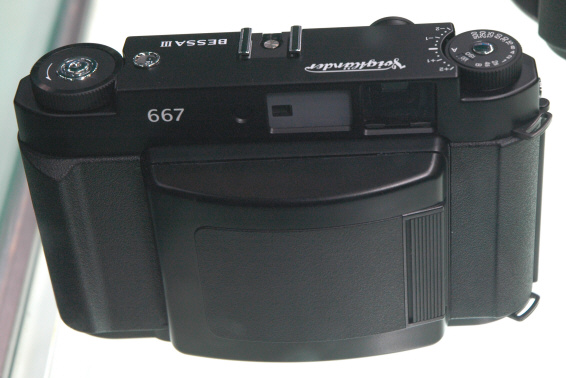
Three questions not addressed by the updated page:
- What is the rangefinder's base length?
- What is the viewfinder magnification?
- Do the viewfinder frame lines also expand and contract to account for changes in field of view while focusing or do they only shift for parallax?
Thanks in advance for answering,
Sal
The specs + some (German site) picture measurements by me (ED), give or take 1 mm.
Technical specifications.
Folding camera with coupled rangefinder
Film choice 120/220 film
6x7 cm (56x69 mm ED)(120-10 exp. / 220-20 exp.)
6x6 cm (56x56 mm ED)(120-12 exp. / 220-24 exp.)
Switch for frame sizes inside the body (ED)
80 mm/f3.5 (4 groups 6 elements)
7 rounded aperture blades (ED)
Close focus is 0.9 m, 3' (CK)
Bright frame-type viewfinder.
Physical rangefinder base 37 mm (ED)
Automatic parallax compensation
Integral LED exposure metering indications
Electronically controlled lens shutter. 4-1/500 sec, B
Exposure control: SPD Sensor
Center-weighted averaging system
Aperture priority AE and manual switchover
Exposure compensation approx 2EV in 1/3EV steps
Film speed: Manual setting, ISO25-3200 (1/3EV step accuracy)
Manual film wind by winding knob
Mechanical-type counter
120/220 (changeable)
6x7/6x6 (changeable)
CR2 (3v) lithium battery
Outer dimensions: 178x109x63 mm folded (ED)
and 178x109x138 mm unfolded (BJoPh)
Weight 1KG (BJoPh)
The rangefinder is in my opinion basically the one of the 35mm Bessas. While brightness and magnification will adjust for the MF size-80mm standard lens the most interesting detail will be how accurate the rangefinder coupling is on this folder. On some older folders it has been good and on other folders lousy. All kinds of designs were used to get good rangefinder precision combined with the folding construction. Mamiya Six film shift, Zeiss ikon optical wedges, Plaubel and Polaroid strut coupling, Agfa + Iskra coupled helix construction that is used in the Bessa III too. Wonder whether there is a Bendix cable used that can be adjusted for wear in time.
Ernst Dinkla