Watch Repair

Just reporting to the forum that I got my watch back from Chris and it runs like a Swiss watch (though it's Russian!). I am most impressed by his workmanship, attention to detail, and communication. And his prices are quite reasonable indeed. If you have a watch, especially a mechanical one, in need of repair or maintenance, I'd strongly consider his services over your local repairer (if you can find one, that is). You can PM him, of course, but his website Watchmaker Chris - Watch Repair in Fort Wayne Indiana is well worth a visit too. (You can see my Vostok there also.)

I hope the moderators don't mind this shameless plug, but I wanted to pass this on.
 
Just reporting to the forum that I got my watch back from Chris and it runs like a Swiss watch (though it's Russian!). I am most impressed by his workmanship, attention to detail, and communication. And his prices are quite reasonable indeed. If you have a watch, especially a mechanical one, in need of repair or maintenance, I'd strongly consider his services over your local repairer (if you can find one, that is). You can PM him, of course, but his website Watchmaker Chris - Watch Repair in Fort Wayne Indiana is well worth a visit too. (You can see my Vostok there also.)

I hope the moderators don't mind this shameless plug, but I wanted to pass this on.


Thanks, Nick 🙂

Here's the link to the story of what I did with Nick's watch: Vostok Komandirske Automatic Watch Repair
 
Nice job Chris.
Thanks for showing your work.

I bought a Seiko in Hong Kong when I was on R & R in the early 1970’s. As I recall, I paid $20.00 for the watch. A few guys that’s all they had as they either drank, gambled, partied or women, thinking they wouldn’t ever get back home.


Do you still have it? My dad gave me a Westclox wristwatch that he bought at the base store right after he finished Air Force basic training in 1968. It has a Seiko movement. I'm planning to service it, soon.


westclox-crown-field.jpg
 
I have a watch I'm working on now that's a complex one. A mechanical watch with an alarm function! Never worked on one of those before. I just got the timekeeping part of the movement assembled today and it is running exceptionally well. It was the nastiest looking movement I have ever worked on; filthy and even had some corrosion on some parts. The owner is about my dad's age, mid 70s,, and he said it had been his dad's watch. He said it quit working in the late 1960s when he was a teenager and had not run since then, but he had kept it all that time and had tried in recent years to get it serviced so he could wear it in memory of his dad; but no one would work on it because it was an off brand watch called "Clinton." They should have opened the back; it has a movement made by A. Schild, a major Swiss movement maker and parts are easy to find for it. They lost out on a good paying job.

Because it was so dirty, I was afraid it would have a lot of wear and would be hard to get enough amplitude and accuracy out of it, I was wrong; the movement right after reassembly and lubrication, with no adjustments at all done yet, was running +25 seconds per day with an incredible 291 degrees of amplitude and no beat error! Its running like a brand new watch. I need to finish assembling the alarm mechanism now, then I'll be done.


clinton-alarm-repair.jpg


Can't do anything about the patina on the dial, but the owner is ok with that. I did get the case cleaned and it is very bright now.


as1475-dirty.jpg


The dirty movement. The second crown is for winding the alarm; it has its own mainspring separate from the one that drives the watch!


as1475-cleanedparts.jpg


Some parts after cleaning.


Running!


as1475-intitial-timegrapher.jpg


Right after I finished assembling and lubricating it, I put it on the timegrapher just to see how it was running. I need to wait a few days before doing the final adjustments, to let the lubricants work in and stabilize. The initial, no adjustments done readings are exceptional.

• Rate: Its running about 25 seconds per day too fast. That's not a problem, I'll correct that when I do the final adjustments.

• Amplitude: This one surprised me. Amplitude is a measure of how much power is being transmitted through the gear train from the mainspring to the escapement. It needs to be higher than 250 for the watch to run well. This one was giving 291 degrees of amplitude; that's like a brand new watch! Usually an old movement that is as dirty as this one was will have a lot of wear in the parts that rob the movement of amplitude, and getting enough can be challenging. I'm very happy with this!

• Beat Error: If you look at the video, you'll see the balance wheel oscillates back and forth. The clockwise rotation and the counter clockwise rotation need to take the same amount of time. If they don't, you have beat error. As long as it is less than a 1 millisecond difference, the watch will run accurately. This one has no beat error!

 
This mechanical alarm watch was the hardest watch repair project that I've done. Getting the alarm to function correctly was a nightmare, but it works now!

This came to me from a customer who inherited from his father. It had stopped working in the late 1960s and had sat unused for more than 60 years until it arrived in my workshop. The movement was in bad shape, very dirty with a lot of wear and a couple of broken parts that needed replaced. The customer said several other watchmakers had refused to work on it.

In addition to servicing the movement, I cleaned the case and replaced the broken crystal and installed a new case back gasket.


1940crawford-case-dial.jpg

This one's a personal project; a Crawford brand watch that I'm restoring to give to my dad for his birthday next month!

Crawford watches were made in the 40s, 50s, and 60s. I have another one in my own collection that was made in the late 50s. When I found this one on eBay, I thought it was from around 1960; but when I looked at the movement, I realized that it was made around 1940!

I just finished reassembling the movement. I had to replace the balance wheel; the one that is oscillating back and forth in the video. The hairspring on the original was bad. I was able to find a factory original part, brand new! Now its working great. I need to wait a few days to let it settle in, then I'll regulate it, put the dial and hands back on, and glue the crystal back into the case.

 
Finally finished working on the "Crawford" watch from 1940 that I am going to give my dad for his 76th birthday in a couple weeks. I overhauled the movement and cleaned the case a couple weeks ago, but its taken me some time to find a new crystal for it, as it has an unusual shape and the watch is 86 years old!


1967-bulova-5at-parts.jpg


This is the tiniest watch movement I have ever worked on! It is from a Bulova ladies watch made in 1967. Notice the dime in the photo for size comparison! Some of the screws in it were so small that the .5mm screwdriver, the smallest watchmakers screwdriver sold today, was too big! I had to take one of my .5mm drivers and grind down the tip on a knife sharpening stone to make a screwdriver small enough for this job.

I photographed all the parts right after they came out of the cleaning machine. I'm going to replace four parts that have some rust on them. All of there were parts near the area where the stem goes into the movement. I think someone let the watch get wet at some point, and water got in through the stem tube and damaged the movement. Fortunately it was only a few parts; I've seen movements so badly rusted that they were un-repairable. I'll reassemble it after the new parts arrive later this week.
 
View attachment 4889861


This is the tiniest watch movement I have ever worked on! It is from a Bulova ladies watch made in 1967. Notice the dime in the photo for size comparison! Some of the screws in it were so small that the .5mm screwdriver, the smallest watchmakers screwdriver sold today, was too big! I had to take one of my .5mm drivers and grind down the tip on a knife sharpening stone to make a screwdriver small enough for this job.

I photographed all the parts right after they came out of the cleaning machine. I'm going to replace four parts that have some rust on them. All of there were parts near the area where the stem goes into the movement. I think someone let the watch get wet at some point, and water got in through the stem tube and damaged the movement. Fortunately it was only a few parts; I've seen movements so badly rusted that they were un-repairable. I'll reassemble it after the new parts arrive later this week.
And the face of the watch is actually legible? 🙂 Impressive, Chris.


Running!


as1475-intitial-timegrapher.jpg


Right after I finished assembling and lubricating it, I put it on the timegrapher just to see how it was running. I need to wait a few days before doing the final adjustments, to let the lubricants work in and stabilize. The initial, no adjustments done readings are exceptional.

• Rate: Its running about 25 seconds per day too fast. That's not a problem, I'll correct that when I do the final adjustments.

• Amplitude: This one surprised me. Amplitude is a measure of how much power is being transmitted through the gear train from the mainspring to the escapement. It needs to be higher than 250 for the watch to run well. This one was giving 291 degrees of amplitude; that's like a brand new watch! Usually an old movement that is as dirty as this one was will have a lot of wear in the parts that rob the movement of amplitude, and getting enough can be challenging. I'm very happy with this!

• Beat Error: If you look at the video, you'll see the balance wheel oscillates back and forth. The clockwise rotation and the counter clockwise rotation need to take the same amount of time. If they don't, you have beat error. As long as it is less than a 1 millisecond difference, the watch will run accurately. This one has no beat error!

That's a very healthy amplitude indeed – well done!
 
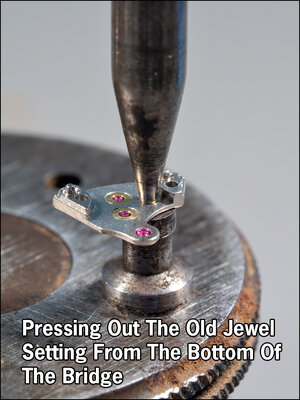
I'm still working on that tiny Bulova ladies watch I posted about last week. I had to wait for a part that finally arrived yesterday. I had to replace a jewel setting in the drivetrain bridge, the metal plate that holds the upper bearings for the drive wheels (gears) and escape wheel. Lab-grown rubies are used as bearings because they are very hard and do not wear out. I thought some of you would find the process interesting.

I used a tool called a staking set. Mine is 110 years old, and has some rust on it, but it still works great. These old American-made staking sets are better made than modern imported sets!


bulova-5at-jewel-replacement-1.jpg


bulova-5at-jewel-replacement-2-jpg.4890336


The train bridge was placed upside down on the staking frame, with a hollow stump under it for support. A steel punch goes in from the top, touching the brass setting that the jewels come mounted in. A couple of taps from a small jeweler's hammer on the top of the punch knocks the jewel setting out through the bottom!


bulova-5at-jewel-replacement-3.jpg


The train bridge is then flipped over and placed on a solid stump. The new jewel setting is placed over the hole in the train bridge and a larger punch that pushes on the top rim of the setting is put into the staking frame and tapped with the hammer to push it into the hole. After that, I realized that it had gone down too far, and I turned the bridge over and tapped the jewel with a punch lightly to push it back up slightly. I may have to adjust it again when I put the movement back together. If it is pushed down too far, the wheel that uses this jewel bearing will not turn; and if it is not pushed down far enough, there will be too much slop in the wheel's motion.


bulova-5at-jewel-replacement-4.jpg


bulova-5at-jewel-replacement-5.jpg
 

Attachments

  • bulova-5at-jewel-replacement-2.jpg
    bulova-5at-jewel-replacement-2.jpg
    443.5 KB · Views: 22
Very nice work. I had in mind to try taking up watches when I retired, but my hands have gotten too shaky for such fine work. I can disassemble and reassemble most of a watch but getting the balance back in safely has just been too much for my hands. Still OK with cameras though so far.....

I have a thing for Elgin watches because I grew up about 10 miles from their factory in Illinois. Some of their last US made wrist watches with the freesprung Durabalance were an interesting design.
 
Very nice work. I had in mind to try taking up watches when I retired, but my hands have gotten too shaky for such fine work. I can disassemble and reassemble most of a watch but getting the balance back in safely has just been too much for my hands. Still OK with cameras though so far.....

I have a thing for Elgin watches because I grew up about 10 miles from their factory in Illinois. Some of their last US made wrist watches with the freesprung Durabalance were an interesting design.


lordelgin-clubman.jpg

I have an Elgin watch with an American made movement from 1952 in my collection that I am going to service soon. Its a "Lord Elgin Clubman." Later Elgins, from the 60s and 70s were Swiss made and not so interesting. I've seen the Durabalance movements online and they look really interesting. I've heard they're a real pain to regulate though due to the unusual balance design.
 
Back
Top Bottom