What double gauss lenses are out there?

De_Corday

Eternal Student
Local time
2:07 AM
Joined
Oct 5, 2013
Messages
369
Location
Brooklyn via NJ
My two favorite lenses for black and white work are both double-gauss 50's -- the F-mount Nikkor HC 50 f/2 and the Canon LTM 50 /1.4

Theres something about the transition to OOF and the mild contrast that works a treat on film.

I would love a mild wide-angle (28-35) and a mild tele (75-90) in M mount or LTM with a double gauss design and a similar rendering... Any suggestions?
 
6 elements / 4 groups, my favorites

- canon 100/2, the perfect match to your canon 50/1.4
- 35 Summicron v3

If you need 28, try the MS Optics Apoqualia-G 28mm f2.

Roland.
 
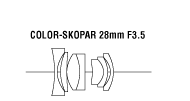
CV 28 3.5 Skopar. It's LTM, no distortion.


I believe it's a non symmetrical retrofocus design.

6f72aab6gy1fhn1843yjcj20go0a0di0.jpg


The Avenon/Kobalux 28/3.5 looks like double gauss.
 
The 35mm Cron and it's derivatives - Canon 35 f2 ltm, UC-Hexanons to name a few.

The Voigtlander 35 f2.5 is also symmetrical enough to be a close derivative of the double Gauss.

I own 2 double Gauss lenses myself, the 50mm f1.5 Nokton LTM and the L-Hexanon 50mm f2.4, the latter of which performs exactly like you describe your rendering to be like.
 
I'm not sure double gauss by itself leads to a pleasing transition to OOF and mild contrast. Spherical aberration is caused by the different focal lengths of rays, axial vs. peripheral. Double gauss lenses seem to try and correct this by guiding axial rays to the periphery where, it seems, they act like peripheral rays i.e. tend to have the same focal length. This increases sharpness but the downside, if the spherical aberration is over-corrected, is an OOF disc with a ring like structure (the 'ring' being the peripheral rays). Not pleasing, to me at least. Double gauss lenses can have lower contrast because of the relatively large number of glass-air interfaces although the advent of anti-reflection coatings addressed this 'drawback'. Sonnar lenses seem to tick to a different beat: however it is done, these lenses are quite sharp and yet have a pleasing OOF transition. I think to get a lens with a pleasing OOF transition and mild contrast is a particular embodiment of a design rather than a particular design.
 
I'm not sure double gauss by itself leads to a pleasing transition to OOF and mild contrast. Spherical aberration is caused by the different focal lengths of rays, axial vs. peripheral. Double gauss lenses seem to try and correct this by guiding axial rays to the periphery where, it seems, they act like peripheral rays i.e. tend to have the same focal length. This increases sharpness but the downside, if the spherical aberration is over-corrected, is an OOF disc with a ring like structure (the 'ring' being the peripheral rays). Not pleasing, to me at least. Double gauss lenses can have lower contrast because of the relatively large number of glass-air interfaces although the advent of anti-reflection coatings addressed this 'drawback'. Sonnar lenses seem to tick to a different beat: however it is done, these lenses are quite sharp and yet have a pleasing OOF transition. I think to get a lens with a pleasing OOF transition and mild contrast is a particular embodiment of a design rather than a particular design.

That's a good point. My Nikkor HC and the LTM /1.4 are both of the same era and country of manufacture, so there's likely more going on than simply similar designs.

Also, I think we're on the same page, but just to be sure: what I love about these lenses is less the bokeh, which I don't find at all offensive, as some do, nor do I love it. But what I do love is the way the in-focus areas transition towards the bokeh. Theres a smoothness to how the focus runs out.

You bring up a Sonnar design... the Sonnar I'm most familiar with is the Jupiter 8, of which I've shot a few. I find it to be very, very sharp (on film at least) with very pleasing bokeh, but there's a clear delineation, to my eye, between the in-focus area and the OOF.

I guess the only way to be sure is to get my hands on a couple of these other double-gauss lenses and see if they do the same thing.
 
Well, its a black art, lens design, but I think in very general terms, if you push too hard in one direction it can be at the expense of something else, whatever the basic design. I just have this feeling that increasing lens sharpness can ultimately impact the OOF areas. I personally like a 'pleasing' OOF (and the transition to OOF). Its more apparent than sharpness when you are looking at a picture as a whole.
 
The Nikkor 50mm f1.4 Millennium is a double gaussian design.
Though the Nikkor-sc and hc in S mount are both sonnars.


the c in hc or sc just indicates coated and was dropped on later lenses. A better indicator is whether the lens focal length is marked cm or mm. The sonnar formula lenses are marked cm and the double gauss formula lenses like the millennium are marked mm.
 
I believe the Nikkor 105mm f/2.5 is a celebrated double guauss design.

Rangefinder version is a Sonnar.

First version F-mount with larger rear element is a Sonnar.

Later F-mount version is a double-gauss.

(DG is sharper and focuses closer, S has smoother bokeh and more classic look)
 
I wouldn't call the Nokton a double gauss.

50mm_f1_5_nokton_lc.jpg


770px-DoubleGauss_horizontal.png

Looking closer, I stand corrected. I would also make the amendment that it is the Voigtlander 35 1.4 which has the double Gauss design, not the 2.5 pancake.

We can't have false information floating about the web, after all!
 
Looking closer, I stand corrected. I would also make the amendment that it is the Voigtlander 35 1.4 which has the double Gauss design, not the 2.5 pancake.

We can't have false information floating about the web, after all!

Hmm. The aspherical element in the 1.5 Nokton replaces 2 elements, and therefore, it can be considered a back-extended Ultron (see also http://www.rangefinderforum.com/forums/showthread.php?t=156630), which itself is derived from the Planar. In a way, there are so many lenses "derived" with additional elements, airspaces, etc., from the Planar that the OP's question is hard to answer if you allow all of them, plus, how they render, is dependent - of course - on how they are optimized.

I thought the OP asked for lenses more similar to the two he mentioned, and respectfully suggest that we restrict ourselves to true Planar 6/4 designs. Like the 6 element Summicron or the 100mm Canon that I mentioned above. (For its speed, the 6 elements in the Canon 50/1.4 are quite unique). Plus, both the Summicron and 100mm Canon do have the interesting "transition to OOF", I feel, which the OP is looking for.

Roland.
 
Slightly off topic, but I found the 55/4.5 Nikkor lens on the Plaubel Makina W67 to be a Topogon design. People love this lens. Could be the last of its kind.
 
Back
Top Bottom