What kind of exposure meter do u have?

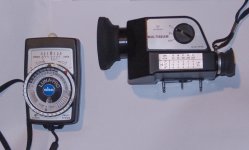
I've got an old Gossen analog Lunapro SBC with the original multibeam 1-5-10 degree spot attachment. You should see the eyes widen when I pull that out of the kit! It works beautifully, and as others have said, while bulky does the job!
 

Attachments

  • Lunapro-SBC-Light-Meter.jpg
    Lunapro-SBC-Light-Meter.jpg
    284.2 KB · Views: 0
I used to use a Gossen Sixtino, which is a small Selenium (i.e. without batteries) meter. Good points: small, and with an incident metering option by sliding a translucent window in front of the cell. Bad points: expensive, and extremely fragile. After the second one fell apart, I bought a cheap Hama Selenium meter. It's reflective metering only, but at least it doesn't fall apart..
 
A Gossen Pilot2 had been my mainstay.
The Gossen has suddenly started reading very incorrectly--I noticed this last week as I was leaving work. I metered the street and got just about 1/1000 @ f11. At 11 PM.
The meter is fairly old and I really don't know how it was treated before I got it so I'm looking to replace it.
I'm thinking about the Gossen digi-F but haven't decided yet.
Rob
 
I have a Weston 2 and a Weston 4 with an invercone so i can read light reflected off the subject and falling on the subject and make an intelligent guess someplace in between the two readings.

Don't thank me i got the idea from one of Roger Hicks books. Good idea too 🙂

The Weston's don't read the same but the 4 seems to be spot on so i use that one all the time. The 2 is in Westons and the figures are a little on the small side for me.

Would buy a modern Sekonic if I had to do it again.
 
Gossen Luna Pro SBC. Very sensitive, very accurate, very large. I had an old Lentar selenium meter, but after dropping it on some rocks and breaking it in several pieces a couple of years ago, it doesn't seem to be very accurate anymore. Duct tape can't fix everything afterall.🙁
 
Strangely enough I am the only one with a Minolta Spotmeter. I strongly recommed it. It can average, read stop differences and read ambient/fash. What a pity Minolta is defunct! For many years in the 70 and 80 I had a Lunasix. I grew nostalgic and recently bought a Lunasix F on Ebay. Alas! it is jumpy at high EV (any idea how to fix it?) . Now for my meterless camera I am thinking of buying a digiflash. A NEW one I mean
 
Gossen Digisix and Luna Star F, and ancient but accurate Sekonic L-158 selenium, Luna Pro F, Weston Ranger 9. I use the Digisix and Luna Star most often. The Digisix is tiny, the Luna Star easy to read. All meters are very accurate
 
I use the minolta spotmaster which I find good to use. It is big and quite unhandy to use but it does the trick.

I also have the digisix but never use it
 
I have a Weston II and a Gossen Pilot 2. Neither is very good in low light so I recently purchased a VC II. My M2 is out for a (hopefully) quickie repair by Sherry so I haven't used the VC II yet. It gets quite a bit of support around here, and I'm looking forward to giving it a workout when the camera returns.

Roger
 
I have used a Sekonic L328F ambient and flash meter since the late '80s. It is small and accurate. I used to use a Gossen Luna Pro SBC; it was accurate, but fiddlesome. I like the Sekonic much better.
 
For a long time I used a Luna Pro. By the end of 2001 I bought a Sekonic L308B. It´s pocket size, light and accurate, ISO 3 to 8000 (!). I carry it in my photo bag. But... I trust in my Canonet´s QL 19 New meter instead.

Agustín 🙂
 
I have a Gossen Luna Pro. But with an M6 and a CLE as my new lineup, it has not come out of the bag for two weeks. Incidently (no pun intended), the CLE does better than the M6 and I do almost every time (a bit depressing).
 
fgianni said:
I am starting to use the best exposure meter ever, here it is:

http://www.fredparker.com/ultexp1.htm

I have been using this too for quite awhile. The problem is, it's really intended for, and best used in, the outdoors. Much of my reason for using a rangefinder is for the ability to take photos indoors, where lighting conditions are rarely easy to estimate acurately (which is why modern films with lots of latitude are good for duffers like me). Some of Fred's lower EV examples overlap, sometimes quite a bit.
 
It would e good of us to refine the fredparker charts for indoor use. I started to do this for a while onto my own hardcopy, but it would be great if it were ever done in a way that all of us could share our experiences in one place.
 
Back
Top Bottom