Photoworks - I work for them!
🙂
What makes a good photograph...?
I don't think any of the answers in this thread are sufficient because they could describe a "good" anything. For example, mfogiel wrote "it has to stir in you the right emotion" - but "it" could be a painting, a movie, a book, even cheese or a pet!
I suggest that for a photograph to be good, it must do more than, say, "stir the emotions": the latter may make a good picture but a poor photograph. What, then would make a photograph both a good picture and a good photograph? My answer it needs to play to the strengths of what makes a photograph "good" - that is, those qualities which differentiate a photograph and make it unique from other types of picture such as a painting.
After all, if it makes no difference whether a picture is, for example, a painting or a photograph, then surely it is a poor painting or photograph because you're ignoring the strengths of a particular medium? Take sculpture: this medium emphasises three dimensions, and is suited to subjects best explored in that way.
This is an old argument - "medium specificity" - and was a driver of abstract painting: the reasoning being that paintings are flat, so are more suited to the exploration of two dimensions rather than of three dimensions through the artifice of perspective.
Between the two world wars and with the rise of Modernism, photography began to be increasingly treated as a medium in its own right, with unique properties separate from other pictorial media such as painting. As Steiglitz said in 1910, "It is high time that the stupidity and sham in pictorial photography be struck a solar plexus blow ... Let the photographer make a perfect photograph". Photographers began to make images based on the photographs unique properties - i.e. its medium specificity.
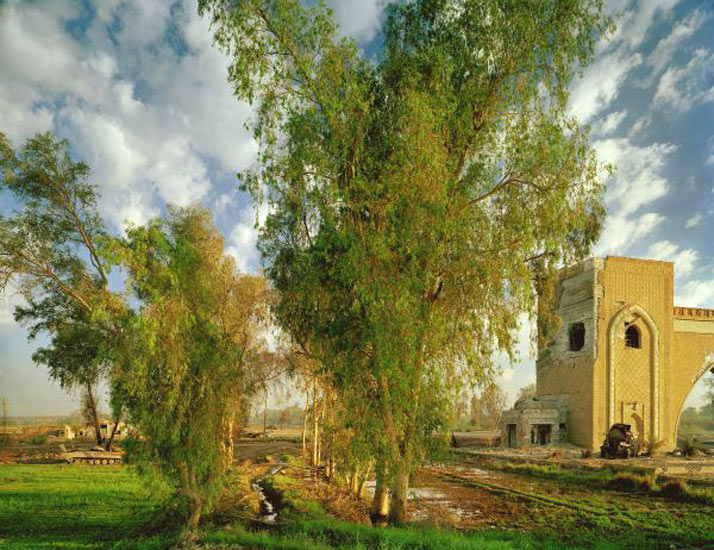
However, medium specificity has now largely fallen by the wayside: the mainstream view is that just because a medium isn't great at something, that's not a reason not to use it in that way. What is important is an awareness of the strengths and weaknesses of a medium, so that if either is ignored, this is integral to how you treat the medium. Consider painting: if you use it in a three-dimensional way by, for example, painting a three-dimensional object, then this should be deliberate rather than because you're unaware that paintings are best suited to exploring two dimensions - flatness. This is no different to writing: to be a writer, it helps to be aware of grammar so that you can ignore "the rules" to achieve a particular aim. To pick a photographic example, pictorialism has returned but in a very self-aware way - as by the war photographer Simon Norfolk (see photo below).
Before leaving medium specificity, it's worth pointing out two major failings that led to its sidelining. First, mediums are not distinct: Does Photoshopping eventually turn a photograph into a digital illustration - and if so when? If you take all the individual frames out a movie and put them in a book, is it still a movie, or are you now looking at photographs?
That said, it is undeniable that each medium has its own essential qualities: sculpture is not great at narrative, unlike literature.
Returning to photography, what is it good at? What are its unique qualities? These have been much discussed, and among the most well-known attempts is that by John Szarkowski in his book
"The Photographer's Eye"
• The thing itself
• The detail
• The frame
• Time
• Vantage point
One way to observe these properties clearly is not to look at accomplished photographs but at, say, family snapshots or a CCTV image, where the camera is used simply as a recording device.
The thing itself:
The camera sees reality, but a photograph is only a representation and thus exists as a separate object on its own terms. Despite the strong connection between the subject and the photographic image, the photographer should recall this difference, and, while looking at reality through the viewfinder, make choices based on how the image will appear (e.g. How will the film record colours? How big will the print be?).
The detail:
Photographs are full of details, and insignificant - often mundane - details can take on unexpected meaning and symbolism. This nature of the detail in the photograph was pithily summarised by Capa, who famously said, "If your pictures aren't good enough, you're not close enough."
The frame:
The frame is a window on reality, and allows the photographer to create a selective view of reality, creating relationships that never existed. The frame bisects objects too (not common in painting until the invention of photography).
Time:
Photographs immobilise the passage of time, whether a short instant or an exposure of hours. We thus have "the instant" showing time seemingly impossibly frozen, which caused such a furore when Muybridge showed his galloping horse in the 19th century (the sculptor Auguste Rodin was outraged, declaring, "It is the artist who tells the truth and photography that lies"), as well as ethereal blur and the trace of motion (e.g. blurred faces, and light trails).
Vantage point:
The camera does not have to see the world from head height: it can be pointed down, held at an angle, at ground level, under water... The camera allows us to see from unexpected vantage points.
If we bear in mind these unique properties of the photographic medium, then that goes a long way, I suggest, towards making a "good" photograph. We need to realise that photography is not painting.
Below, in my opinion, is a "good" photograph. It's by Simon Norfolk, and it's a large print, over a metre wide. An
article comments: "When you see this picture in a gallery from 20 metres away, you think, 'God, that's gorgeous!'" But when you're close up, you notice disturbing details, such as ruins, a bombed-out tank and a rocket launcher. And a label stating that it's a photograph taken during the Iraq War in 2003. It's not an idyllic scene but a war photograph: "you're looking at a place where people were slaughtered".
Simon Norfolk is aware of the unique strengths of the photograph and uses pictorialism in an ironic way - and it is arguable that this deliberate contrast between beauty and horror is as powerful as the usual photographs of war that depict death.