Which Digital Cameras have the best Dynamic Range?

Rob-F

Likes Leicas
Local time
10:07 PM
Joined
Mar 22, 2007
Messages
7,662
Location
The Show Me state
Forget megapixels and ISO ratings for a minute. Forget whether it's a rangefinder or an SLR. Which models have the best dynamic range? I'm getting tired of blown highlights vs. empty shadows. I'd like a camera that can handle a wider range than my D200. Is the best option still that Fuji that is built on a D200 chassis? (Not sure of the model anymore--S2 or S3?) Or is there something else now that is superior?
 
I have read that the Fuji S3 Pro is the one!

I know where you're coming from with the empty shadows blown highlights thing ... sometimes I wonder how digital has got to where it is. It's still a poor substitute for film in regards to dynamic range IMO!
 
Rob,

This is the question the digital camera industry does not want you to ask.
The industry only cares about Mega pixels, face recognition, video and very large and heavy zoom lenses.
 
This is the question the digital camera industry does not want you to ask.

Really?

The industry only cares about Mega pixels, face recognition, video and very large and heavy zoom lenses.

The industry, like any industry, cares about whatever it thinks its customers want. Sometimes the industry's marketing department and the consumers feed on each other in an endless cycle, yes. The industry thinks that more megapixels is a way to create consumer interest, so they push that in their marketing. Consumers pick up on it and demand more megapixels, and any manufacturer who doesn't want to get squeezed out of the market goes along with the gag to the best of their ability.

It leaves us with niches. The consumer camera niche, which does indeed care about mega-pixels, ultra-zoom, image stabilization, face detection and so on. The prosumer niche, which gives us G10's and Ricoh GRD's, and the like. The pro-am, which gives us the various micro four-thirds devices and the less-expensive dSLR cameras, and the professional, which gives us the Canon and Nikon full-frames, etc.

And each camera manufacturer is trying to find a nice they can carve out for themselves. Sigma is pushing Foveon technology (slowly). Fuji still uses the Nikon dSLR bodies but with their own tech sensors, which emphasize latitude and wedding photogs seem to love 'em. Sony is clearly going after both Canon and Nikon on the high end. Pentax and Samsung and Olympus and Panasonic all have odd little niches to go after. I'm a Pentax fan because of their continued ability to be backwards-compatible with every Pentax lens ever made, but that's my little quirk.

Megapixels? It might - just might - be nearly over. It seems that we're pushing some technical boundaries that make it hard to keep doubling the number of megapixels every six months or so (the current release cycle), so naturally the manufacturers are starting to downplay 'more megapixels' as the be-all and end-all. They want to find out what the next big demand will be with consumers. Blue-tooth? Wifi? GPS? Enhanced facial recognition? Casio is experimenting with ultra-fast captures, an interesting niche to be sure, if limited.

It's always an interesting dance. Find out what consumers want and give it to 'em. If they don't know what they want, sell them something until they do want it.

I get all that. But to me, it's all perfectly normal. For others, it's a continued sense of hostility and us-versus-them paranoia. Like they're plotting a world takeover or something. You'd think they were selling health care. Like a camera company ever chased you down, tied you up, and forced you to demand more megapixels. Sheesh. If you don't like it, don't buy it.

In answer to the OP's question, I suspect that Keith had the right answer. Fuji is big on enhanced latitude, to the extent that lots of wedding photographers swear by them. I would have thought the S5 would have more latitude than the S3, but I have no experience with either, so I do not know.

In any case, wedding photographers would tend to have the inside track on what camera has the best latitude. They shoot lots of very black and very white scenes, so the ability to handle extreme contrast and light/dark scenes is very important to them.

I also found this online:

http://photocritic.org/25-cameras-with-the-best-dynamic-range/

 
A medium format digital ;-)

Some of the lower resolution ones are down in the $10,000 range, maybe demos and last year's models, etc. are even a bit less. I guess the resellers are pretty negotiable.

I looked at the Fuji's closely last year. There are some issues around working with the RAW files that the DP Review and other internet articles report.
 
Does someone know why the Fuji sensor has such an amazing DR ... I think I read that it's at least two stops better in even the S3 Pro than the equivalent Nikon? Obviously though the technology that gives it this improved range restricts it to around 6 Megapixel because even though the latest offering is advertised as 12 Megapixel apparently it ain't necessarily so and is mainly the result of software manipulation.

I've been very tempted to go down this route because the S3 Pro is not an expensive camera used ... very cheap in fact and even though the latest S5 Pro has fairly substantial imrovements body and menu wise the image quality is much the same apparently.
 
The fuji DSLRs use a sensor that uses 2 pixels for every normal DSLRs 1 pixel. They're split into normal ones and highlight ones that operate on a different level, and they basically capture a little more information on the sensor level because of this. The s5 and s3 use the same sensor, the s3 uses an old crummy Nikon body and the s5 uses a d200 body. The s3 is archaic in it's write times and speed and the s5 is also pretty average.

Because of that pixel setup, at 400% DR (maximised DR mode) you get 6mp image.

To be honest, the 5d is the better camera out of them, simply because it has a bigger sensor with bigger pixels on it. The reason why the s5 and s3 fujis get such good ratings in DR on tests is because they test JPEG output, which is pretty crummy on the 5d, and limited to somewhere around 8-9 stops. Using raw you can easily achieve 12-13 stops of DR with the 5d, at much higher resolution, using a camera significantly more responsive and quicker with write times etc.

This is my opinion - I came really close to buying a fuji S5, but didn't end up doing it because it's clunky in all other ways besides DR. A 5d/5d mkII/d700 has just as much DR when shot in RAW and is a much better camera in every other way.
 
Fujifilm DSLRs would have to be about the best - they have extra pixels designed specifically to capture the brightness information giving them excellent dynamic range. I think from memory that they advertise their sensor as 12.6 megapixels but because of this the actual image size is the same as a 6meg camera or thereabouts - but with extra info from the additional sensor sites. I suppose this means the file sizes must be larger than those from a 6 megapixel camera as a result.
 
Fujifilm DSLRs would have to be about the best - they have extra pixels designed specifically to capture the brightness information giving them excellent dynamic range. I think from memory that they advertise their sensor as 12.6 megapixels but because of this the actual image size is the same as a 6meg camera or thereabouts - but with extra info from the additional sensor sites. I suppose this means the file sizes must be larger than those from a 6 megapixel camera as a result.
I had the S3 for a couple of years, (now sold) yes - a nice camera, if a bit heavy and bulky (reminded me of a slightly smaller Nikon F5) I did a lot of portraits, and one or two weddings with it, yes-good DR but not approaching what I get from colour negatives - in contrasty lighting.
Dave.


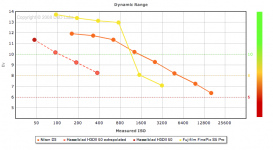
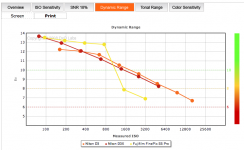
Interesting to compare the S5 Pro to the 5D on that site ... according to their tests the Fuji has a noticable advantage over the full frame Canon. The 5D II may be improved over the 5D, I haven't checked, but it's also a lot more recent than the S5 Pro which has been out a couple of years.

Interesting to note that the Fuji only retains it's (substantial) advantage up to 800 ISO then it's all Canon and Nikon.
 
Last edited:
The fuji DSLRs use a sensor that uses 2 pixels for every normal DSLRs 1 pixel. They're split into normal ones and highlight ones that operate on a different level, and they basically capture a little more information on the sensor level because of this. The s5 and s3 use the same sensor, the s3 uses an old crummy Nikon body and the s5 uses a d200 body. The s3 is archaic in it's write times and speed and the s5 is also pretty average.

Because of that pixel setup, at 400% DR (maximised DR mode) you get 6mp image.

To be honest, the 5d is the better camera out of them, simply because it has a bigger sensor with bigger pixels on it. The reason why the s5 and s3 fujis get such good ratings in DR on tests is because they test JPEG output, which is pretty crummy on the 5d, and limited to somewhere around 8-9 stops. Using raw you can easily achieve 12-13 stops of DR with the 5d, at much higher resolution, using a camera significantly more responsive and quicker with write times etc.

This is my opinion - I came really close to buying a fuji S5, but didn't end up doing it because it's clunky in all other ways besides DR. A 5d/5d mkII/d700 has just as much DR when shot in RAW and is a much better camera in every other way.

I've not shot with the Fuji, but have a Canon 5D and 1Ds3. Both are very good if you shoot raw - DXomark suggests that they both are able to deliver between 11 and 12 stops of dynamic range at the best iso (100 on 5D, 200 on 1Ds3) if shot well. The 5D only has a 12-bit ADC so more than 12 isn't possible. The 1Ds3 has a 14bit ADC but appears to have a similar noise floor to the 5D. However, any lower level data is still there under the noise.

Both cameras are able to deliver remarkable files and the shadow detail available tends to be much easier to get at than anything in neg film when scanned. OTOH, you need to watch the highlight.

Mike
 
Take Dxo-marks numbers with a grain of salt. Their numbers indicate that the D5000 has better DR than the D3, which in real life definitely isn't the case. You get a stop or two more out of a D3 RAW (I've got a D90 and I've worked with D3 RAWs) than one from a D5000/D90/D300.

Other than that, out of "normal" cameras that a Joe Sixpack actually can/may realistically afford, the Nikon D3/D700 and the Canon 5dmk2 seems to be what you're choosing from, with the Sony FFs and somewhat aging Fujis as a outsiders. Important to note that DR continuously gets better with each generation of digtal sensors. Won't take on MF film tomorrow, but from the aforementioned offerings you get very nice files and the cameras themselves are a joy to use.

/Mac
 
Back
Top Bottom