Why and when did you switch from non-ASPH to aspheric lenses?

raid

Dad Photographer
Local time
12:18 PM
Joined
Nov 2, 2005
Messages
36,440
Location
Florida
I wonder whether using aspheric lenses is for everyone or not, assuming we can cover the extra cost of such lenses.

If you switched away from the non-aspheric lenses to aspheric lenses, could you share with us why you did it. Is it the less-flare effect? Is it the prestige? is it because you were curious about it? Why?
 
When I bought a smart phone. Because I didn't have much choice, AFAIK most of them have aspherical elements. There really has been a sort of revolution that apparently went largely unnoticed, aspherical elements have become much cheaper to manufacture and with the simpler lens designs they allow, are in many cases actually cheaper than comparably corrected lenses with spherical elements. Note the Voigtländer Ultrons, not terribly expensive, from quite a few years back already incorporate asphercial elements. Leica and Zeiss are behind the times or have a pure marketing thing going on, still reserving aspherical elements for their super-premium lenses.
 
In many photographic lenses an aspherical element alone doesn't make much difference.

ASPH lenses often come with modern designs (i.e. you're stuck with double-gauss lenses and their mid-aperture shifts with non-aspherical 35mm Summicrons), which is what actually set things apart.
 
This is a good question, Raid has brought up. Over the space of a few years, I have bought the ASPH 21, 24, 28, and 75mm ASPH lenses. I bought them thinking they were "sharper" than spherical ones. I started with the 28mm Summicron, because it was more compact than the 28 Elmarit I first tried. The Summicron doesn't block the finder (much). My understanding was that one aspherical element does the work of two spherical ones (probably an oversimplification), with the possibility of making the lens more compact. And the 28mm and 75mm Summicrons do seem compact. But my 21mm ASPH is a lot bulkier than my old 21mm SA; so this rule seems not always to apply!

As to sharpness. The ASPH lenses are certainly sharper wide open, compared to sphericals. And I do like my photos to be sharp. But I also like the somewhat softer look of my 50" plasma TV, preferring it at times to the 40" 4K TV we have in the living room. It is so easy to look at. I'm not happy they have discontinued making plasma screens. And some older lenses are like that. Less sharp, to be sure, but pleasing nevertheless.

And I do like my Leica lenses to be compact, which my 21mm and 24mm ASPH lenses are not! I could see changing one of them to a spherical type. In fact, I do have the 21mm CV Color-Skopar. Maybe I'll just take it on the next outing, and leave the ASPH behind.
 
Dear Raid,

If I'm buying new, it may well be that the only realistic choice is aspheric: cf. my 75 Summicron. Or indeed as Santini said the 15 Heliar.

On the other hand, I've tried aspheric 35 Summiluxes and I prefer the smaller, lighter V2 pre-aspheric.

I've NEVER changed from non-aspheric to aspheric. I just don't change lenses like that.

Cheers,

R.
 
I never targeted a lens for being aspheric. Like Roger, I like using the V2 Summilux 35/1.4 pre-asph. Some of the newer CV lenses have aspherical elements. The price is of course a factor too if you want a Leica lens that is ASPH. My 74/1.4 Lux is not ASPH. Some prefer the Summicron 70/2 ASPH over the Lux.
 
Honestly don't really consider it as price/cost is a much more important factor to me. Of the lens I have/use I think one, possible two are/maybe aspheric namely the VC 21 F1.8 and possible the 28mm Summicron V1 all my other lens are from the 1950s and 60s.
 
As some have mentioned, the aspherics and modern formulas go hand in hand. For that reason, I tend to shy away from them, preferring the rendition of more classic formulas.

My personal exception is the 35mm Summicron ASPH (V1), particularly for color. The images (on film) look incredible.
 
. . . My personal exception is the 35mm Summicron ASPH (V1), particularly for color. The images (on film) look incredible.

On the other hand, when I tried the original 35 Summilux Aspheric, I was deeply unimpressed. The previous (pre-aspheric) was so much smaller and lighter, and only slightly inferior optically. Better still, I already had the older lens and didn't need to buy a new one. On top of all this, my old pre-aspheric is now worth several times what I paid for it, so presumably I'm not alone in holding it in high regard.

Cheers,

R.
 
I don't think I have ever replaced any lens, non-aspheric or otherwise. I couldn't tell you whether any of my lenses contain aspheric elements or not. Seriously, did anyone intentionally replace their non-aspheric lenses with aspheric ones because the new lenses were aspheric?
 
To the best of my knowledge I have never made a decision on whether or not to buy a lens based on it having an aspheric lens element in the design. So I can't say there was ever a conscious decision to switch from a non-aspheric design to a similar lens that included an aspherical lens element. However I do have a few that I have found to be quite useful as well as being very good lenses.

In fact, though I am not typically a fan of wide angle lenses, one of my favorite lenses of all time is my SMC Pentax FA 31mm f/1.8 AL Limited. It is an amazing lens on both digital and on film (for which it was originally designed.)

Another of my favorite lenses (currently mounted on my LX) is my Voigtlander Ultron 40/2 Aspherical. This lens reportedly includes two aspherical element yet is quite small in size. So I don't believe that the inclusion of aspherical elements is what would cause a lens size to increase. I turn to this lens frequently when shooting TMX100 or CMS20 because of its impressively high resolution and good contrast.

I own a few other lenses, mostly Pentax glass, that include aspherical elements. A couple of exceptions of which I am aware is the Voigtlander Apo-Lanthar 90/3.5 LTM (which I like well enough that I also bought as a K-Mount lens) and the Nokton 50/1.5 M mount. The first one I tend to turn to whenever I need additional reach with my Leica III while the latter gets occasional attention on my M-A.

I used to own the Voigtlander Nokton 50/1.2 which was a very nice lens but also a very large lens. Since it was used so infrequently it ended up being sold to Raid for his own collection of 50s.

There are likely others but the last one that gets a surprising amount of use is my SMC Pentax DA 18-135 zoom. This is actually a pretty useful lens when photographing grandkids and their various sports activities. It is not a particular fast lens but it is so versatile that it ends up on the Pentax K5iis quite frequently.
 
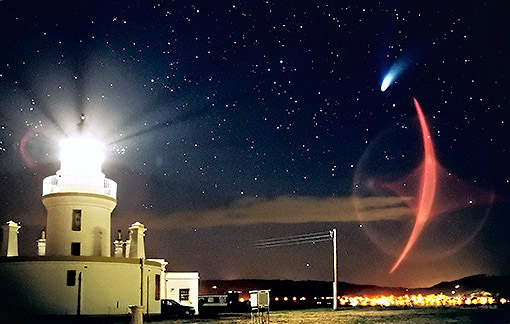
I was not happy with the softness of the 35mm summicron 11310 when used wide open for nightscapes and auroras etc.
The newly introduced 35mm Summilux ASPH was breathtakingly sharp wide open and free of any glow around point sources. ( A lot of money ) money well spent.

Flare could be provoked - admittedly the light house must be 20 stops brighter than the comet and stars.

HaleBopp35summilux.jpg
 
Do note that even the cheapest of the current Nikkors, the lowly AF-S 18-55/3.5-5.6 DX, has a "hybrid aspherical lens element that eliminates various types of lens aberrations".
 
I had considered going from a 28/f2.8 non-asph to a 28/f2.8 asph M lens because of the much more compact lens size and better image quality, but the thing that actually made me do it was spotting a really good secondhand deal.
 
I had considered going from a 28/f2.8 non-asph to a 28/f2.8 asph M lens because of the much more compact lens size and better image quality, but the thing that actually made me do it was spotting a really good secondhand deal.
Getting a good deal fuels a lot of purchases. I use to tell my daughter it's only a good deal if you wanted it enough to pay full price.
 
As some have mentioned, the aspherics and modern formulas go hand in hand. For that reason, I tend to shy away from them, preferring the rendition of more classic formulas.

My personal exception is the 35mm Summicron ASPH (V1), particularly for color. The images (on film) look incredible.

I also favor the old lenses, such as the Tessar, Elmar, Summar, Summarit, ... and so on. I can see that aspheric lenses are better designed to withstand flare and maybe get vibrant colors, but the old lenses have their own character and beauty to them.
 
On the other hand, when I tried the original 35 Summilux Aspheric, I was deeply unimpressed. The previous (pre-aspheric) was so much smaller and lighter, and only slightly inferior optically. Better still, I already had the older lens and didn't need to buy a new one. On top of all this, my old pre-aspheric is now worth several times what I paid for it, so presumably I'm not alone in holding it in high regard.

Cheers,

R.

I've been very impressed by the B&W images I've seen from the 35mm Summilux Pre-Asph. It's definitely on my all-time lens list. The performance at f/1.4 doesn't bother me simply because I never use lenses at f/1.4.
 
To the best of my knowledge I have never made a decision on whether or not to buy a lens based on it having an aspheric lens element in the design. So I can't say there was ever a conscious decision to switch from a non-aspheric design to a similar lens that included an aspherical lens element. However I do have a few that I have found to be quite useful as well as being very good lenses.

In fact, though I am not typically a fan of wide angle lenses, one of my favorite lenses of all time is my SMC Pentax FA 31mm f/1.8 AL Limited. It is an amazing lens on both digital and on film (for which it was originally designed.)

Another of my favorite lenses (currently mounted on my LX) is my Voigtlander Ultron 40/2 Aspherical. This lens reportedly includes two aspherical element yet is quite small in size. So I don't believe that the inclusion of aspherical elements is what would cause a lens size to increase. I turn to this lens frequently when shooting TMX100 or CMS20 because of its impressively high resolution and good contrast.

I own a few other lenses, mostly Pentax glass, that include aspherical elements. A couple of exceptions of which I am aware is the Voigtlander Apo-Lanthar 90/3.5 LTM (which I like well enough that I also bought as a K-Mount lens) and the Nokton 50/1.5 M mount. The first one I tend to turn to whenever I need additional reach with my Leica III while the latter gets occasional attention on my M-A.

I used to own the Voigtlander Nokton 50/1.2 which was a very nice lens but also a very large lens. Since it was used so infrequently it ended up being sold to Raid for his own collection of 50s.

There are likely others but the last one that gets a surprising amount of use is my SMC Pentax DA 18-135 zoom. This is actually a pretty useful lens when photographing grandkids and their various sports activities. It is not a particular fast lens but it is so versatile that it ends up on the Pentax K5iis quite frequently.

Hi Dan.
It was the CV 50/1.1. It is a great lens. Thanks. 🙂
 
Back
Top Bottom