Why film?

Bill Pierce

Well-known
Local time
2:39 PM
Joined
Sep 26, 2007
Messages
1,407
I still maintain a wet darkroom, but it sees most of its use providing silver prints from some of my old negatives for folks who prefer silver over inkjet. My family and friends are likely to get inkjet prints from scanned negatives. This afternoon I was scanning some family negatives from the ’70’s, and I wondered why some folks still shoot film. In many technical aspects, today’s digital cameras produce images that are superior to film, especially if you are one of the many who did the majority of your pictures with relatively high speed 35mm films.

I could only think of 2 reasons, although I’m sure there are more. (1) If you first looked at digital some time ago, and haven’t looked since then, it really has improved. News photographers were among the first to use digital. Believe me, the sensors are better, the cameras are better, the final images are technically better. I’m reminded of this every time I look at my early digital images. (2) Film slows you down. There are a limited number of frames on a roll of film (much less a sheet film holder). There’s only one ISO at a time. And it’s highly unlikely you have a motorized film camera that is going to shoot 11 frames a second. To put it simply - it’s more likely that you think before you press the button. That to me is the important reason.

Now it isn’t impossible to think before you press the shutter release on a digital camera. It may not be done very often, but it is possible with a great deal of self discipline. Therefore I want to know from the folks who are still shooting film why they are doing it.
 
Why I shoot film.
1. I like Going slow
2. I like the ratty look compared to digital (because digital is just so good).
P.S. I was the guy in high school that was told I had so much potential but was wasting it on goofing off.
 
I shoot film because originally it was different to digital and i fell in love with that aspect but now that magic has long worn off i keep shooting it because I enjoy the process and the end goal and sure my digital is better than my 35mm equipment but I HATE editing which is required as the raw files are always very flat meanwhile I have the darkroom process which I love, I have some speakers in my darkroom and can easily pull a ten hour day in there working.

However, I still have to edit and scan film for sharing online and any jobs ive worked who need digital files but its often far better than digital editing because Im not selecting from 5 different versions of the same shot and putting punch into it. Theres also the surprise element even when scanning that really still gets me.

Also the quality I can get from my RB67 is just stunning, really really stunning to the point when I go back to 35 (which isnt very often anymore) I find the quality disappointing when I print 12x16 which is always the end goal.

This year is probably my best year for shooting film as ive been trying to migrate any work ive been doing digitally to film which takes a bit of convincing to clients but ivew had good luck. The pinnacle of this was getting the opportunity to shoot backstage and catwalk at London fashion week where I left my digital and just shot with a Mamiya C33 and Rb67 with a metz flash and now ive got my film back - I regret nothing, they came out great
 
I use a digital P&S for casual snap shots. But for serious recording of images (people, buildings, streetscapes, and scenery) I shoot only B&W film on an archival film base.
That is a polyester film base. I do very little printing - only for my wall or to give away
prints.

I just obtained some Arista Litho film to start copying some of my old slides onto.
 
Though I do use digital I really enjoy the process of using film much more.

To start, there is a certain anticipation that builds between the capture and seeing the negative.

The delay also results in a bit of separation and I seem to be able to be a little more objective when I view the results.

With film I capture my image, or a series of images, and move on. With digital I have found myself taking and deleting what amounts to more then a roll or two of shots trying to get that specific exposure.

I get to use some really interesting equipment. I certainly can't go out with a full WeeGee setup of Speed Graphic with flash and bulbs, or a Leica 1, if I am using digital.

I get to really learn the characteristics of a given camera, lens, film combo, and what I can and cannot do with it. Digital allows me to pretty much post process anything I want.

I don't remember ever having accidentally deleted a negative, or losing an entire hard drive full of negatives.

There are probably tons of other reasons I could think of, and probably will later on. But there is the one reason that captured my attention back in High School in the first place, and still sends a thrill running up my spine every time it happens.

I am hooked anew everytime I turn on the lights and I see that print that I created floating in the fixer. That is magic my friend, pure magic. No computer monitor can recreate that same magic for me.
 
I was discussing boating with a colleage while out on the lake yesterday, He prefers everything modern, with GPS navigation and computer control. Basically set your origin, your destination, and let the boat take care of the rest.

A few decades ago, one of my professors got into boating big time, but his passion was for sailing. His dream was to sail down the Atlantic coast (of Canada, and the USA), into the Carribean Sea and then make his way back. I think that he finally did it soon after he retired. He loved the feeling of the wind, the adjustment of the sails, all of that stuff.

I guess there are two types of people in the world.
The first type are those who just want the end results in the most efficient way.

The second type are those who want the experience of the journey, with all of the uncertainties, and mystery of whether or not the end result will turn out. The second type likes the craftsmanship aspect of working with your hands, thinking on your feet. You may produce something as good as the computer controlled version can do it, but you have a much higher likelihood of botching it up. But, that uncertainty of outcome is what makes it so much fun.

I can see why news photography went digital ASAP. They want the picture before the event becomes stale. My wife loves digital photography. She thinks that the cell phone is the greatest thing that was ever made for picture taking. I'm of the second group. I'm not in any hurry to see my pictures. When I finally do see the roll developed, I see the event from a different perspective. I'm not in the emotion of the moment, and I can see the results from a more detached perspective. I do own a digital camera: an 8MP Kodak from 2006. It still works, and I occasionally use it to take pictures for stuff I want to sell on ebay. For that role, it is fantastic, and I get instant results. I rarely use it for anything else, though.

I still like the mystery of not knowing with certainty what the outcome will be. I'm frustrating myself further with my experiments with IR film, and using flash bulbs for fill-in flash. I just did some of this today. I was wondering about my sanity for being out in 94 F heat with high humidity, hiking up and down woods and firing off flash bulbs as I go. (I did bring along a bag to collect the used bulbs, not to pollute the woods).

My own personal view is that digital is like microwave cooking. Fast, efficient, and able to raise about as much passion in me. I'd rather cook over a wood fire, or charcoal. It's much messier, takes way longer, and there's a good chance that I'm going to turn a good piece of meat into cinders. But, when it's done right, it just feels so good.
 
1. fLeica is cheaper than dLeica.
2. fLeica needs no batteries.
1 and 2 are practical reasons for me.

3. I see no reason to use digital for art part of my photography. News, FB, paid shots are for digital. But it has nothing to do with art for me. Darkroom print is the art. Even if it family snapshot. For me.

4. I have tried all bunch of digi for street and landscape. And not long time ago. Modern cameras with 20+ mPixels and 12K+ ISO. It just doesn't work for me. Every time I hold film Leica, it feels right for me.
 
I shot digital only for 10+ years. I just did a extensive scanning project of B&W negatives from India in the 70s and 80s. I was so taken with the look of the images, that I decided to give film a serious go. I replaced my MM1 with an M6.

So for me the pull is mainly the more organic aesthetic. I also appreciate the slowing down aspect. The prospect of jumping off the digital camera merry-go-round is also appealing. And, of course, film Ms are such a treat.

We'll see where it leads, but so far I'm finding the results and the experience wonderful.

John
 
I take photos for a living. I shot film for many years before going to digital under client pressure in 2006. My work-work is almost all digital now. I occasionally run a roll or two of 35 b+w on a portrait job after making digital photos.

I like the look of film better. It's a personal taste thing. All of my personal b&w images are made on film. Color is mixed between film and digital.

All of my printing is digital. I think pigment printing is far better for my personal work than wet printing. Another taste choice. If some of the older Agfa papers I loved, like Portriga Rapid, were around I might be willing to do some wet printing again.

Another reason for making my personal images on film is the number of problems with digital archiving. Bit Rot is real. Friends in the music business complain of it often. A recording made days before will have lost something over a short time. Piano harmonics are often cited. Storing digital data on changing materials is also an issue. With digital media storage types changing constantly - (remember 5 1/4 & 3 1/2 floppy disks, Zip Drives?) in a few years the devices used to recover data will be lost to "more modern" methods. A piece of film as a Master, can always be scanned on whatever modern method is in vogue.

A fellow I know got the contract to digitize a great part of The Library of Congress. He's using very high end Creo IQ scanners for this work. But the storage media chosen is 78 RPM vinyl disks.. 78 RPM records. The thinking being, that a simple stylus on a vinyl disk, moving at 78 RPM would be easy to construct far into the future. The digital data is safe on vinyl, it's not magnetic or UV problematic like much of the optical media available .. no Bit Rot.

https://en.wikipedia.org/wiki/Data_degradation
 
Film cameras are less complicated to operate; i.e. fewer settings and controls, in standard locations.
Decisions are made solely by me, in my head, not by a microprocessor using the latest algorithm.

And then there are the negative and the print, tangible results of the craft.
Making the darkroom wet print is my favorite part; so magical, so sensual...

Chris
 
Therefore I want to know from the folks who are still shooting film why they are doing it.

1. My digital cameras cannot duplicate the image quality I am able to obtain from my medium format and large format film cameras.

2. I cannot fiscally justify replacing my medium format and large format film cameras with comparable digital cameras.

3. I prefer battery independent cameras.
 
Moved from digital to film for similar reasons others have stated above:

1.Could not afford a digital rangefinder at the time (2008). Still cannot afford a digital rangefinder (2017).

2. Like the look of black & white film, particularly the grain, whereas I never liked digital noise.

3. Love the process itself, well, most of it. Really though, the film advance alone is a tactile delight.

4. I will soon start making my own darkroom wet prints, because I psychologically struggle with the ‘surface’ aspect of B&W inkjets. I say psychologically, because it's primarily an issue when I already know the print is an inkjet.

5. Discovered after switching the joys of not fretting over batteries or the latest and best B&W digital conversion software/method...why bother trying to emulate?

6. Yes, it did slow me down in a positive way, although I think both digital and film have their pedagogical advantages depending on the individual.
 
Pretty simple really, I see more money from making silver prints via the darkroom in my future than from digital. I also see a better life lived in doing it and eventually sharing my passion for it in teaching workshops at my new home which I am currently building out a 500 square foot, top of the line fine art darkroom in.

For the past few years and considering how much it added to the cost of my new home, I have invested well over $100,000 into being able to do film and silver gelatin printing for the rest of my career....a career that has seen full time use of digital since 1994.

It's the real deal, it takes real talent and it is now more popular and respected as an art form than ever...
 

Attachments

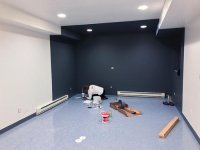
  • Dryside.jpg
    Dryside.jpg
    20.3 KB · Views: 0
  • wetside.jpg
    wetside.jpg
    14.8 KB · Views: 0
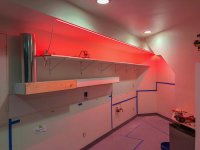
  • Safelight.jpg
    Safelight.jpg
    27 KB · Views: 0
First of all, I'm an amateur photographer, so I have none of the pragmatic pressures that weigh upon the professional.

I like the simplicity and the tangibility of film.

I was originally alienated by auto-focus, multi-mode film SLRs. I'm left-eye dominant and I wear glasses. The grouping of controls just to the right of the eyepiece was always an ergonomic nightmare for me. Add to this the fact that with my slower, more contemplative approach to photography, I never felt the need for auto-focus. So, I stuck with the older technology.

Then, I started migrating more and more into medium format and square composition with TLRs. I really like composing on a waist-level finder with the camera on a tripod. It's like laying the composition out on a canvas while viewing with both eyes and having both hands free to adjust the camera controls and placement.

Back to the principle of simplicity, I like all-manual cameras with just the basic controls, all managed by me. Modern cameras with all the menus and controls - all to manage just focus, aperture, and shutter speed - feel so chaotic. This chaos utterly destroys the "Zen" of photography for me.

(Oh well, I drive an Accord with a stick shift and I like fountain pens, mechanical watches, and such.)

- Murray

PS. I'm really gratified to see someone Jake Mongey's age so rapidly developing solid photographic skills, in digital, film, and the traditional darkroom. Finding a sixteen-year-old who is interested and skilled in film photography and who makes such solid contributions to a forum like this amazes me.
 
I'm an old timer and started shooting film, processing and printing when I was a kid. One I like the look of a fine silver gelatin print vs digital. I feel there's a tonal depth that's different than digital prints. Digital prints have come a long way but they still don't equal a fiber base silver gelatin print. Archiving raw digital files and retrieving them to browse is a pain. Important digital files need to be backed up on multiple storage devices. Film in archival pages in archival binder boxes are so easy to view on a light box. No booting up a disc and waiting for previews to load and render.

The East Tennessee History museum has established a special collection of my documentary work in Appalachia. I've willed roughly 100,000 negatives of cock fights, moonshiners, kkk cross burnings, serpent handling church services and many more topics to them. Many museums won't accept digital files due to archiving issues and questions as to whether those files will be readable in 100 or 200 years. I continue to shoot subjects for the museum and continue to shoot B&W film. Today I drove 4 hours and shot a serpent handling church service in the mountains of East TN.

I got into digital around 1998 shooting with a Dycomed scanning back for commercial work. I adopted digital when the Nikon D1 came out and upgraded regularly and phased film out as digital improved. I still shoot a limited amount of commercial work of which most is digital. I will however use large format when extreme enlargements are requested.
 
My earliest digital work has bit rot. And lots of it.

Sure, film can get damaged and technology will migrate, but it has a chance of being useful to somebody in the 2100 and 2200's. My digital files won't have a chance in &@**.

So I shoot b&w film for the future. And iPhone for the rest. But I'd love an X100F or M10.
 
Back
Top Bottom