
XPAN - when to use/when not to use the center filter?

Local time
9:39 PM
Joined
Jun 21, 2006
Messages
2
Location
London
What's people's experience with when/when not to use the 49mm centre filter on the Hassy XPAN 45mm and 90mm lenses? (with slide film)

On the 45mm lens, discussions seem to agree it's essential at f4-f8, but what are people's experiences at f11-f22? Hasselblad say it's not necessary, but I read that many people leave the centre filter on the 45mm even at f11-f22 - what's the reason for leaving the centre filter on then? Are people still finding there's some residual vignetting which the centre filter corrects? (Or is it just that it's easier not to keep changing the centre filter on and off?)

For the 90mm lens, I read that many people don't use the centre filter 'at all'. So are people happy shooting the 90mm lens even at f4 without the centre filter?

Many thanks for all help! Background: I shoot exclusively Fuji slide film. Most of my work is tripod-based landscapes shot around f16 for depth-of-field, hence particularly the question about filter or no-filter on the 45mm at f16... Would also like to try handheld candids at the f4 end...

(Have just purchased the XPAN kit plus 45mm/90mm lenses and centre filter -not 30mm lens yet🙂..., Was able to try a second-hand XPAN outfit on a hire basis, but wasn't able to try the center filter from the hire outfit.)
 
Quick and not very useful answer would be to shoot a few test rolls. Stick it on a tripod aim it an an evenly lit subject, a wall shall we say and work your way through the f stops shooting one with and one without the filter. Shoot one roll at reasonably distant subject so that you can fcus close to infinity, another at a middle distance, another close. Noting always what you did. The results should give you the answer.
 
Although I have the center filter, I shoot both my 45 and 90 all the time without it, even wide open. I don't see any discernable difference. The only lens which really needs one is the 30mm where vignetting is highly apparent with the use of the filter. If you haven't gotten one, save your $200 and go without it. I wish someone had told me before I forked out the dosh for one.
 
When shooting slides for projection purposes with the 45mm at high apertures you will need the center filter.
If not. a digital center filter is easily applied during the PP

Wim
 
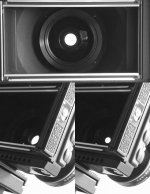
You have two vignetting problems with panoramic cameras. First, below f/11, the aperture is being vignetted and is not round. This cause light to fall off toward the edges because the effective aperture is getting smaller. The attached image show a Horseman SW612 (the same thing happens to the Xpan). The top image show the aperture from the center of the film, which is the area that is properly exposed. The two lower images shows the aperture from the corner of the film gate both wide open (f/4.5) and stopped down to f/11. The f/11 aperture is round; the f/4.5 aperture is oval iand is being vignetted by the physical obstuction of the lens barrel. (BTW, the oval aperture also impacts sharpness because it affects the shape of the Airy disk. This is most noticable with point light sources.)

The second kind of vignetting is due to the cosine 4th law. The further the light strikes the film from 90 degrees, the greater the light fall off. For most cameras this is not a problem. For panoramic cameras, this is a major issue and the reason they need a center filter. This is also the reason that no one uses the center filter with the 90mm.

How much vignetting is tolerable depends on the photographer and the film used. Slide film shows the affect the most because of the high contrast. The vignetting can be corrected in negatives when printing (or in photoshop). Vignetting can also cause a color stift toward the edges. With color film the shift is usually toward blue.
 

Attachments

  • Mech_Vignetting.jpg
    Mech_Vignetting.jpg
    84.7 KB · Views: 0
One other thought. While you can even out the vignetting during printing or in photoshop, you cannot regain any shadow detail lost by underexposure.
 
Other conclusion: the ctr filter is the most expensive filter / piece of glass I ever saw.
Think I will go for scanning and removing the effect, if I want, sometimes it is just nice.
cheers
Sven
 
Terence T said:
Although I have the center filter, I shoot both my 45 and 90 all the time without it, even wide open. I don't see any discernable difference. The only lens which really needs one is the 30mm where vignetting is highly apparent with the use of the filter. If you haven't gotten one, save your $200 and go without it. I wish someone had told me before I forked out the dosh for one.

I agree with Terence

Although I own the center filters for both the 45/90, I almost never use them. The cut in speed on already slow lenses is just not worth it. I'd rather use that speed+vignetting to shoot lower-light situations. The vignetting that others are worried about is really rather negligible, and certainly easily taken care of with PS dodging.

For me, shooting slow slide film as well as B/W, speed is my first consideration. I rather like the very mild vignetting effect actually.

All a matter of whether you want to fiddle with the filter in the field and lose some speed, or whether you want to deal with it later with PS and take it out 🙂

Wider than 45mm? I have no idea, as I don't have that lens 😉
 
The center filter is really only necessary on the 30mm lens, but not so. I have the Fujinon 30mm lens which does not come with the center filter. It is an extra accessory and an expensive one at that. Since I scan the negatives anyway, it is quite easy to correct vignetting in Photoshop.
 
XPAN - center filter 45mm at f11, 16, 22

XPAN - center filter 45mm at f11, 16, 22

Many thanks to everyone for their answers. Not so much a question of whether to buy the centre filter [I already have] but whether to use it at f11,f16,f22 on the 45mm lens. I shoot almost exclusively landscape at around f/16 from a tripod, so have the choice of whether to go with the filter or not at those apertures...

Can anyone who just leaves the center filter on the 45mm all the time specifically confirm that the results at f11,f16,f22 are evenly illuminated? (and certainly not overcorrected)


I did already have the chance to hire the camera (without centre filter) before buying, and found fairly low fall-off (but some) at f/16 on the 45mm - don't necessarily consider myself a good judge of these things but it looked like about 1/2 stop; it was demonstrably less than the adjacent frames bracketed at 1stop under.

I'm trying to get a handle on whether centre-filter correction on f/11-f/22 would be an improvement (even things out) or an overcorrection - has anyone heard of any reports of overcorrection??


(The filter makes nominally a 1-stop cut at the center, but I'm guessing the effect on different parts of the film [the centre of the image area versus the edge of the image area specifically] might not always be a strict 1-stop, because depends on the path of the light rays illuminating that bit of the film, ie which part of the filter they passed through, which in turn depends on the aperture and a knowledge of optics ... I don't have this knowledge of optics, but if anyone (Finder?) does than please do tell!)

Many thanks!
 
The center filter should produce the exact opposite effect of the light fall off due to vignetting. Since the amount of vignetting slowly increases as you leave the optical axis, the filter should compensate that.

How much of the gradient of the center filter is used depends on the angle of view of the lens. Idealy the filter should be tailored to the lens. But basically the filter is dodging the center of the image so the increase in exposure time due to the filter factor equalizes the exposure across the film plane and eliminates the affect of vignetting.

BTW, all camera lenses vignette when wide open (as described in my first example about the aperture shape). This vignetting is usually eliminated by stopping down two to three stops. Manufacturers realized that most user would not notice it (it is also true with visual instruments such as binoculars). Because of the geometry of panoramic cameras, this can be more of a problem - it really boils down to whether you care about it or not. Some even like the effect.

To completely eliminate the barrel vignetting at the maximum aperture requires very large front and rear elements. The shorter the focal length, the hard this is to do because of the angle of view - my Nikkor 50mm f/1.8 has a much smaller front element than my 55mm f/4.5 Rodenstock on the Horseman even though the Nikkor entrance pupil is over twice as large.
 
Can anyone who just leaves the center filter on the 45mm all the time specifically confirm that the results at f11,f16,f22 are evenly illuminated? (and certainly not overcorrected)

I can confirm this.. i leave my CF on permanently, and never had a problem. I shoot velvia 50. I have also spoken to others also who leave theres on permanently.!! No probs!!

The filter is a +2 stop compensation by the way, and ignore the above post about the guy owning the centre filter for the 90mm, IT IS NOT REQUIRED FOR THE 90, REGARDLESS OF FILM.

Oh and 1 last thing... if youve noticed "falloff" at f11, f16 etc.. it may help to take the following into consideration... the xpan (like other panoramic cameras) has a much wider field of view than a normal camera... So for instance, if youve lined up your shot, and off to the left of the viewfinder is the sun (not in the frames, but close!!!)... if this was the case, youd probably see a falloff in the image from left to right, because the further away from the sun you would get a little bit darker.... I dunno if this makes sense coz im writing fast, but i think NATURAL falloff is what im trying to say... Its not because of the aperture ur shooting at...
Look at the sun... ITS BRIGHT..and near the sun is bright!!!.. the rest of the sky isnt that bright is it?...

I have particularly noticed this when using a polarizer... i find i get very uneven levels of polarisation at times (depending on time and direction). Personally, i think falloff in some photos can be effective!@

Good luck...🙂
 
Last edited:
kbg32.....
what type of film do you use?.. have u ever shot low light with slide film?

I have trannys from before i got my filter,.. shooting at f4 and f5.6 in low light and the falloff can be EXTREME... so much so it can ruin good images.

Can you give any good reason to not "reccomend" using the filter?...


I should also say this... The only reason i leave my centre filter on permanently is because its a pain in the butt to keep changing it all the time. I do shoot alot of early morning, late afternoon low light stuff, which usually means f8 and below hence the filter. I do also shoot blue skies from time to time, f16 stuff, so i just leave it on. It doubles as a lense protector. Id rather clean the filter than the lense.

And if you shoot velvia in low light (dusk n dawn stuff) there aint no point typin on ere that the 45 dont get fall-off, because i have MANY images (pre filter) that proves it does happen.

Thanks 🙂
 
Last edited:
Wow!

Wow!

What kind of subject materials are you people who say the ctr filter is unnecessary shooting?

If you take a slide, landscape exposure @ sunset (looking away from sun) @ f/4 w/o the cetner filter on either the 30 or 45, you just ruined your picture.

The light fallout can be extreme. It is particularly noticable in the sky, where you'll have a white center sky & dark blue edges. RUINED I say!
 
Ben1 said:
kbg32.....
what type of film do you use?.. have u ever shot low light with slide film?

I have trannys from before i got my filter,.. shooting at f4 and f5.6 in low light and the falloff can be EXTREME... so much so it can ruin good images.

Can you give any good reason to not "reccomend" using the filter?...


I should also say this... The only reason i leave my centre filter on permanently is because its a pain in the butt to keep changing it all the time. I do shoot alot of early morning, late afternoon low light stuff, which usually means f8 and below hence the filter. I do also shoot blue skies from time to time, f16 stuff, so i just leave it on. It doubles as a lense protector. Id rather clean the filter than the lense.

And if you shoot velvia in low light (dusk n dawn stuff) there aint no point typin on ere that the 45 dont get fall-off, because i have MANY images (pre filter) that proves it does happen.

Thanks 🙂

I use various films, both negative and transparency. I have never had vignetting problems with the 45 or the 90, only with the 30, which I correct it in Photoshop.

Cheers,

Keith
 
Center Filter

Center Filter

Regarding the xPan without a center filter, I see several people mention correcting for the "Hot spot" using Photoshop. Being quite new to digital can anyone tell me the steps to do this?:bang:
 
For those who want to use a digital ND filter in PS:

- the (anti) vignetting option in the PTLENS plug-in
- the manual procedure as described in the excellent 123di book (details will follow later on the day)

Wim
 
I am very surprised about some of the answers in this thread.
I have used a Lihnof 617 for years and now use an XPan II. Unless I am shooting at midnight the center filter is on. There is an effect when not using the center filter and it not natural to see that effect. I think the "fix it later" mentality is wrong. If you do things correctly up front there is no need for 'fixing' things later.
Finder you are correct, photoshop can not bring back details you chose to not capture.
I prefer to shoot f22 as much as possible and shoot mainly landscapes.
 
Back
Top Bottom