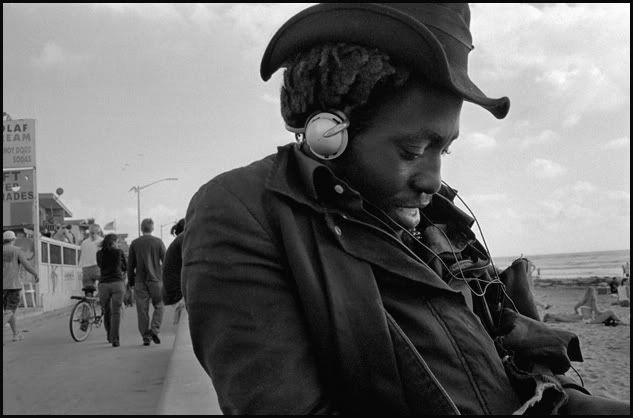
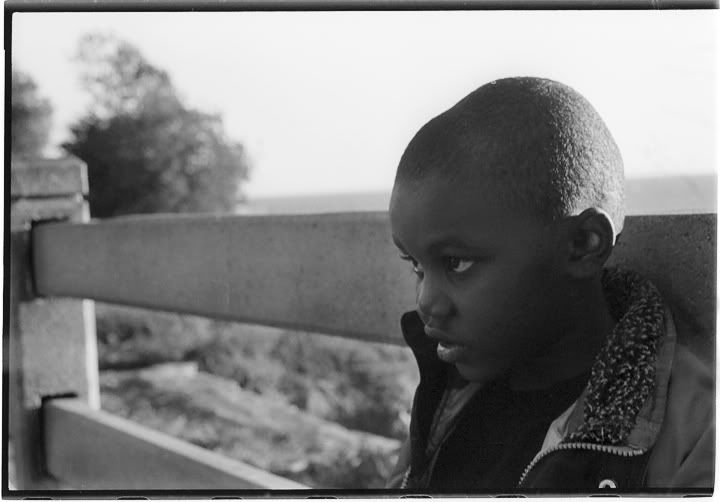
I like randomness in photography, although I agree that the "hit rate" of good shots is less with this method. Digital cameras also enable the cost of this practice to be much lower.
I don't believe that hip shots are entirely random; you wouldn't expect to get a shot of an elephant wearing pink panties when pointing the camera in the general direction of a group of people seated at an outdoor cafe, for instance (...unless it were one of those cafes...!). So, hip shooting is on the very cusp of randomness and order; you know what you generally pointed at, you just don't know precisely how the composition (or maybe focus and exposure with auto cameras) came out. I like being on the cusp of randomness, the interstitial between order and disorder. It's also fun to break the "rules" of composition, if for no other reason than to reinforce the notion that there shouldn't be rules to creativity.
I also feel that hip shots deserve to be credited to the photographer. For one, they're not entirely random. And one could also argue that whatever randomness was involved in the process (one's arm and wrist position, the stance of one's body, the precise but undefined moment of shutter release) all could be credited to one's unconscious motor movements, and perhaps also one's subconscious. There's a lot going on there, more than one would initially expect.
As for the comparison with Pollock and Abstract Expressionism, his technique was much more sophisticated than just throwing paint around. I seem to recall someone did a mathematical study of some of his images and determined them to be, in large measure, structured around some sort of fractal dimension, albeit unintended.
All that said, I don't believe hip shooting is a good substitute for a more disciplined and direct approach to street and documentary photography. Sometimes it matters a great deal what and how one directs the camera toward, in a very precisely defined manner.
~Joe