
Capt. E
Established
With B/W film, the size of the negative is important. Ansel didn't use 4x5, 5x7 and 8x10 for nothing. Prior to the 1960's, 35mm was considered an amateur film. Professionals used 120 and larger.


.... I don't have any images handy that approximate your benchmark subject here, but in small cameras, the resolution of the DP Merrills might come closest out of the box.
This is an f2.8 1/500 snap jpg at iso 800 in overcast:
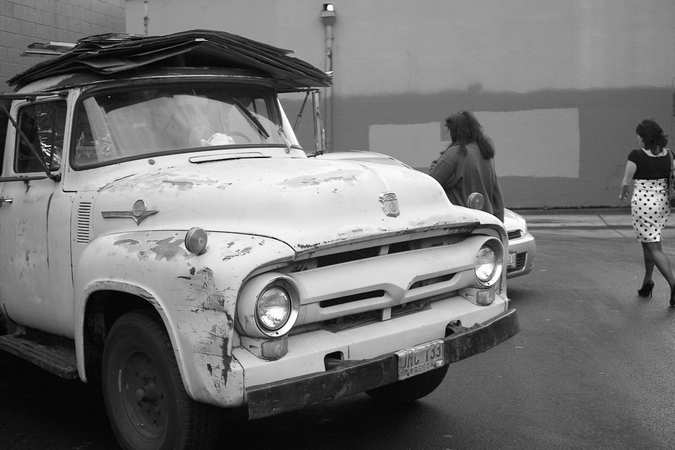

With B/W film, the size of the negative is important. Ansel didn't use 4x5, 5x7 and 8x10 for nothing. Prior to the 1960's, 35mm was considered an amateur film. Professionals used 120 and larger.
With B/W film, the size of the negative is important. Ansel didn't use 4x5, 5x7 and 8x10 for nothing. Prior to the 1960's, 35mm was considered an amateur film. Professionals used 120 and larger.

»It just an illusion, aha »
Jane Bown ditched 120. HCB did so much earlier.
Magnum has contact prints book.
Adams is boring and was weak photographer of people.


Always wondered how I might get a result like this with a digital camera? Any thoughts?


...
If you limit to "Studio/Still Life/Scenic" photography, will find more use of larger format.

Kostya, you're absolutely right—Bown did indeed go from shooting 120 to Pentax (briefly) before settling on 35mm Olympus SLRs, however I'm not entirely sure it was of her own volition, or due to personal dissatisfaction with the 2 1/4" format. After switching to 35mm, she famously rarely ever used more than 1 1/2–2 rolls of 135 per assignment, anyway. And there was a moment for her during her studies under Ifor Thomas when seeing the subject through a TLR finder was absolutely pivotal, that helped hook her into photography. Luke Dodd, who worked with her closely during the latter part of her career wrote in her obituary in The Guardian that:»It just an illusion, aha »
Jane Bown ditched 120. HCB did so much earlier.
Magnum has contact prints book.
Adams is boring and was weak photographer of people.

Kostya, you're absolutely right—Bown did indeed go from shooting 120 to Pentax (briefly) before settling on 35mm Olympus SLRs, however I'm not entirely sure it was of her own volition, or due to personal dissatisfaction with the 2 1/4" format. After switching to 35mm, she famously rarely ever used more than 1 1/2–2 rolls of 135 per assignment, anyway. And there was a moment for her during her studies under Ifor Thomas when seeing the subject through a TLR finder was absolutely pivotal, that helped hook her into photography. Luke Dodd, who worked with her closely during the latter part of her career wrote in her obituary in The Guardian that:
"With some reluctance, she abandoned her beloved Rolliflex [sic] in the early 60s, first migrating to a 35mm Pentax before settling on the OIympus OM1..."
Not that the above should be construed against the point that 35mm was well established as a professional medium long before the 1960s. But Bown adored her Rolleiflex—in her own words, she thought it was "...a wonderful camera...". I think she might have stayed with it for longer, given the choice.
It's not clear to me what characteristics of this photograph you are trying to achieve.
Agreed. I also find Adams photos kinda boring today although they impressed me early on. And he only made one good photo of people--the one of Georgia O'Keefe flirting with the cowboy.
And, to get to the original question, today digital cameras are more than capable of producing better results than film even though film still has a lot to offer as far as the look of the photo. The original post is from 2014. It's a dated question. Better sensors, better processors and better software today. But even in 2014 it was possible to get outstanding results with material on hand. Work and study. The basics.


