Duofold RF
Well-known
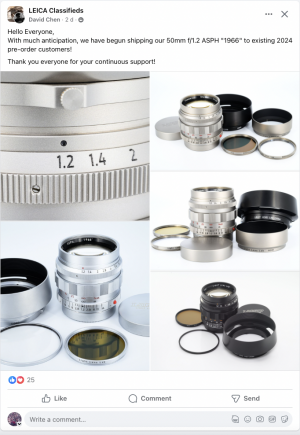
Your $50 dollars Nikkor 50mm f3.5 out performed this $2K onion ring kingHahahaha! It is. Well seen. In fact, I ate a hamburger right after I took this photo.

Your $50 dollars Nikkor 50mm f3.5 out performed this $2K onion ring kingHahahaha! It is. Well seen. In fact, I ate a hamburger right after I took this photo.

Your $50 dollars Nikkor 50mm f3.5 out performed this $2K onion ring king

Of course, but Adobe’s smoothing algorithm is much more effective and sophisticated than I can write, and can be set to fade to the edges, or to be even, or any number of things. But anyway, I’ll go back to searching for photos online from the Noct-Nikkor to decide what I think of its out-of-focus rendition and/or how it renders specular highlights in the out of focus.Nothing that a good Fortran program running scene segmentation, cell recognition, and smoothign algorithm could not fix.
Just like a piece of code my wife had me write almost 30 years ago for her 1MPixel microscope camera to do cancer cell recognition.
 GAMMA by fiftyonepointsix, on Flickr
@Freakscene On the M Monochrom- when my code applies the Gamma curve it takes the 14-bit raw value and scales to 16-bits, changes the DNG fields to output 16-bit significant values. The idea is to avoid collisions, and have a reversible pixel.
Same code that I added the column restoration algorithm for the CCD.
Do the newer versions of Lightroom or other allow this type of conversion?
I have to say I am surprised to see this on relatively coarse grained film. That’s some outSTANding work.And...just to freak you out (okokok...this is too much onion ring for me):
Jenny by Jim Fischer, on Flickr
Leica M5, LLL 50mm f/1.2 '1966,' Fomapan 400 @ 200, Xtol 1:1...handheld at 1/8 of a second.
I know- I spent the 1980s developing image processing algorithms for digital imagers. It's fun, you get to see the results. In the 90s- went on to Optical Networks, and depended on my Wife to task me with image processing. These days- image processing algorithms just for my Leica DNG files. Just to relax.Yes, but I think it happens in Adobe Raw. The MM files were mostly ok, and when I expanded them out to 16 bits they looked very good. The 12 bit files from the 246 drove me insane. The M10M and M11M seem to output 14 bit natively but Adobe Raw expands them to 16 bit without any apparent problems.
That’s not what I’m interested in. I doubt I could write a script to identify the specular highlights to the exclusion of other areas of the same tone, smooth them and make them slightly tonally graded from the centre to the edge but not blur the edges. Lightroom can do that without any trouble.
 Jenny on Her Bday by Jim Fischer, on Flickr
 Jenny on Her Bday by Jim Fischer, on Flickr
 Jenny on Her Bday by Jim Fischer, on Flickr


 Stranger by Jim Fischer, on Flickr
 Stranger by Jim Fischer, on Flickr
 Pigeon by Jim Fischer, on Flickr
 Silvershot Vineyards by Jim Fischer, on Flickr
 Silvershot Vineyards by Jim Fischer, on Flickr
 Pinot Noir Vine by Jim Fischer, on Flickr
 COnes by Jim Fischer, on Flickr
 Spring by Jim Fischer, on Flickr
 Spring by Jim Fischer, on Flickr



![IMG_20240605_122737293[13018]BW.jpg](https://rangefinderforum.com/data/attachments/98/98219-7f2c2cb01269b3b0a49341e346417384.jpg?hash=fywssBJps7 "IMG_20240605_122737293[13018]BW.jpg")


