This is from a past thread I had made on a different site:
50 years ago accessory rangefinders were quite common. A rangefinder is a device to determine the object distance. Most contempory rangefinders are incoroprated into the camera viewfinder as found in the Leica. But there are cameras that require the photographer to guess the object distance and set the focusing scale on the lens accordingly. The accessory rangefinder is a device to help increase the accuracy of that process.
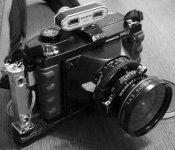
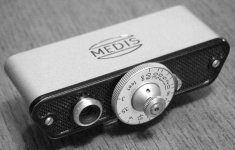
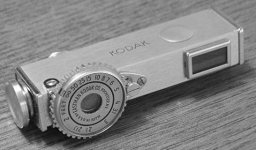
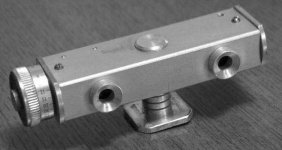
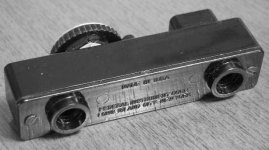
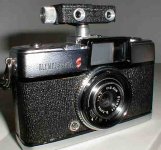
Accessory rangefinders can be handheld or mounted directly on the camera. Two basic rangefinder designs were used. A horizontal design with a shoe mounted in the center as shown on the top of the camera below. Or a verticle design where the end of the rangefinder slid into the flash shoe as shown attached to the bracket to the left of the camera.
----------------------------------
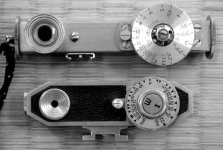
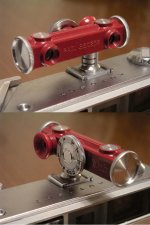
The rangefinder is simple to operate. Simply look though it and turn the distance scale until the two images in the finder merge. The problem with rangefinders is the mirrors can go out of alignment. A problem with virtical alignment will merge images together from left and right, but one appears above the other. For horizontal targets, this is no problem and the rangefinder can be accurate. For diagonal lines, this will cause measuring errors. Some finders like the Watameter (the lower finder) will let you adjust vertical alignment, finders like the Amsco DeJur (the top finder) could only be aligned professionally. However, if you feel confident, most rangefinders can be aligned by either taking it apart or using a few external screws on the body.
Most scales are in feet. Some like the Watameter (the lower finder), are in feet and inches. It is possible to find rangefinders calibrated in meters but they are rarer. Some meters like the Watameter allow the distance scale to be calibrated. The usual minimum object distance for thses devices is 3ft / 1.0m
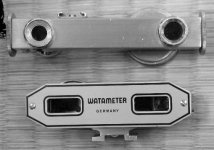
Watameter was a German manufacturer of a very good series of rangefinders. They had three models. The Watameter I pictured below has an external distance scale from 22 inches to infinity. The Watermeter II has the same appearance and specifications, but the distance scale is read inside the finder. The Watameter Super uses an internal scale for distances between 22 inches and infinity and an external distance scale from 12 to 20 inches. All Watameter rangefinders can have the vertical alignment and distance scale calibrated by the photographer.
--------------------------------
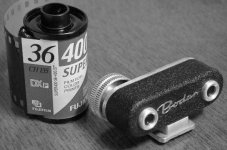
The accuracy of the rangefinder is dependant on the length of the base - the distance between the two front windows. Most rangefinders are designed for normal or wide-angle lenses with maximum apertures of f/2.8 or smaller. Rangefinders become less accurate with longer focal length lenses and wider apertures. Generally the maximum focal length is 135mm at a maximum object distance of 1.5m.
The Amsco DeJur rangefinder (top finder) is a solid accurate rangefinder. Modeled after the Leica rangefinders, an Amsco is far less expensive on the used market. While it is difficult to calibrate the DeJur by yourself, my finder has not needed it. It is also an easy rangefinder to handhold. Since a Leica rangefinder usually sells at auction for $150 to $250, the Amsco in good condition is a real bargin and can be picked up from about $30 to $60. The minimum focus distance is 2.6 feet.