Clip-on / Hot Shoe Rangefinder

Meleica

Well-known
Local time
8:05 AM
Joined
Mar 28, 2005
Messages
680
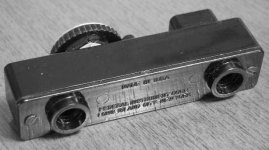
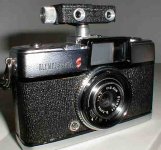
Looking for a small rangefinder that fits into a hot shoe..... any hints - clues ? Maybe a Voigtlander model (although I prefer one in feet, not meters )? Need it to mount a LF Camera.

thanks

dan`
 
Last edited:
This is from a past thread I had made on a different site:

50 years ago accessory rangefinders were quite common. A rangefinder is a device to determine the object distance. Most contempory rangefinders are incoroprated into the camera viewfinder as found in the Leica. But there are cameras that require the photographer to guess the object distance and set the focusing scale on the lens accordingly. The accessory rangefinder is a device to help increase the accuracy of that process.

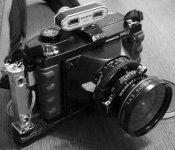
Accessory rangefinders can be handheld or mounted directly on the camera. Two basic rangefinder designs were used. A horizontal design with a shoe mounted in the center as shown on the top of the camera below. Or a verticle design where the end of the rangefinder slid into the flash shoe as shown attached to the bracket to the left of the camera.

----------------------------------

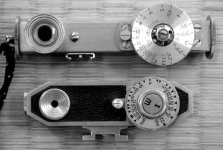
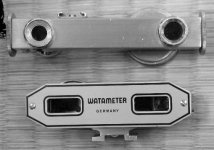
The rangefinder is simple to operate. Simply look though it and turn the distance scale until the two images in the finder merge. The problem with rangefinders is the mirrors can go out of alignment. A problem with virtical alignment will merge images together from left and right, but one appears above the other. For horizontal targets, this is no problem and the rangefinder can be accurate. For diagonal lines, this will cause measuring errors. Some finders like the Watameter (the lower finder) will let you adjust vertical alignment, finders like the Amsco DeJur (the top finder) could only be aligned professionally. However, if you feel confident, most rangefinders can be aligned by either taking it apart or using a few external screws on the body.

Most scales are in feet. Some like the Watameter (the lower finder), are in feet and inches. It is possible to find rangefinders calibrated in meters but they are rarer. Some meters like the Watameter allow the distance scale to be calibrated. The usual minimum object distance for thses devices is 3ft / 1.0m

Watameter was a German manufacturer of a very good series of rangefinders. They had three models. The Watameter I pictured below has an external distance scale from 22 inches to infinity. The Watermeter II has the same appearance and specifications, but the distance scale is read inside the finder. The Watameter Super uses an internal scale for distances between 22 inches and infinity and an external distance scale from 12 to 20 inches. All Watameter rangefinders can have the vertical alignment and distance scale calibrated by the photographer.

--------------------------------

The accuracy of the rangefinder is dependant on the length of the base - the distance between the two front windows. Most rangefinders are designed for normal or wide-angle lenses with maximum apertures of f/2.8 or smaller. Rangefinders become less accurate with longer focal length lenses and wider apertures. Generally the maximum focal length is 135mm at a maximum object distance of 1.5m.

The Amsco DeJur rangefinder (top finder) is a solid accurate rangefinder. Modeled after the Leica rangefinders, an Amsco is far less expensive on the used market. While it is difficult to calibrate the DeJur by yourself, my finder has not needed it. It is also an easy rangefinder to handhold. Since a Leica rangefinder usually sells at auction for $150 to $250, the Amsco in good condition is a real bargin and can be picked up from about $30 to $60. The minimum focus distance is 2.6 feet.

 

Attachments

  • RF_Mounted.jpg
    RF_Mounted.jpg
    74.2 KB · Views: 1
  • Wata_DeJur_Back.jpg
    Wata_DeJur_Back.jpg
    66.7 KB · Views: 1
  • Wata_DeJur_Front.jpg
    Wata_DeJur_Front.jpg
    53.4 KB · Views: 1
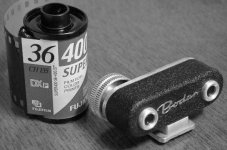
Rangefinders can come in very small packages. The Boden from Germany is very cute. This model was also sold under different names and the distance scale can be in feet or meters. Accurate to 1m. The scale can be calibrated, but not vertical alignment. This particular sample had a vertical alignment problem.
 

Attachments

  • Bodan.jpg
    Bodan.jpg
    58.7 KB · Views: 0
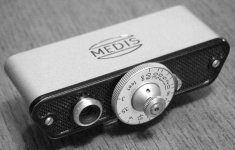
The Medis rangefinder is a high-quality German unit. The base is similar to the Watameter. The distance scale can be calibrated. Accurate to 3 feet.
 

Attachments

  • Medis.jpg
    Medis.jpg
    53.4 KB · Views: 0
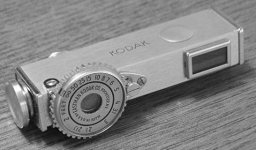
The Kodak Service rangefinder has an elegant design. The distance scale is on the front and the distance is read inside the finder. Instead of merging images, this finder merges a split image like an SLR. Accurate to 3 feet. This finder cannot be calibrated by the photographer. In the sample I bought, the materials used in the optical system yellowed and darkened making the rangefinder unusable. This mounts vertically in the camera flash shoe.

-----------------

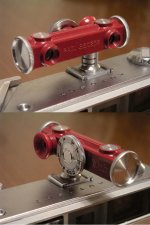
Walz rangefinders were modeled after Leice finders of the period except they came in bright colors. A shoe was mounted in the camera's flash shoe and the finder slides into the shoe. This allowed the rangefinder to be swung to the side so the shutter speed dial could be used. It also made taking off and mounting the rangefinder easy. Of course, many shoes have been lost so make sure one comes with the rangefinder - a problem with the Leica model too. The two silver caps covering the alignment screws on the top are also know to fall off and can be missing. Distance scale in feet and accurate to 3 feet. Cannot be adjusted by the photographer.

----------------------

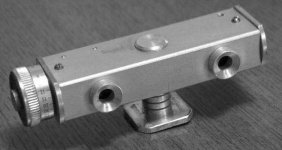
Accurange is a cheap rangefinder with an interesting design. The distance scale can be calibrated by the photographer. The sample I bought was in bad shape. I do not know if this is usual for these rangefinders, but I was not impressed by the construction. Maybe someone else had better luck.

-----------------------

The only two rangefinders I have now are the Watameter I and Amsco DeJur. The others I sold for one reason or another. I would also recommend Medis, Walz, and Leica. The Ideal is a good deal and a good finder regardless of its construction. If you can get a clear Kodak Service rangefinder, then they appear to be excellent as well. Small rangefinders like the Bodan are cute and can be used with normal and wide-angle lenses quite well, but the Watameter is not much bigger and you can easily calibrate it. Be careful with Accurange.

When buying rangefinders, vertical alignment is important especially if it cannot be adjusted by the photographer. Be careful of sellers claiming ignorance of how the finder works. Some really don't know, but some don't want to know.
 

Attachments

  • Kodak_Service.jpg
    Kodak_Service.jpg
    50.4 KB · Views: 0
  • Walz_3.jpg
    Walz_3.jpg
    92.8 KB · Views: 0
  • Accurange.jpg
    Accurange.jpg
    39.5 KB · Views: 0
Just for a note to make this complete even though it does not have a mounting shoe, but it is worth a mention:

The Ideal is the poorman's rangefinder. It is plastic and the finder mechanism consists of two mirrors on a simple channel rod moved by a screw and no windows to protect the inside from dust. It has to be handheld as there is no mounting shoe. It has a long rangefinder base and is quite accurate. The distance scale is in feet can be calibrated and this sample had no vertical alignment problems. Accurate to 2.5 feet. For a carefree, inexpensive rangefinder this is ideal. (Naturally, no pun intended.)
 

Attachments

  • Ideal.jpg
    Ideal.jpg
    52.4 KB · Views: 0
BTW, Leitz made an excellent rangefinder, but the prices are very high because of the collector value. All the rangefinders above were less than $50. A Leitz finder will be well over $100.
 
A very comprehensive series of posts, Finder. Many thanks.

I used a cheap accessory rangefinder on my Franka Solida I scale-focus folding camera, but I forget the brand. I always thought one of these would also be handy with a Bessa L.

Clarence
 
Not being a golfer I can't speak authoritatively, but don't golfers use rangefinders for distance measuring? Are they available (affordably) in golf supply shops? I've also been thinking of looking into a laser ruler (Stanley, I believe, at home supply shop) for distance measuring. That solution might be suitable for close-up and macro but I'm not sure of the range of these devices.

None of these would be as cool at the Leitz rangefinder, of course!

[EDIT: nor would they fit conveniently into a hot/cold shoe!]
 
Funny thing about golf finders is they are too accurate (and no good for short distances) and construction finders can be easily confused with non-construction targets or situations. None have a foot to mount in a hot shoe and both are more expensive than the finders listed above. I checked these out before I realized that rangefinders were made for cameras when dinosaurs roamed the Earth.

BTW, Leitz came in two basic configurations - short and long base. The long base looks really cool. Actually, these accessory finders are really interesting and my list is certainly not exhaustive. (And they are darn cute.) They are wonderful things if you like to collect stuff.
 
Oh, yes. Voigtlander made excellent rangefinders, but like Leitz they are in demand and so can be expensive. The Voigtlander is not really any better than the Wataman, Waltz, etc. I think people indentify with the name whereas the others, while well known in their day, were forgotten.
 
Yup, I just found that out about the golf rangefinders. Minimum distance about 1 yard; accuracy within 1/3 inch; price about $350 USD. Most have Leitz technology in them, though.

Maybe the Stanley (or other) laser ruler?? They will definitiely will have same limitation of larger size and no shoe mount. Me, personally, would be willing to give up the shoe mount if the price is right for some other option that would work. The bidding for gen-u-ine camera rangefinders on eBay is often too competetive for me.
 
Brian, if you go for little known rangefinders, the bidding is not that bad. If you go for Leitz or Voigtlander then the bidding goes high. The Ansco DeJur is modeled after the Leitz and I got mine for $37. Just engrave a new name on it. 😉
 
I have five or six different rangefinders. My favourite is the Walz. And it can be adjusted: remove the cover from the right side and use a pointy tool to manipulate the adjuster. I used a bbq skewer.

The smallest I have is a "Major -2-", made in France. It's accurate enough for my Olympus Pen.
 

Attachments

  • P8180005.JPG
    P8180005.JPG
    23.1 KB · Views: 0
Last edited:
I have a couple of "Accura" rangefinders. They fit in the shoe on top of the camera. Accura made a lot of accessories for cameras in the 50's and 60's. Search in e-Bay under Accura and narrow the search to "camera and photo". The gpoing rate is around $25.

-Paul
 
I am aware of two soviet made rf's - both of which are decent and dirt cheap(check with Oleg-he seems to have one or both).THey come in two flavors -"smena" - old fashioned metalic one and "blik" black plastic one.both seem to have a standart shoe mount.Both are calibrated in meters.
I own a Blik.It is rather
small.They shouldnt cost more then 15$ at most.
 
Finder said:
Brian, if you go for little known rangefinders, the bidding is not that bad. If you go for Leitz or Voigtlander then the bidding goes high. The Ansco DeJur is modeled after the Leitz and I got mine for $37. Just engrave a new name on it. 😉

You are HILARIOUS... and so right! I'll have to try that. I've always wanted to learn the traditional craft of hand engraving.
 
Adjusting the DeJur Rangefinder

Adjusting the DeJur Rangefinder

I thought I'd resurrect this old thread to keep the info on how to adjust the DeJur together with Finder's excellent reviews above.

I've purchased a DeJur rangefinder based on Finder's recommendation above. Very pleased with it and while it arrived looking new, it was off both horizontally and vertically, but I figured out how to adjust both in a few minutes. It gives the same range results as my SLRs, both near and far, so I'm quite happy with it.

Similar to other accessory RFs, the slotted screw in the center of the range dial (blue arrow) adjusts distance (horizontal) calibration. The outer spanner head screw (blue arrow) is the locking screw. It needs to be loosened first, then tightened after adjusting the center slotted screw. Adjust using a tree or flagpole at distance to infinity on the dial.

Vertical alignment is handled by unscrewing the cap at the bottom of the RF, on the dial side. Inside there are 2 small screws on the back of the rotating mirror (red arrows). These adjust the angle of the mirror for vertical alignment. A little small-movement trial and error will let you figure out what's needed. The result is a remarkably accurate little RF.

Thanks to Finder for his comments.

- Charlie

August%202010%20038.JPG
 
Last edited:
Back
Top Bottom