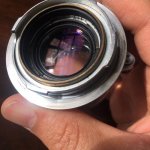
"I've seen some very interesting tests of badly damaged lenses online. The trick (if you need a trick) is to completely black out the damaged area: peterm1's lens could have been rendered as flare-resistant as it was intended if an opaque paint had been placed over the exposed area. This drops the lens to an f2.9 from an f2.8 for example - but rarely a significant issue.
I have a 1950 Nikon 85mm/f2 Leica mount lens, which cost about $30 due to partial rear coating loss. I've never noticed anything amiss with it in use. This would prevent reflections between the lens and the film. I'm probably (theoretically) getting slight haze from it - but honestly it's almost trivial to consider. I have a few 1930's uncoated lenses and no-one cares about the film-lens interaction with them. And in their case, it's definitely bright light in general that is the issue, not in-camera reflections."
Scrambler, I am aware of the trick of blacking out a scratch or flaw on the front element of a lens. And yes it does work - with scratches, I know as I have tried it. I am not convinced it would have worked though, with the loss of coating over several square millimeters of the lens surface as happened to the lens l dexcribed and which produced a kind of hazy, veiling flare in affected parts of the images - much like that produced by uncoated lenses in bad lighting but only in affected areas of the image. Possibly, it could have I grant you, but eventually a flaw like this becomes too big for the problem to be rectified in this way.