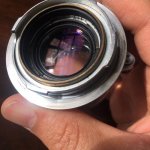
Coating marks on rear element

lxmike

M2 fan.
Local time
3:13 PM
Joined
Jun 28, 2008
Messages
4,147
Location
Co Durham NE England
Usually will not go near a lens if the rear element has coating marks, front element issues l might consider it, what do people think regarding coating marks, have attached an image of a lens l am considering, it has obvious marks to rear element. Thanks in advance for any coments
 

Attachments

  • s-l1600 (95).jpg
    s-l1600 (95).jpg
    36.7 KB · Views: 0
Probably it will effect to some degree the picture quality but to what extend and under what conditions it will be noticeable - it's difficult to say. If you are going to buy it, make sure you test it and return it if you don't like it. Also, resale value would be low so make sure you get it cheap.

I have this post on my blog - maybe you will find it interesting.

http://pansfilmcameras.blogspot.co.uk/2016/10/scratched-vs-unscratched-lens.html

Edit: Not sure if i answered your question but regarding marks on rear elements - i had a few lenses with scratches on the rear element and never noticed anything wrong. Apparently wide angle lenses are the ones to be avoided but as i show on the link above, i would still consider them if the price was right.
 
Probably it will effect to some degree the picture quality but to what extend and under what conditions it will be noticeable - it's difficult to say. If you are going to buy it, make sure you test it and return it if you don't like it. Also, resale value would be low so make sure you get it cheap.

I have this post on my blog - maybe you will find it interesting.

http://pansfilmcameras.blogspot.co.uk/2016/10/scratched-vs-unscratched-lens.html

Edit: Not sure if i answered your question but regarding marks on rear elements - i had a few lenses with scratches on the rear element and never noticed anything wrong. Apparently wide angle lenses are the ones to be avoided but as i show on the link above, i would still consider them if the price was right.
Nice piece -- thanks!

Cheers,

R.
 
Probably it will effect to some degree the picture quality but to what extend and under what conditions it will be noticeable - it's difficult to say. If you are going to buy it, make sure you test it and return it if you don't like it. Also, resale value would be low so make sure you get it cheap.

I have this post on my blog - maybe you will find it interesting.

http://pansfilmcameras.blogspot.co.uk/2016/10/scratched-vs-unscratched-lens.html

Edit: Not sure if i answered your question but regarding marks on rear elements - i had a few lenses with scratches on the rear element and never noticed anything wrong. Apparently wide angle lenses are the ones to be avoided but as i show on the link above, i would still consider them if the price was right.

many many thans for this useful reply🙂

nice article by the way
 
Do you shoot contre-jour a lot? Do you normally skip the use of a hood? If you answered yes to either of those, I would pass.

If you are more appreciative of the fact that a 35mm rangefinder is generally not the sharpest way to make an image (compared to larger formats, using a tripod, etc) and thus won't notice the slight degradation it may have on image quality, AND it is an excellent price compared to normal market value, then you could give it a try.
 
I cannot answer directly as to the effect but I do recall that in my early days of photography I owned a Nikonos underwater camera that I also used extensively for topside shooting with its standard 35mm lens. The lens took pretty sharp and contrasty images but not long after buying it new I noticed that there was damage to the front element coating - a several millimeter by several millimeter patch of coating was missing somehow. I believe it was a manufacturing failure as it did not look like damage caused by rubbing etc. and that somehow in use the coating had flaked off in this region - imperfect cleaning of the front element during manufacturing prior to coating perhaps.

While the conventional wisdom is that front element damage is less destructive of image quality than rear element damage, boy that lens thereafter flared like the dikkins whenever I shot it on the surface and the sun was anywhere near forward of the camera even if not in direct view. I have been very sensitive about buying lenses with any kind of coating damage ever since.

Partial loss of coating like this causes loss of contrast, flaring and color degradation in the image portion affected. This kind of partial image damage is near impossible to fix in post processing. Or so my experience tells me. It would almost be less problematic for all the coating to be missing on an element as at least the image damage is across the whole image and could be played with readily in post processing other wise it is very fiddly.
 
Usually will not go near a lens if the rear element has coating marks, front element issues l might consider it, what do people think regarding coating marks, have attached an image of a lens l am considering, it has obvious marks to rear element. Thanks in advance for any coments

If it's cheap why not.
 
I've seen some very interesting tests of badly damaged lenses online. The trick (if you need a trick) is to completely black out the damaged area: peterm1's lens could have been rendered as flare-resistant as it was intended if an opaque paint had been placed over the exposed area. This drops the lens to an f2.9 from an f2.8 for example - but rarely a significant issue.

I have a 1950 Nikon 85mm/f2 Leica mount lens, which cost about $30 due to partial rear coating loss. I've never noticed anything amiss with it in use. This would prevent reflections between the lens and the film. I'm probably (theoretically) getting slight haze from it - but honestly it's almost trivial to consider. I have a few 1930's uncoated lenses and no-one cares about the film-lens interaction with them. And in their case, it's definitely bright light in general that is the issue, not in-camera reflections.

PS - marks on the front of the lens don't appear on the image, though they may influence bokeh circles.
 
"I've seen some very interesting tests of badly damaged lenses online. The trick (if you need a trick) is to completely black out the damaged area: peterm1's lens could have been rendered as flare-resistant as it was intended if an opaque paint had been placed over the exposed area. This drops the lens to an f2.9 from an f2.8 for example - but rarely a significant issue.

I have a 1950 Nikon 85mm/f2 Leica mount lens, which cost about $30 due to partial rear coating loss. I've never noticed anything amiss with it in use. This would prevent reflections between the lens and the film. I'm probably (theoretically) getting slight haze from it - but honestly it's almost trivial to consider. I have a few 1930's uncoated lenses and no-one cares about the film-lens interaction with them. And in their case, it's definitely bright light in general that is the issue, not in-camera reflections."

Scrambler, I am aware of the trick of blacking out a scratch or flaw on the front element of a lens. And yes it does work - with scratches, I know as I have tried it. I am not convinced it would have worked though, with the loss of coating over several square millimeters of the lens surface as happened to the lens l dexcribed and which produced a kind of hazy, veiling flare in affected parts of the images - much like that produced by uncoated lenses in bad lighting but only in affected areas of the image. Possibly, it could have I grant you, but eventually a flaw like this becomes too big for the problem to be rectified in this way.

 
Back
Top Bottom