Collimating a Jupiter 9

Thanks Kim. This has been desirable for quite some time.

Actually it's not really J-9 specific - the way you wrote it it's a general-purpose lens collimating guide for rangefinder lenses.
 
Hi Kim,

Long time no speak 😉

Great write up, and the pics of how to collimate are v good - just what I do when working on LTM lenses. I think the only "improvement" might be some more explanation around changing the focal length - you mention that this may be required if the lens is focussing to the rear (or front), but you don't explain whether more shims = longer or shorter FL, and which is required to rectify front or rear focus.

Maybe a couple of pics of a J9 to illustrate where the different shims sit, and the securing ring might help too?

Just my 2p, and no slight on a really helpful how-to article.
 
Hi John,

Thanks for the feedback. It is what I was looking for. I will reword the part about shortening/lengthening as soon as I can. In my mind I was also thinking of the service guide for the J9 I wrote which shows the shims. I might try to combine the 2 so it is more obvious.

Kim

Hi Kim,

Long time no speak 😉

Great write up, and the pics of how to collimate are v good - just what I do when working on LTM lenses. I think the only "improvement" might be some more explanation around changing the focal length - you mention that this may be required if the lens is focussing to the rear (or front), but you don't explain whether more shims = longer or shorter FL, and which is required to rectify front or rear focus.

Maybe a couple of pics of a J9 to illustrate where the different shims sit, and the securing ring might help too?

Just my 2p, and no slight on a really helpful how-to article.
 
close distance collimation

close distance collimation

IMHO, Kim’s notes are magnificent. I also used them for repairing my J-9. The two camera collimation method for infinity is also simple and effective.

However, I suffered when I had to check the close focus with groundglass and a loupe. I wear glasses and my eyes accommodate quickly. I applied a 30x watchmaker’s loupe though, I wasn’t able to succeed. The problem is not that the picture is sharp or blurred (this can be decided easily), but where the maximum point of sharpness is. I mean that the type of groundglass, the lights of the room etc.
clip_image002.jpg

For me test shots are more convenient, and unfortunately expensive and slow.


clip_image004.jpg
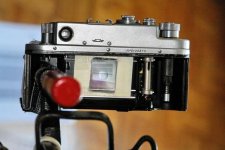
Than I have read about other a method, which was published in 1964, by a Hungarian artisan, Dénes Botta. For checking the working distance of a lens/camera, I typically use groundglass projection. I draw a vertical line to a post-it and I fix it on the wall. Then I make a cross on the groundglass with a soft graphite pencil and place it to the film rails so that the x-mark turns inward, to the lens. In this way the mark is in the place of the film exactly. I set B, lock the exposure button and project the groundglass with a lamp onto the wall. Tripod is necessary. When the image will be so sharp that I can count the grains of graphite mark, the rangefinder must be also aligned with the focus target.


Test best results come by combination of different methods. However, J-9 derives from Contax portrait lens, which were designed for 90 mm RF base length. Zorki has just 38mm RF base, so J-9 lens cannot be set correctly wide open at close distances.
 

Attachments

  • bDSC03209.jpg
    bDSC03209.jpg
    31.3 KB · Views: 4
  • bF1000015.jpg
    bF1000015.jpg
    23.2 KB · Views: 4
Back
Top Bottom