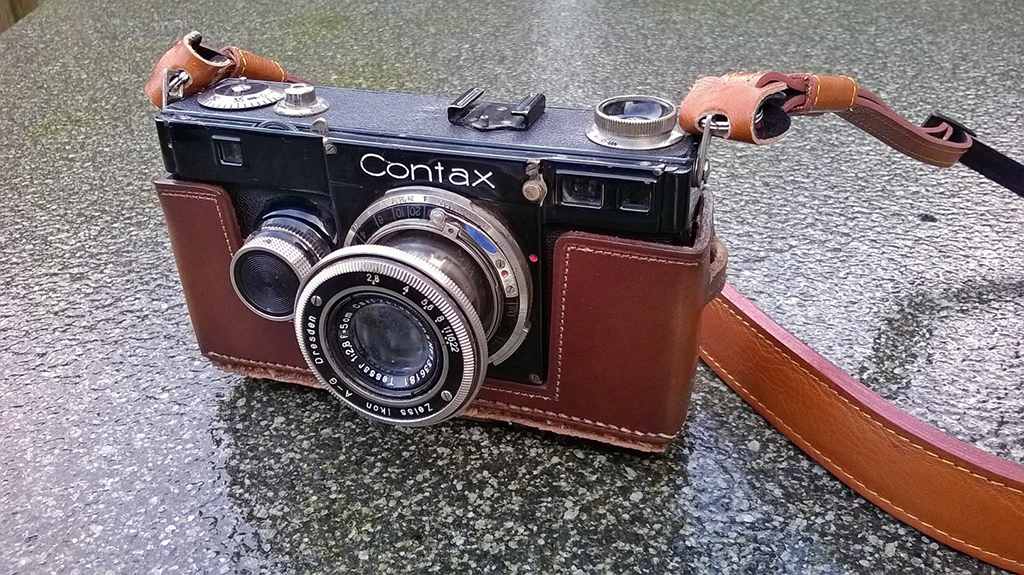
:dance:Suddenly I have two Contax I, this subject an "f" model and the second an "e". The first was a mystery to operate until examining it closely for a bit along with the Contax I manual which does more explaining about why this is a great feat of photographic engineering than how to operate this great German feat of engineering! Since my age is close to 70 now my eyes no longer qualify me to begin Naval Flight Training...the micro numbers on the dial came to life only after resorting to a loop. Because the lubrication was very stiff I was afraid to wind too hard for fear of breaking the aged ribbons which I could actually see sideways looking with a bright light.
When I aligned the white triangle on the dial with the green semi-triangle [my understanding originally green anyway] and got the white dot at 1/1000, bang! [But first I had to get the second curtain rolled down with a special little, modified slotted screw driver without scratching and damaging the curtain...got that done.]
Next I got my small vintage TV and checked the 1/1000 image [compared to a Nikon I have known to be accurate at 1/1000] tilting the Contax I 90 degree, as I do the Nikon, to do the viewing and the image was a narrow perfect elongated rectangle. My adrenaline started pumping so I fixed a time for break before breaking something to consider my next step.
Which was to check to see the other high speeds or "sport" settings out. This worked but the pins fixing the speeds was not cooperating fully [not retracting and then extending to fix the speed selected for winding purposes]. After some careful exercise of the shutter and cycling the rewind button I heard and felt a small click so upon winding the white dot would stop at "a" speed.
Now, time for some film, Fuji 200 was put into the camera and I put on a 35mm Biometar [with fungus to compare to a Jupiter-12 I had been using on a Contax II and III and known to produce sharp images but hey why not do more than one thing at a time, I am getting up there!]. After getting the scanned negative results emailed and finding not even a light leak, I thought now was the time to lubricate the gears and escapements. I had previously put a drop of cheap Dollar Tree penetrating oil, known to leave a light white residue after evaporating the carrier penetrating ingredient, to the front knob.
Then, after arranging my small collection of tools and magnifying headset, loop and lights together and reading what was otherwise on line, I removed the film cartridge and spool pressure units, in the film compartment, the two small screws at the base of the film plane mount, two large screws [relative to the former] on the right side of the film plane cover in the film compartment, and even removed the rewind knob [so I could access the one screw at the left side of the film plane mount without destroying the slot]. Then examining further I saw a retaining slotted pin extending from and on the right top of the film plane mount. After jiggling the film plane mount cover a bit the cover loosened and released enough to remove for accessing the escapements and gearing. Before beginning the lubrication I examined the on line information which provided photographs of the escapements and the winding room gearing, my winding compartment gearing was bright and clean and the only residue was some piece of mashed film....do they put silver on this stuff?
For lubrication I used Syl-Glyde on the winding gearing, just dabbing enough on a few gears to get it to spread itself out...That "grease" will not dry out, freeze or evaporate easily. Next I put a little "Kenmore Sewing Machine Oil", one drop [Is this lyndseed oil?], on the gear that rotates in the film compartment winding room when the shutter operates, with a syringe. Then, I used a little of the penetrant mentioned earlier on the escapement I could see looking past the tape or ribbon, which looked to be in good condition, on the right side of the film plane mount. Since I did not want to get the lubricants on the shutter tape or ribbon I was careful to dry the syringe off and pick up the tape or ribbon gently before inserting the syringe.
Next, the shutter was exercised, all but the B or Z setting group of two, operated. The the B or Z group of two still objected to winding. Since I considered this escapement group to most likely have the finer, greater number of gears, on this I used some "trumpet key oil" which I through experience have used before and knew to not be a hazard after aging- so far as I know. This oil was applied where I thought the B or Z group was located.
Afterwards, after applying oil to the B or Z escapment group, using some pressure, not much, on the shutter gear in the winding compartment after tripping the B or Z setting I helped it along through its completion of movement of the 2nd curtain a few times applying pressure with a small screw driver and then,, then.. it came to life...singing. Yes! What a relief!
I read this thread a few more times and exercised the shutter through each group and was ready to put some film in [however rechecked the "sport" speeds on my TV again, one more time].
When I took off the back to put film in there was spatter on the film pressure plate from the lubricant(s). Holy...sXXt!
Back to break time [ I tend to want to finish the work which is ok if the returns on effort are not diminishing.] with some banana, coconut milk, ice and Puerto Rican in a Waring "rocket" blender from 1945. to help to relax and consider. Decided to clean the curtains with petroleum distillate [lighter fluid] from a yellow bottle with q-tips and old t-shirt and set out overnight to complete evaporation. Thank God this is not a Barnack!
Using old 35mm cartridge I ran a roll through finding no more spatter and now I am ready.
What a joy!
In the mean time I found a second "e" unit needing new ribbons or tapes and since I had already purchased your aforementioned supplier'(s) replacement stuff am ready to brave what you [above] have so carefully described before me, and replace those straps, or ribbons.
As an aside..if all this is not considered an aside, while replacing ribbons on the Contax II and III several years ago I found that gluing some brass foil cut in 2.5mm strips, glued to the end of the strap or ribbon to be installed, after putting the brass foil strip through the slot, the:dance: ribbon would easily follow [ not wanting to brave the removal of the caps]
Thanks for the help.
Sincerely,
Thomas Shafovaloff