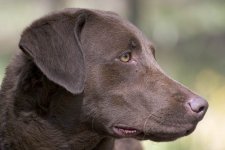
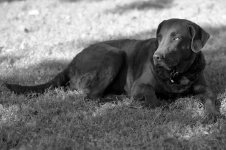
Correct exposure for a chocolate lab

kennjg

Member
Local time
1:48 PM
Joined
Nov 2, 2006
Messages
30
Anybody have suggestions for taking a good picture of a chocolate lab, like a portrait or full body shot. I have a Bessa R with the 35/2 lens. I have only tried indoors and I did not get one good shot because of poor lighting in the house. I set the lens fully open and tried shutter speeds of 1/30 and 1/15. Everything comes out a yellowish cast and the dog looks almost black, eyes almost glow. In the house, most of the background is shades of yellow and brown. Outdoors this time of year is mostly gray clouds. Plus the dog won't stay still outside.
 
😀 I was trying to work out why anyone would want to photograph a laboratory ... a chocolate one even!😱

Maybe some faster film ... you didn't say what you were using and some of the discussions on low shutter speed hand held shots on this thread are interesting.🙂
http://www.rangefinderforum.com/forums/showthread.php?t=32535
 
Last edited:
Yeah, I thought it was a chocolate factory too, and I was going to provide a bit of advice on indoor industrial photography.

Ted

PS: How to get a dog to stand still outside? Simple. When he's not looking, toss your keys in the air. When they hit the sidewalk and make a clinking sound, he'll stop and turn toward the sound. Click. Works much better inside someplace with a hardwood or concrete floor. More noise. I saw a professional dog photographer do this at an AKC show in St. Louis.
 
Mention chocolate and here they come....hmmm.

I'm using 400 speed Fuji film. I could also try faster shutter speeds if he is moving around outside. I can get him to trot over to me even if I just lift the camera to my eyes. Maybe try 1/500 when he is trotting to me?? He'll really run to me if I hold out a biscuit.
 
My sister's Chocolate Lab can be tricky to shoot as his eyes are very bright, but nose is slightly more pale than his body.

I try to make sure he is near a light background, however the background needs to be relatively bland or muted or you will overexpose easily.

That way you can meter the light hitting his brownish coat and then use that ultimately as your exposure.

Your Lab's background is most important because it will effect the color representation of your lab.

Also labs have long noses, so focus on the eyes when shooting wide open
 
kennjg said:
I set the lens fully open and tried shutter speeds of 1/30 and 1/15. Everything comes out a yellowish cast and the dog looks almost black, eyes almost glow. In the house, most of the background is shades of yellow and brown.

Even with a large aperture and possibly even a flash 1/30 and 1/15 is far too slow a shutter speed to get a decent shot of a) something that will potentially move, and b) a hand-held shot.

You need to meter the scene you're in, otherwise you're shooting blind really. You need some fast indoor film - at the very least 400ISO - and make sure it's tungsten balanced, not daylight film. Daylight film will produce an orange/yellow cast if you shoot indoors as the wavelength of tungsten light (indoor light bulbs) is different to sunlight and outdoors.

If you're not using a flash, you really should try to get some shots on a sunny day outdoors (I understand with the weather, being from the UK) and try to shoot at least 1/250 or possibly even faster, depending on the light.

Your question is part technical, and part subject technique. I'd try getting a closer shot to the lab, and hold your camera with a toy it loves right next to it and try to hold it's attention by waving it around. It's much the same as shooting a child, as their attention span can be rather short.

Good luck! (^ ^)
 
Metering dark dogs is a challenge. If you can meter directly off the fur…great, otherwise, I just over-expose by 2/3rds or so.
You are far better off in the natural, diffused light outside. Getting the dog to stay still is a challenge, especially with young dogs. I’ve tried running her to death till she wants to stay still, but then I always get that tongue hanging out. I’m afraid the answer seems to be to spend lots of quiet time outside with the dog…so she loses her expectation that you are out there with her to play.
In the 2 years that I’ve had my Chesapeake Bay Retriever, I’ve only gotten a few shots that I’m really happy with. As she’s past 2 years old now, she’s starting to be more prone to quiet moments and I’m hopeful for better results in the future.
 

Attachments

  • penny1.jpg
    penny1.jpg
    76.6 KB · Views: 0
  • penny2.jpg
    penny2.jpg
    115.4 KB · Views: 0
Correct exposure is correct exposure - regardless of subject. That said - you may want to cheat just a bit towards overexposure for more shadow detail.

The yellow background is due to the warmth of indoor tungsten light. Not much to be done about that without filtering, or using a tungsten balanced film. (Or shooting black and white) 🙂

You can correct it a little bit in post processing if you are scanning your negatives. Or if you are shooting digital, you could change the white balance before shooting.

For a well lit (store / office) interior, I find with 400 speed film that I can get f2.8 at 1/60th - homes tend to be more dimly lit, so if you can't supplement the lighting you need faster lenses or faster film - pets tend to move to much to get away with exposures over 1/30th.

Good luck - post samples as you shoot. 🙂 Chocolate Labrador's are some of my favorite dogs.
 
I took a few shots outside today with a Yashica GSN. It was a nice sunny day so I set the aperture at f8 and let the camera set the exposure. I'll see how they come out tomorrow. He was as still as a statue as he awaited a biscuit.

As far as overexposure goes, I would think the meter would try to expose as if the dog were gray which to me would be lighter than the dog's color. So, wouldn't I want to under expose to get a darker color on the dog?
 
Back
Top Bottom