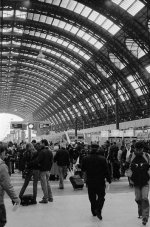
Developing Neopan 1600 in DD-X Shot at EI 800

JPSuisse

Well-known
Local time
6:46 AM
Joined
Jan 20, 2008
Messages
434
Hi,

So, after my first success with developing my first roll of film (FP4 Plus 125 @ 125 in DD-X). I'm getting ready to develop a role of Neopan 1600 @ 800. According to Ilford's DD-X specification sheet the development time (1+4) for Neopan 1600 @ EI 800 is 4:30.

Now, I know the images on the roll of film will be somewhat low contrast, and in the development I want to increase this contrast. So, what should I do for the development? Should I maybe go to 5:30?

Based on my first roll of film, it seems like, if you increase the development time, you should also under expose the film slightly. My MP's exposure meter is dead on, and I almost NEVER over expose, for instance, slide film. Therefore, I was rather surprised that several images on my first roll of film were over exposed. And, I'm thinking that it's because I increased the development times slightly. Any comments on this?

Any advice for these 2 questions would be appreciated!!!!

Cheers, JP
 
I was under the impression that increasing the development time will give me generally a wider range of tones on the negative.

That is why I wanted to increase the development time.

JP
 
Yeah, I'd go for 5:30 or even as much as 6:30, depending on the contrast. As Hans says, DDX gives an inherent speed increase, but of course the Ilford figures take account of this. My own rule of thumb for increased/reduced contrast is '15/50': minus15% for high contrast, plus 50% for low contrast, so 4:30 + 2:15 = 6:45. For this and other information on development technique, see http://www.rogerandfrances.com/subscription/ps neg development 1.html

Don't worry about 'overexposure'. You'll probably get better tonality at the speed you used than if you'd rated it at 1000 or more.

Cheers,

R.
 
I was under the impression that increasing the development time will give me generally a wider range of tones on the negative.

That is why I wanted to increase the development time.

JP

as beginner I believe for this [range of tones] you need to use weaker dilution.
 
as beginner I believe for this [range of tones] you need to use weaker dilution.

This is not really a question of range of tones (densities), but of contrast. A subject with low contrast can be made to give a more contrasty negative with more development (any one or more of longer time, stronger dev, higher temperature, more agitation); a subject with high contrast can be 'tamed' with reduced development (any one or more of shorter time, weaker dev, lower temperature, less agitation).

The range of tones (densities) in the negative can be made identical for subjects of widely differing contrast by using these variations, so that they will both print convincingly on the same grade of paper.

Cheers,

R.
 
Last edited:
Roger, thanks. This is the kind of tip and info I was looking for.

BTW, I did take a read through part of your website. Very impressive! Your advice on DD-X weighed heavily on why I went with DD-X.

I see that I'm not using the terms correctly. I mean increased contrast as you point out.

Also, in one of my posts in the other thread I posted several results of my first roll...

JP
 
Last edited:
I've been using the Ilford DDX Developer with my Neopan 1600, and I do tend to overexpose it. I believe the actual speed of this film is around EI 640, and that is how I set the internal meter on my Leica M5.

I'll be using this film quite a bit in the future, as I have seven 100' rolls of it, in my deep freeze. I have eight 36 exp rolls set to develop, and I think I'll stay with DDX for now. I've also seen good results using Kodak D76, may try ADOX Borax MQ next.

With Eastman XX Motion Picture for slow, and Neopan 1600 for fast, I am set. 🙂
 
Last edited:
JP just bear in mind in everything you do that neopan 1600 is not a true 1600 film. It makes about 500-640 and so even rating at 800 is actually a slight push! In DDX in everage contrast I rate mine at 640, with 500 in high contrast and 800 if the contrast is very low. If you have important shots on the roll I would recommend doing some tests on other rolls to get your times and exposure dialed in. I can guarantee you one thing, if you have metered properly, an EI of 800 with Neopan 1600 in DDX will not have resulted in over exposure. If the contrast was middling, your speed rating should be pretty close.
 
Tim:

I know that the motives were low contrast because I always take notes when I shoot. The 2 criteria I mark are:

1) Are there any highlights in the shot? (I.e. clear discernible highlights and edges)
2.) Is the lighting intense? (I.e., shots inside are inherently less contrasty than shots outside in full sun.)

If both conditions give me a yes, I would tend to go for a less contrasty development. If one condition is yes and one no, then I would standard development as per instructions. If both are no, then I have to increase the contrast of the negative.

This is my "current" attempt "to improve the quality" of my negatives. What is quality for me? I find flat negatives difficult to scan. They require intense usage of post processing, which takes time and brings out unwanted affects like exaggerated grain.

Better to get it right, right out of the camera/developer. That why we shoot film, right? 🙂

Best, JP
 
Tim:

I know that the motives were low contrast because I always take notes when I shoot. The 2 criteria I mark are:

1) Are there any highlights in the shot? (I.e. clear discernible highlights and edges)
2.) Is the lighting intense? (I.e., shots inside are inherently less contrasty than shots outside in full sun.)

Fair enough. I wasn't sure if you meant that previous rolls you had developed were super low contrast AFTER development, or it was low contrast scenes, etc.
 
AND THE RESULTS...

In the end, I developed for 6.5 minutes 1+4, even though Ilford recommended 4 minutes. Indeed I overdeveloped about 5 pictures on the roll, but the other ones turned out great.

I've never had such an easy time post processing low contrast shots! It seems:

1.) I require less time to get a good picture post processed
2.) The grain is much less pronounced

Also, Neopan 1600 @ 800 in DD-X is a good mix, if you ask me. The grain structure is really nice.

Thanks for the input folks!

JP
 

Attachments

  • 20091025-30IT.jpg
    20091025-30IT.jpg
    29.6 KB · Views: 0
  • 20091025-32IT.jpg
    20091025-32IT.jpg
    41.4 KB · Views: 0
  • 20091025-35IT.jpg
    20091025-35IT.jpg
    60.9 KB · Views: 0
I used DD-X too, but you get similar results with Xtol with more control over development time. It should be possible to dilute DD-X 1:9, but there are no official recommended times, so you need to experiment.
 
I used DD-X too, but you get similar results with Xtol with more control over development time. It should be possible to dilute DD-X 1:9, but there are no official recommended times, so you need to experiment.

Similar? Yes but less speed, different tonality and different grain. I think I'd stick with the DD-X on that showing. They really were rather nice.

Cheers,

R.
 
You pictures look okay to me, but a bit more contrast than i like.

If you shoot B&W film and scan it, as I do, then I find that processing for lower contrast works better for me, as i can always add contrast in Photoshop, but for me a fairly thin (i.e., not overdeveloped) negative scans best.

I love Neopan 1600 @1200 developed in DD-X (1:4) at 20C for 5 minutes. The pictures belw are from a wedding shot with a 1930s Leitz Summitar at f/2. So that partially explaines their relative low contrast. But the look is vintage and lovely in my opinion:

2948193397_d625734cc8.jpg


2949046544_67532eaffa.jpg


2948193017_c8878d84f4_o.jpg
 
Hans, I think it has to do with the way I post processed the last image - softer and more romantic - and also perhaps some veiling flare from the sort-of backlit situation and the uncoated Summitar.

For example, here's another back-lit shot from the wedding dinner, that is also very low contrast:
2949046652_ae9e8c493a.jpg
 
Sleepyhead - your first two pics have a very nice look to them. Number one especially - I know its a small web image, but I've not seen that look from Neopan 1600 yet.
 
Back
Top Bottom