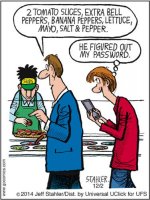
Do camera names make for secure passwords?

Austerby

Well-known
Local time
3:42 PM
Joined
Feb 7, 2007
Messages
1,069
Location
Fircombe
Given the incessant demand for more and more complex passwords I've been thinking about using some favourite camera makes and models as they're both memorable and contain useful letter and number combinations.

For example (and these are not ones I've used):

FujiX100s
NikonFM2n
LeicaM240
Canon5dMkIII
Rolleiflex2.8e

Would these be considered as an adequately secure password these days?
 
no, i was not safe.
any string you can find in some kind of data collection (dictionaries or other published text) is prone to a brute force attack.
 
I think it's safer to use the first letters of each word in a phrase, such as: "My First Camera Was An Isolette 1 But Now I Shoot M 240" = MfcwaI1bnIsM2
 
Wow .... I've just managed to hack two RFF accounts! 😱

yay!.gif
 
Here is a typical password I use.

NVBxNDusjGp9rroWfU

The passwords are generated based on pseudorandom, simulated dice throws. Obviously I don't memorize these. They are generated by a password management App called 1Password. I use a different password for each site/login and often the App (not my browser) autofills the username and password. There are many alternates to this app.

In general, the easier a password is to remember, the less secure it becomes. Secure passwords, especially when they are forced to expire are notoriously insecure. It is difficult to memorize these passwords so people write them down. In many businesses/institutions of all sizes it is trivial to access their networks if you are inside the facility. People write passwords on Post-Its and stick them under their keyboards, etc.

Re-using the same password on several on-line accounts is convenient, but increases risk quite a bit.
 
I start with a favorite non-common and highly personal term or phrase (not necessarily in English), then insert $,#,%,& or whatever character(s) is/are allowed between every word.
 
No. You need "salt" in any type of word or phrase to make it secure.

"LeicaM240" is a bad idea probably, but "LMe2i4c0a" should be pretty good...
 
Given the incessant demand for more and more complex passwords I've been thinking about using some favourite camera makes and models as they're both memorable and contain useful letter and number combinations.

For example (and these are not ones I've used):

FujiX100s
NikonFM2n
LeicaM240
Canon5dMkIII
Rolleiflex2.8e

Would these be considered as an adequately secure password these days?

By themselves? No, but as part of a good 16+ character string of words, they could work. From your list, let's say you took your FujiX100s to Barcelona in June to photograph the wedding of your friends John and Marsha, you could then have:

FujiX100sBarcelona614John&Marsha

Which you'd likely remember, but is functionally un-crackable by current brute force password cracking software.

16 characters is the current suggested minimum. That one is 32, and easy to remember.
 
Entropy is key.

Over the years people have been trained to generate passwords that are very easy for computers to "guess" simply by trying random permutations of character substitutions into dictionary words.

These types of password have a very low level of entropy. The reasons are mostly because early variants of UNIX could only handle short password strings and the practise stuck.

Something based on a sentence is the best approach because it has a high level of entropy. If you can add spaces, so much the better, but if you can't just contract the words together; you don't even need to substitute letters for numbers and symbols.
 
No. You need "salt" in any type of word or phrase to make it secure.

"LeicaM240" is a bad idea probably, but "LMe2i4c0a" should be pretty good...

Actually in a brute force hack they are the same...same number of characters=same probability of selection. Randomizing the order of the letters/numbers has no effect. The first is probably less secure if someone is looking over your shoulder and sees a part of the password.
 
Back
Top Bottom