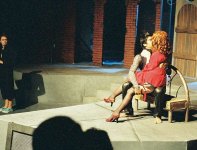
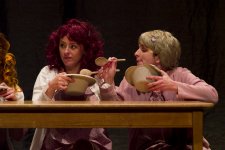
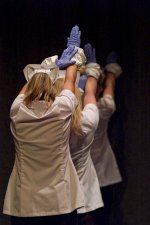
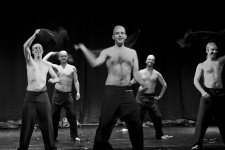
I've photographed a lot of stage performances (check my gallery) and I think you'll do fine with your Leica equipment -- certainly better than you'd do borrowing an unfamiliar SLR and a slow tele or tele-zoom lens.
Assuming you can sit reasonably close to the stage, the lenses you've got should work well. The 50/1.4 is a must-take, and the 90/2.8 is worth a try, although it will restrict your shooting opportunities somewhat. The vast majority of my best stage photos have been shot within this focal length range.
As Kim said, it would have been a bit easier if you could have attended a dress rehearsal instead of a performance, since you'd have been free to move around without worry about blocking other patrons' view. But if opening night is tonight, you'll just have to do what you can!
High school theaters vary a lot -- I've been in some that are huge and have state-of-the-art lighting gear, and others that are tiny and lit by nothing more than dim "PAR cans" (reflector lamps in scoop-shaped metal shields; some schools used to make these on the cheap out of coffee cans, hence the name!) So your strategy will depend a lot on the layout of your particular theater. That means I can't give you much specific advice, but here are a few ideas:
-- You're going to want to shoot a lot. (How many times is your daughter going to have her first lead in a musical?) If Tri-X is what you want to use, go out today and buy a brick of it. Don't worry, it will be a good investment. Are you sure I can't talk you into trying a few rolls of T-Max P3200? If you rate it at 800 or 1000, most labs will be able to process it at their normal times, and it will give you a useful speed boost without adding contrast. (Pushed Tri-X will be sharper and finer-grained, but you won't get as much shadow detail, and that's critical in theater shooting.)
-- Plan to attend every performance. (But you were going to do that anyway, right?) That will give you the chance to apply your experience to future shooting, and to sit in different parts of the theater to try different angles.
-- Try to scout the theater beforehand and pick out seats that are close to the stage and have unobstructed sight lines. Usually these will be on an aisle. If there are two side aisles rather than one center aisle, seats on the outside of these aisles will be nearly ideal. If there's just a center aisle, simply pick a seat on either side of it.
-- Two or three rows back is probably better than the front row, so you won't be looking up the performers' noses, but unobstructed sight lines are critical, so take the front row if there's no other way to get a clear view. A few seats right or left of dead center is better than dead center; the lighting will have a bit more dimension that way.
-- Don't worry about camera support; a theater seat is a great "tripod." Sit in the seat, brace your elbows on the arms, and you'll have good support. Better yet, stake out the seat in front of you and rest your elbows on the seatback. (If you've got a short rug-rat-age child who likes theater, bring him/her along to 'reserve' this seat for you.)
-- Borrowing a spot meter is a great idea if you can get it organized today, but if you can't, don't worry excessively about exposure. As long as you're close to the stage, your built-in meter should give you good guidance. Because the lights are focused on the performers rather than the scenery, you'll probably want to use at least 1/3 stop less exposure than the meter indicates; if the backgrounds are especially dark, try -2/3 stop; and if the production uses follow-spots (gaaahhh!) on the leads, you may need to go -1-and-a-third stops or more. Obviously, bracket like heck during your daughter's big numbers.
-- If you're worried about disturbing other parents, try to buddy up with some of them, maybe by agreeing to try to take pictures of their kids as well, in return for their being tolerant of you hogging the good seats and possibly blocking somebody's view occasionally. Everybody tries to take pictures of their kids during a performance with whatever awful camera they have, and almost none of those pictures ever turns out well, so if your shots are even marginally decent, people will be tearfully grateful later.
-- About that 90mm lens -- Don't assume you can't use it, just wait for moments when there isn't much action in the scene, then brace your elbows, breathe easily, and just shoot while focusing your mind on calm, relaxed confidence that you'll get sharp pictures. You probably will! One of the pictures on my gallery page was made during a performance (not a rehearsal) with a 90/2.8 Tele-Elmarit.
So... take gear you're familiar with; think and plan ahead a bit so you'll be calm during the performances; then just relax, enjoy the show, and shoot whenever you see something that looks good. Now, go out and buy that brick of Tri-X so you'll be ready for tonight, okay? It's show time!!