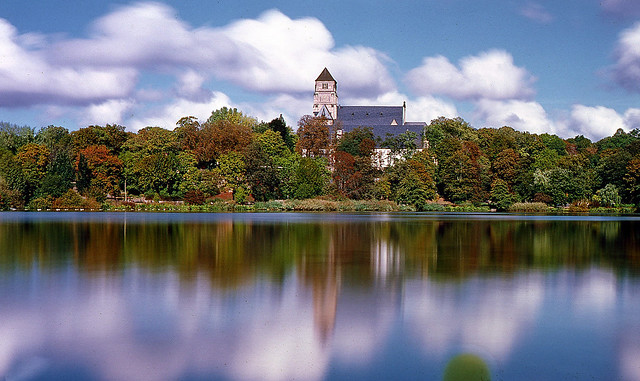
Fuji know how to establish the correct ISO of their films. If you don't have a specific reason for setting the meter to another setting (Exposure Index technically) you are really taking a stab at getting the exposure correct. Why not set your meter at the ISO speed rating of 100, and meter competently? It is ultimately what you need to do to get best results with transparency.
Unlike neg you cannot simply over or under expose to get usable results. If you over expose Provia by much more than half a stop the highlights (depending, of course, on what they are, how bright they are, etc) will begin to blow and when that happens detail cannot be recovered. Yes you can underexpose, and this will save your highlights. But transparency film is extremely dense when underexposed. You will either need to use a really high quality scanner to get any clean noise free detail from the shadows (if the underexposure is not too extreme) or there simply will not be any detail to recover, period.
These are generalisations, obviously. If you are shooting outside on an overcast day for example, the dynamic range may be so minimal that it all works out quite easily (if there isn't any grey sky in the frame I should add). But in brighter outdoor situations with deeper shadows, you can't rate Provia higher or lower, you are quite likely to lose either the shadows or highlights depending on which way you go.
The only way to get the best results is to meter accurately. This may mean using the built in light meter, in which case you will need to take a reading from a good mid tone or interpret readings from elsewhere if your scene doesn't have anything resembling a middle grey or equivalent luminosity. Personally, I can do this if I need to, but tend to have an incident meter with me when shooting any type of film, and when correctly used this can often make life a lot easier if shooting transparency, because by definition the recommended meter setting should prevent highlights overexposing, unless these are atypically bright.
There is no getting around the fact that as gorgeous as a well exposed frame of Fujichrome is, it simply does not have the same dynamic range (or exposure latitude) of an equivalent C-41 film, and that is going make it more of a challenge in scenes with bright highlights and deep shadows. The previous comment mentioned the point about shooting for projection and this is quite relevant in that you can pull the exposure a bit if this is the case. I'd be the first to acknowledge just how sublime a projected colour slide can be. But most people today if they shoot E-6 shoot in anticipation of scanning it. Unless you are fortunate enough to have access to a very high end scanner (Imacon, Howtek and so on) you'll need to eke as much detail out of those shadows as you possibly can, without blowing the highlights. In this sense, exposing to scan is arguably harder than traditional exposure for projection.
The good news is that although Provia is no C-41 film in its exposure tolerance it is a little better than Velvia/Velvia 50. Many of my cameras only offer half aperture stops and whole shutter speeds. Unless the meter reading happens to fall bang on a full stop or a half stop, in practice, I usually have to make a decision between slight underexposure, or slight overexposure. Although I do still project slides occasionally, I anticipate scanning the frames to share, hence, I will overexpose by up to half a stop in preference to underexposing, if there are any important shadows areas I would like to grab something from, in the scan. It's entirely true that Provia does not have a lot of scope for overexposing the highlights. But this is not the same as no scope despite what some may suggest. It can usually handle a half a stop over an accurate incident reading (or equivalent reflective reading from a mid tone). That half a stop can help a lot, if the scanner you can afford to use, is not the same as the scanner you would like to use.
You don't have to spend a fortune on a decent meter with incident capability. I am still using my old Minolta Auto Meter III, easily available for under USD 100, and the IV is not a lot more. This is not to say that an incident reading is the solution for every exposure scenario you may ever encounter. They are of little benefit if you are, for whatever reason, unable to get a reading from the same light direction or of the same exposure value as your subject (think: the tiger lying in its enclosure at the zoo, under the tree--how can you get to the tree to take the reading, if you are in the sun?). There will be situations where, for various reasons, a built in reflective meter, or even a spot meter, will be what you will wish you had. That said: for general transparency exposure setting, a good incident meter is likely to be the one you may end up using the most because it will help protect your highlights and also sidestep the tonality/luminosity dilemma inherent in reflective metering processes.
Cheers,
Brett