Fixed lense rangefinder recommendation?

beebleb

Newbie
Local time
12:57 PM
Joined
Aug 2, 2006
Messages
8
Guys,

After reading around a bit I'm leaning towards a fixed lense rangefinder as the ideal way to start my rangefinder journey without blowing the bank. The style of photography I'm interested in could well do with the restriction of a single focal length and its unlikely I'd be able to afford more than one lense with a Voigtlander or Leica setup anyway!

Anyway, I'm asking for recommendations. I've read up about the Canonet QF17 and that certainly sounds like a great start. Wish me luck on ebay 🙂 But as I cruise around the second hand shops I'd like to keep my eye out for others.

I'd prefer cameras which are a bit newer (to reduce the amount of post-purchase repair/maintenance I'm likely to have to do). A meter isn't essential but would be great (I love the idea of going without a battery; what a great "glovebox" camera) and I don't think I'm particularly fond of complicated film loading. Oh and under US$100 if possible.

Thanks guys, looking forward to getting back to film!
 
Welcome! The fixed lens cameras are an excellent way to start. I'm sure that many will say the QL17 is the way to go, but I've never been as fond of it as some. It just didn't fit my hands well.

Now, a different but great glovebox camera if you're willing to forgo a meter is the Agfa Karat 36 or Karat IV. Great compact little cameras that have wonderful lenses (there are a number of different ones available.) A page on the Karat IV is here: http://www.cameraquest.com/agfakar4.htm If that sounds interesting, let me know as I know where a Karat 36 (slightly older model but with a better shutter) can be found for way under your budget limit 😉

William
 
Two excellent cameras that fit what you are looking for is the Canon GIII QL17 or the Yashica Electro 35 series.
The Yashicas are bigger than the Canon and only offer aperture preferred automation so if you want manual operation go with the Canon 😛
 
I used for many years a Minox GT. It is tiny, and it has a sharp lens.
Disadvantage: no rangefinder; zone focusing.
For many, this is OK.
Advantages: small/sharp lens/light/cool.

If a rangefinder is needed, go for the Konica S2 and don't look back.

Raid
 
When I was in a similar situation to yours, I found two cameras that met my needs. Here are my notes on one of them, the Canonet QL17 GIII.

PROS:
Except for built-in light meter and flash guide number feature, camera operation is battery independent (my most important pro)
Low cost
Small size
Lightweight
Quiet operation
Auto parallax correction
Hot shoe and PC flash connections
Aperture priority auto exposure mode
Quick film load feature
Auto or manual exposure modes
Manual focus
Fast 40mm f/1.7 fixed lens
Attractive appearance
Electronic flash sync at all shutter speeds
Tripod socket centrally located on underside of body
Has flash guide number feature that allows the diaphragm and focus mechanism to couple for automatic flash exposure


CONS:
No depth of field scale on lens (my most important con)
Foam light seals on inside of camera back deteriorate over time
Hard to see f/stop and shutter speed numbers on lens barrel
Shutter speed and f/stop controls are too close together on lens barrel
Flash guide number feature does not work well
Flash guide number feature requires batteries to function
Uses obsolete mercury battery for light meter (PX625 work fine as substitute)
1-second and ½ second shutter speeds missing
It is hard to read exposure settings when the camera is mounted on a tall tripod
Lens hood blocks one corner of the viewfinder
Built-in light meter does not work in manual exposure mode
Uneven frame spacing on my two cameras
 
Here are my notes on the other, a Minolta Hi-Matic 9.

PROS:
Except for built-in light meter, camera operation is battery independent (my most important pro)
Has guide number feature that allows the diaphragm and focus mechanism to couple for automatic flash exposure. Feature works well.
Has hot shoe and PC flash connection
Aperture priority auto exposure mode
Shutter priority auto exposure mode
Program auto exposure mode
Manual exposure mode
Auto parallax correction
Electronic flash sync at all shutter speeds
Tripod socket centrally located on underside of body
Low cost
Fast 45mm f/1.7 fixed lens

CONS:
No depth of field scale on lens (my most important con)
Long film advance stroke
Uses obsolete mercury battery for light meter
Hard to see f/stop and shutter speed numbers on lens barrel
Shutter speed and f/stop controls too close together on lens barrel
Difficult to turn light meter off
Lacks style in appearance
It is hard to read exposure settings when the camera is mounted on a tall tripod
Lens hood blocks one corner of the viewfinder
 
Last edited:
You can get submerged in tech stuff if that is your interest and there are a lot of RFFer's that are inclined to that direction.

I think it's all about images. I have a great number of the Yashica Electro shots in my galleries. If you like what you see these are low cost cameras which are plentiful on Eboy and can be "won" for about 50$. Good luck with the decision.
 
I would recommend the Canonet QL 17, the old model it is the one with full set of speeds, or the Konica Auto S2.
Both are battery dependant for the meter and automation which is shutter priority, and lens quality is good. The Canonet´s meter is inoperative when in manual mode, but the Konica keeps it allways working so it can be used also in manual mode. Besides it´s meter is visible from the top of the camera.
Only con for the Konica is that you should have a lens cap, otherwise the meter is allways on.

Ernesto
 
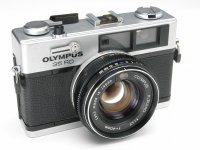
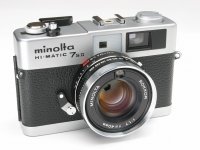
While the Canonet QL17 GIII is readily available on ebay, there are some equally capable cameras out there for a little extra effort. Don't discount the Olympus 35RD or the Minolta 7sII -- they are both excellent fixed-lens rangefinders. One thing regarding the Oly RD -- the Seiko leaf shutter is notorious for oily blades. I sent mine to Photosphere (an authorized Olympus repair center) and they completely CLA'd the camera for approximately 70 bucks -- it's a real beauty!
 

Attachments

  • IMG_0925.JPG
    IMG_0925.JPG
    730.4 KB · Views: 0
  • IMG_0928.JPG
    IMG_0928.JPG
    721.1 KB · Views: 0
I purchased a QL17 for about $65 (US) on Ebay, spent another $65 to replace light seals, repair the film door, clean and adjust shutter speeds and recalibrate the meter for a 1.5 volt battery. The result is a neat compact non-battery dependent camera with a crisp lens that rivals anyother lens you might come across. I like Kodak Retinas better but they don't have framelines in the viewfinders to aid in composition. The QL17 is a great camera. You will not go wrong with it.
 
You didn't mention under what conditions you'd be shooting, but I thought I'd throw in my two cents as to why I ended up with a Yashica Electro 35 GL. I shoot in low light fairly often and am rather meter-dependent. I've found that many of the fixed-lens rangefinders max out at ISO 800 or less; there are a handful of examples that understand ISO 1000, and then there's the 35 GL, which is the only such camera I know of that goes up to ISO 1600. (I'm sure there are tricks to circumvent such limitations, which will vary by camera model, but the simplest thing for me was just to find one that would do what I want.) 🙂

The Electro 35 series cameras are all aperture priority with no manual override (and they don't indicate the chosen shutter speed either). While they will work without batteries, they will do so only at the fastest shutter speed (typically 1/500 sec). In my case the aperture priority is an advantage (as that's how I prefer to shoot), but others will see this as an unacceptable limitation (and it sounds like you may be in this camp).

Cheers,
Jeremy
 
Have only 1 of each, but of the 2, I like the GSN lens better than the QL17, but I like the QL17's size, and metering better.

I'd say if you can live with the larger size of the GSN, and the lesser exposure control than the QL17, to consider the GSN, but it's hard to go wrong with either.
 
Actually I currently shoot aperture priority exclusively, but I am finding it a bit limiting, especially in bright light and shadow situations as well as when I want to light a bit more creatively. I'm just pass the bit where you can get a "correct" exposure (so easy these days with a modern DSLR) and want to expose more creatively.

I also want a compact camera that can focus and meter the way I want to as quickly as I can depress a button. Since I can't find anything that can do that, I'm thinking manual focus, manual exposure, and a fast eye will give me what I want.

I guess I could have gone on a bit more about the type of photography I want.

I want to be able to frame a scene in my eye, bring up a camera, quickly take the shot, and keep moving. I'm hoping to improve my pre-visualisation skills and rely less on cropping and post-production (which digital almost encourages).

I love fast lenses because they let me work at night (which is when I'm often free), I love "normal" lenses because they let me previsualise more effectively.

BTW: I currently shoot with a Nikon D70 and a Richo GR-D, both of which are excellent cameras IMHO.
 
For the bigger RFs, the following are popular, inexpensive and come highly recommended:

Yashica 35 Electro GS series
Minolta HiMatic 9
Konica S2
Yashica Lynx 14/14e (fast 1.4 lens, but also prone to flaring)

Smaller models that people love include:

Canonet QL17 GIII
Olympus RC/RD
Minolta 7SII/ Konica S3/ Revue 400/Vivitar ES

Oh, and if you're looking for the smallest--there's the Olympus XA.

These are all good performers, what you'd like best would have to go to personal preference which you might know only when you are holding the camera in your hands and actually using it. I decided on the Yashica GS as my first RF and I really liked it, but I couldn't help getting curious about the others and buying some, I ended up liking another that I had thought would serve as a "backup" camera.
 
Last edited:
Based on what I own and use and recommend:

Minox GT: stealth in quietness of shutter; very good lens; makes a great street camera with slide film too. Needs battery.

Olympus XA: Similar to GT but I find holding the XA and taking photos with it is awkward. Needs battery.

Konica S2: much larger body; super sharp lens (like a summicron), manual in operation if battery fails.
 
Last edited:
Rangefinder choices

Rangefinder choices

Well, you have gotten a good many great responses, so here is mine.
I have 31 rangefinder cameras in my collection and there are 2 i would
not mind recommending. Konica S2 and Petri 7s. No need for batteries.
both take great pictures IF the lens is clear and clean. Actually i have one other one that, believe it or not takes even sharper pics. It is a Petri "Blue Magic Scope" It has no selenium, no meter, no batteries, but what sharp pics.
Good luck. harold motte
 
Back
Top Bottom