Getting good B & W prints inspired me

I'm generally with Godfrey on this. I use a Nikon V scanner (though am dealing with a lot less film these days) and an Epson 3800 with OEM pigments and its native ABW B&W driver. PC/Lightroom. I also agree with part of what Kanzir said....but I remain a little nostalgic for wet darkroom and I never minded the chems.

If you can visualize your B&W image when you make the photo, or from the file, you can get what you want from inkjet by developing the same sorts of basic skills you'd need in a darkroom. I differ with Godfrey's concern with calibration etc for that reason. B&W photographers that I've known are used to visualizing with minimal tech.

Crane Museo and Ilford Gold Fiber Silk papers are favorites, typically toned warm (tending toward selenium), but Office Depot (big box store, like Staples) sells ultra-cheap, brilliant white "professional photo paper" matte surface that serves wonderfully...I don't deliver important prints on it: it's a little thin and I'd be embarassed because it's so cheap 🙂

Nobody here will be able to tell the difference between a fine inkjet print on similar paper (fiber/baryta) and a fine silver print from the same neg without a loupe, and with the loupe they'll find the inkjet print higher resolution if it was well scanned (eg with a Nikon scanner).

Look here...and take part if you'd like: http://tech.groups.yahoo.com/group/DigitalBW-PrintExchanges/ Virtually everybody in this group uses Epson printers, and my 3800 is among the oldest. If I was buying today I'd get a 3880 directly from Epson (not from a dealer) as a refurb.
 
Last edited:
I appreciate the encouragement. To me printing digital requires a big commitment to get to your levels.

There's a tipping point occuring for me right now with the possibility of a B&W M10, Also I got aquainted with my friend's M9, but I also might just do even more MF B&W.

I use to be a great B&W printer, but right now I have mucho good negatives. I agree that for a quality print the real key is a good detailed negative that was exposed properly.

Thanks for your posts.

Cal
 
...
If you can visualize your B&W image when you make the photo, or from the file, you can get what you want from inkjet by developing the same sorts of basic skills you'd need in a darkroom. I differ with Godfrey's concern with calibration etc for that reason. B&W photographers that I've known are used to visualizing with minimal tech.
...

The reason I am concerned with calibration is that I also print color work ... I want one printing workflow, not two, and prefer to do all my image rendering (including toning) prior to engaging the print process. It is more consistent that way, I make fewer mistakes and waste less paper.

But I agree that if I were ONLY printing B&W and using the ABW driver controls instead of the image rendering process, the need for the color managed workflow would be greatly reduced. You still need to calibrate and profile a display if you want consistency in the editing process.

calzone said:
I appreciate the encouragement. To me printing digital requires a big commitment to get to your levels. ...

I don't know what you mean by a big commitment. I have been using the even cheaper Epson printer - the R2400 - since 2005. It does a fine job. (I'd have bought an R3800 in a heart beat, but I needed a printer in October of 2005 and the 3800 came out in January of 2006 or around there...)

So there's a bit of money into a computer system (which you already have), a bit of money into a printer (which lasts a very long time), and if you're shooting film, some money into a scanner (or have the film processed and scanned for you). The time investment is the same time investment it will take to learn how to make fine prints in a darkroom.

Which commitment is "big?"
 
I don't know what you mean by a big commitment. I have been using the even cheaper Epson printer - the R2400 - since 2005. It does a fine job. (I'd have bought an R3800 in a heart beat, but I needed a printer in October of 2005 and the 3800 came out in January of 2006 or around there...)

So there's a bit of money into a computer system (which you already have), a bit of money into a printer (which lasts a very long time), and if you're shooting film, some money into a scanner (or have the film processed and scanned for you). The time investment is the same time investment it will take to learn how to make fine prints in a darkroom.

Which commitment is "big?"

My 2004 Mac book needs to be updated, no printer, and no scanner. The biggest commitment would be the time to learn digital printing. Also I remain reluctant to abandone wet printing because I really liked it. That's how I became a good printer. Not sure if that will happen printing digital.

Like I said, "I'm at a tipping point," because of the M9 and the M10.

BTW I have a friend who has his setup calibrated like you suggest, and I really admire what he does.

Cal

Cal
 
For those having a garage to spare a 4' x 5' space at a corner, should not be much problem to turn into a darkroom. Ventilation can be accomplished with a small fan. Once the prints are accumulated in a tray of water, they can be washed later in a bathroom too.

If I didn't have a girlfriend, I'd print in my Madhattan apartment. When I lived in Queens in a row house I had a second bathroom, but the elevated 7 Train rattled the house every 4-5 minutes.

Cal
 
hm.

I've used a darkroom in the past, went fully digital for almost a decade, and now that I started to use film again, I couldn't be happier with scanning + Appler Aperture + Epson Printer...I cannot imagine going back to a darkroom anymore.

I never liked the smell of all that stuff, the darkness in there and I prefer the results that come out of my Epson to most of what I produced back then 😉

Good for you!
I enjoy digital printing also especially with the Canon printer I just got.
But there's no way I'd stop printing in the darkroom.

Result's wise, I find different strengths in both methods.
 
My 2004 Mac book needs to be updated, no printer, and no scanner. The biggest commitment would be the time to learn digital printing. Also I remain reluctant to abandone wet printing because I really liked it. That's how I became a good printer. Not sure if that will happen printing digital.

Yup, it's long past time to update to a newer computer. And you would need to buy a printer, maybe a scanner, and spend time learning.

Personally, I don't see this as much of a big deal ... mostly because I never really liked printing in the darkroom. It always seemed a very tedious and variable process. Printing digitally, with a properly set up system and some skills developed at rendering, is perfunctory and simple: all of my effort goes into making photos, rendering them, and thinking about how to use them to communicate a message.
 
Yup, it's long past time to update to a newer computer. And you would need to buy a printer, maybe a scanner, and spend time learning.

Personally, I don't see this as much of a big deal ... mostly because I never really liked printing in the darkroom. It always seemed a very tedious and variable process. Printing digitally, with a properly set up system and some skills developed at rendering, is perfunctory and simple: all of my effort goes into making photos, rendering them, and thinking about how to use them to communicate a message.

I'm a bit of a lazy slacker. Like you said one of the keys is a good properly exposed negative. I produce negatives that I basically can straight print without very much or any darkroom manipulation. I also could squint my eyes, adjust the lens aperture, and get a perfectly exposed print without making any test strips. One key to this is making consistent negatives. Also I was able to print on number 2 graded paper without any need for filters and get perfect contrast.

For me wet printing became easy because I was in art school and being the photo editor and darkroom manager for the schools newspaper allowed me to spend entire weekends immersed in the darkroom.

Today I'm making even better negatives. Also not sure if digital is cost effective because I want to print really big to show off my technical skills.

Cal
 
It's much easier to print really big with a digital printer. For a lazy slacker, that's where I'd go. My printer can't handle larger than a 13" wide sheet of paper, but I made a 15x35 inch canvas wrap for the living room by rendering a favorite image and sending it off to Artistic Photo Canvas for printing. Came out beautiful.

My negatives (and digital exposures) are right on the money too. I guess exposure about 60% of the time. Same experience with being able to print on #2 paper and get good results. Much easier to do the same thing with Lightroom and press the print button, takes less time and i don't have to slop chemistry around. Or clean up.

Digital capture is much more flexible in editing as you don't have to manage or contend with grain and other defects of chemical film emulsions.

whatever turns you on. seems to me you are enjoying putting barriers in the way of making prints.

i like to make prints, and want to do it the best, easiest way possible.
 
2nd roll of Ilford HP5...

2nd roll of Ilford HP5...

Wow, lots of thoughts here while I was out getting another roll of film developed and printed! I love reading all your thoughts!

For me, holding in my hands, and seeing the prints from the 2nd roll of HP (a bit more conscientious after seeing the 1st roll prints) all I can say is, I'm beginning to understand the expression, "slippery slope".

3%252017%25202012%2520foggy%2520shine%2520level.jpg

(Contessamatic E/Ilford HP5+400)

3%252017%25202012%2520sea%2520shell%2520level.jpg


(Contessamatic E/Ilford HP5+400)

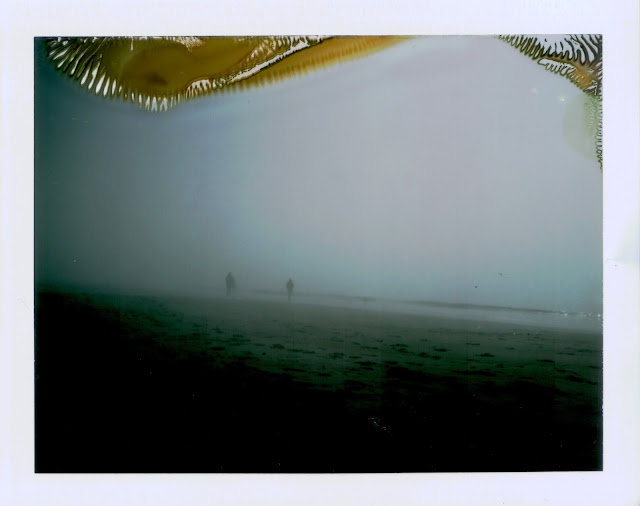
01%2520Heavy%2520Fog%2520level.jpg

(Color shot taken on the same day with Polaroid Automatic 250/Fujifilm FP100C)

I respect that everyone has gone through what I'm going through at the moment, but at the same time, I'm thrilled to be at this point in time. Moments after the first shot, I was in that very water swimming. The water was 46 degrees, the air was in the 50's ...The fog had lifted quickly, and I wouldn't have been able to capture the scenery even just half and hour later.

Let's get printing guys, however you do it 🙂 (I'm still pining for wet printing though)
 
It's much easier to print really big with a digital printer. For a lazy slacker, that's where I'd go. My printer can't handle larger than a 13" wide sheet of paper, but I made a 15x35 inch canvas wrap for the living room by rendering a favorite image and sending it off to Artistic Photo Canvas for printing. Came out beautiful.

My negatives (and digital exposures) are right on the money too. I guess exposure about 60% of the time. Same experience with being able to print on #2 paper and get good results. Much easier to do the same thing with Lightroom and press the print button, takes less time and i don't have to slop chemistry around. Or clean up.

Digital capture is much more flexible in editing as you don't have to manage or contend with grain and other defects of chemical film emulsions.

whatever turns you on. seems to me you are enjoying putting barriers in the way of making prints.

i like to make prints, and want to do it the best, easiest way possible.

I think you are correct in that digital capture is more highly flexible and after the initial steep learning curve its a slacker's dream.

I guess I know myself as stuborn, and I truely enjoy the wet darkroom, especially when it reminds me of those college days so long ago. I think LHing has it right for me: nothing like wet printing, bad smells, chemicals and all.

What would be really crazy for me is to eventually get a M9 or M10 and do both digital and analog printing. Perhaps I'm not the slacker I once thought I was. To me digital is a different medium.

Cal
 
whatever turns you on. seems to me you are enjoying putting barriers in the way of making prints.

That's a strange statement.
If I don't get why people do certain things a certain way, I'd be very careful to say that they enjoy putting barriers in their way.

Just because I don't get it, it does not mean there's no merit.
 
Back
Top Bottom