Grain Unlimited - How? (Moriyama)

antiquark

Derek Ross
Local time
8:02 AM
Joined
Nov 11, 2006
Messages
1,494
Location
Winnipeg
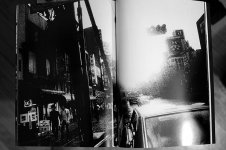
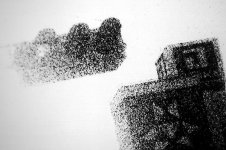
Here's a picture from Daido Moriyama's book "Shinjuki 19xx-20xx." Some of the pictures in the book are grainy to an extreme degree. For educational purposes, below is an image from the book, and a close-up so you can see the grain. Some of the images have almost a "pointillist" effect.

Does anyone know what kind of ISO this would have been developed to? I know Moriyama said he used Tri-X (in fact he said he'd use it until it was discontinued), but I don't think I've read about his developing techniques.

Also I've heard that he crops the images sometimes, which will enhance the grain.

Image from book:
attachment.php


Closeup of image:
attachment.php
 

Attachments

  • -DSC_0972.jpg
    -DSC_0972.jpg
    81.5 KB · Views: 0
  • -DSC_0974.jpg
    -DSC_0974.jpg
    89 KB · Views: 0
Choice of developer can affect the grain, as would pushing it. Surface type developer like Rodinal/HC110 - concentrated (Rodinal 1:10 - push the hell out of the film 2400 -3200 iso)
Shake and rattle it for 8-10 min - you get grain.
The old Kodak 1250 iso Recording could be souped in Dektol 1:3 for 10 minutes. Rated at 2500-4000 it had golfball sized, sharp grain.
 
I believe Moriyama uses Tri-X developed in D-76. His earlier super grainy stuff (71' New York) was shot on a half frame Pen W camera, which is why it's so grainy.

Not sure what his formula is now but I would guess over exposure + high temperature in the developer. You could probably find this out with some googling and translating from Japanese websites.

I've had good results using Tri-X and developing in Dektol trying to get this sort of look but settled on Rodinal at 1:25 for a bit more control.
 
Taking into account the lack of shadow detail, I would say that whichever film
Moriyama was using, he was underexposing it heavily, so push processing
was required. Try pushing alot, after underexposing by two or even three
stops.

Best,
Pau
 
I guess that it was Fuji`s Superprodol (SPD) because it is cheap and from my experience it produces high contrast negs with quite some grain.
 
Sam Haskins did similar work way back in the 60s. No clue how he did it either. Experiment. Find your own way.
 
That grain rasterized effect usually was achieved by large scale printing push-developed Tri-X to lith papers or by xeroxing prints. I did my exams exhibition with the former. For me it was not really a "grain" thing, but more about exhibiting "billboard look" oversize size prints directly glued to the showroom wall, where the posterisation and plain-paper looking papers were merely part of the overall effect.
 
Last edited:
I have recently learned a lot about Japanese Photobooks because I purchased this:

Japanese Photobooks of the 1960s and 70s

The basics of it (and a very interesting point) is that, traditionally, Japanese photographers saw photobooks as being art in their own right and as important (or even more important) than making and showing prints.

So the photographers worked with the designers and printers to achieve certain qualities through the printing process. I don't know if this would apply to the book you have but it is something to keep in mind. I.E. it may be the result of the printing process and work done during this process, and not something easily replicated through development and traditional wet printing.

I have never seen Moriyama's prints so I can't say anything more than this.
 
I've been to a few of his exhibitions and his prints look pretty much the same.

Both his developing and printing are done to emphasize grain and this is replicated in the books as well.
 
I've wondered about his technique as well. That said, it was news to me that Tri-X was discontinued. I'm sure Kodak would find that surprising as well ;-)
 
I'm struggling to find somewhere in this thread that says Tri-X has been discontinued! The OP did mention that Moriyama stated he would use Tri-X until it was discontinued ... it may outlive Moriyama though.

The day Kodak chooses to discontinue Tri-X they'll be very busy defending their fortress from hordes of angry photographers! 😀
 
"Met Daido Moriyama san at Place M again...I had a chance to have a nice discussion with him this time, asking him about a few of the images in particular. It was a real treat to hear a couple of stories behind the images. I also asked him what film and developer he uses; Kodak Tri-X in D76, and whether he still soups and prints his own stuff, to which he said “mochiron” (of course), with the exception of the very large stuff, which he sends to a printer."

http://zokyo.jp/uncle-mori/
 
He definitely shoots digital as well

He definitely shoots digital as well

One of his recent booklets, record 14 and the most recent color ones were shot with digital. Ricoh grd cameras. He comments on how ironic it is for him to dedicate a whole issue to digital.

Maybe I saw it because he mentioned it was digital but I swear that some of the images look smeared from noise reduction and others have that noisy look that reminds me of a bad tv set or security camera. I Dont think I like he digital shots as much because when you look for detail in the underexposed areas you get noise patterns... Yuck. Over all I think Moriyama is great at setting a mood.

"Met Daido Moriyama san at Place M again...I had a chance to have a nice discussion with him this time, asking him about a few of the images in particular. It was a real treat to hear a couple of stories behind the images. I also asked him what film and developer he uses; Kodak Tri-X in D76, and whether he still soups and prints his own stuff, to which he said “mochiron” (of course), with the exception of the very large stuff, which he sends to a printer."

http://zokyo.jp/uncle-mori/
 
I did a bunch of my China work with the want of big grain. I found what worked well for me was using d72 paper developer as a film developer. (NOT D76!)

Crude, but it got the job done. It was easy to find d72 in China, but never was able to get it in Canada.
 
Back
Top Bottom